 During the final week of February, the parish staff participated in an overnight retreat led by Fr. David Convertino, OFM, one of our Franciscan brothers. We are a busy staff whose ministry and schedules do not often see the whole staff in the office most days. Given some ministries require weekend work and some do not, it turns out Tuesday is the only day the whole staff is present. So, it was a wonderful time to be away together as brothers and sisters in Christ without the ebb and flow of life and service in the weekday parish office.
In his opening remarks, Fr. David asked, “What do St. Francis, Pope Francis, and home have in common?” He then led us through a series of talks about the connected values of poverty, mercy, and belonging as revealed in the stories of St. Francis of Assisi. I certainly would not attempt to condense the retreat into this column – besides, I am still thinking about Fr. David’s question. And here are some thoughts.
In March 2013, Pope Francis famously, and perhaps controversially, said that he wanted a “poor church for the poor.” Not surprisingly, this raised an eyebrow or two. Many online commentaries have excoriated the pope as an opponent of capitalism, socialist-in-religious clothing, or another South-American-reactionary-liberation theologian. Equally, many have concluded that Pope Francis wants Catholics to devote greater attention to poverty-alleviation social programs. Both miss the deeper meaning Francis attaches to poverty.
No one should be surprised Pope Francis is so vocal about material poverty. After all, he comes from Latin America: a part of the world in which millions seem locked into dire poverty. You would have to be less-than-human not to be disturbed by the contrast between Buenos Aires’s beautiful Recoleta district which gives the city the appellation “Paris of the South,” and the misery of a Buenos Aires slum like Villa Rodrigo Bueno. The pope has made it clear that indifference in the face of such disparities is not optional. But in understanding Francis’s words about poverty, we should remember his conception of poverty and the poor goes far beyond conventional secular understandings of these subjects.
Pope Francis said this about Christianity and poverty: “For us Christians, poverty is not a sociological, philosophical, or cultural category. No, it is a theological category. I would say, perhaps the first category, because God, the Son of God, abased Himself, made Himself poor to walk with us on the road. And this is our poverty: the poverty of the flesh of Christ, the poverty that the Son of God brought us with His Incarnation. A poor Church for the poor begins by going to the flesh of Christ. If we go to the flesh of Christ, we begin to understand something, to understand what this poverty is, the poverty of the Lord.”
It is strange to think about the “poverty of the flesh of Christ,” but in this view, the pope and St. Francis share a common view. The pope uses the language of the humility of Christ to come take on our flesh; St. Francis speaks of the condescending of Christ using the Latin condescendere – the stepping down to the posture of a servant. Each paints a verbal portrait of the beloved Son of our Heavenly Father becoming one of us to serve us that we might join the table. Each points to the Eucharist as the earthly invitation to the table. Each challenges us to our own condescendere in the way we invite others. Pope Francis posed two questions to his listeners: “Tell me, when you give alms do you look into the eyes of the man or woman to whom you give alms? And when you give alms, do you touch the hand of the one to whom you give alms, or do you toss the coin?”
What do St. Francis, Pope Francis, and Belonging have in common? I hope you weren’t expecting a one-sentence summary – I am still working on it. But I can see a way forward. There is a part of the Eucharistic prayer said in silence during the Mass. That’s too bad, because it is amazing. It comes as the priest adds a small part of water to the chalice of wine. “Through the mysteries of this water and wine, may we come to share in the divinity of Christ who humbled himself to share in our humanity.” It is moment of poverty, mercy, and belonging, all pointing the way home. It is the moment we are called to replicate in the world, to be Christ for others.
What are the “two questions” for your life? Do you condescendere? Do you look in their eyes? Do you touch their hands? This is the beginning of understanding poverty. It is the beginning of the way home.


 Jesus Arrives at Bethany. Upon their arrival in Bethany, Jesus’ assertion about Lazarus’ death (v.14) is confirmed. The four-day period underscores the finality of death. According to the popular belief, the hovered around the body for three days after the death, hoping to reenter the body. But after the third day, when the soul “sees that the color of its face has changed,” the soul leaves the body for good (Gen. Rab. 100). When Jesus arrives fellow mourners had already arrived to console the grieving sisters – but they will also serve another purpose: witness. Continue reading
  There was a barber in a small town. One day he’s sitting in his barbershop and a man walks in wearing a pair of sandals, and a long brown robe with a hood. The man sits down in the barber’s chair. “Excuse me,” says the barber. “I was wondering: why are you dressed like that?”
 My first job after active duty in the Navy was with a technology company in Northern Virginia. Initially I was assigned to work on a project for NavSea 07, the submarine programs office. My first supervisor was a good man named Michael. One day I walked into Mike’s office to ask a technical question. He was at his desk reading and as he stared down at the document on his desk, he was rather oddly turning his head to and fro from side to side. It was almost as though he were trying to read one page with only one eye. I asked him why he was doing that and he looked at me as though I was the harbinger of bad news. “You know everyone has a blind spot, so I was just adjusting to be able to read around my blind spot, but you know….” and his voice trailed off.
 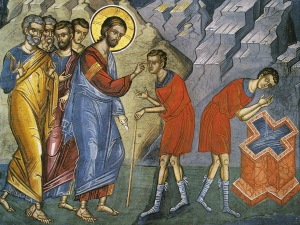 Being Lead to Decision: Faith or Disbelief. Where the authorities drive the man away (v.34), here Jesus finds the man (cf. 6:37) and asks: “Do you believe in the Son of Man?” Just as the Samaritan woman was confronted by Jesus with the possibility of the anticipated Messiah’s being already present (4:25-26), so also the healed man is confronted by Jesus with the possibility that the future judge is already present. To this point in John 9, the theme of the judgment evoked by the light of the world (9:5; cf. 3:17-21; 12:31-36) has largely been implicit. Jesus’ question makes this theme explicit as he asks the man whether he recognizes in his healer the one who brings of salvation. As v.36 indicates, the man is ready.
