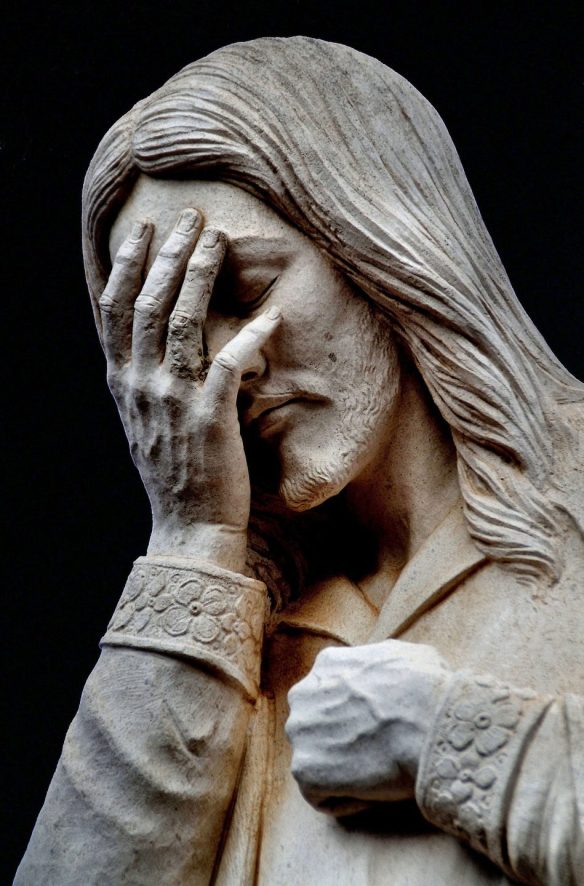
Woe to the soul

From the Office of Readings for the Day – a homily attributed to Saint Macarius, bishop (Hom. 28: PG 34, 710-711). A note: while we often think of the word “woe” as pertaining to accusation and condemnation, the biblical meaning is most often as a lament, a sadness or mourning over an instance or circumstance.

Woe to the soul that does not have Christ dwelling in it

And Jesus wept…

When God was displeased with the Jews, he delivered Jerusalem to the enemy, and they were conquered by those who hated them; there were no more sacrifices or feasts. Likewise angered at a soul who had broken his commands, God handed it over to its enemies, who corrupted and totally dishonored it. When a house has no master living in it, it becomes dark, vile and contemptible, choked with filth and disgusting refuse. So too is a soul which has lost its master, who once rejoiced there with his angels. This soul is darkened with sin, its desires are degraded, and it knows nothing but shame.

Woe to the path that is not walked on, or along which the voices of men are not heard, for then it becomes the haunt of wild animals. Woe to the soul if the Lord does not walk within it to banish with his voice the spiritual beasts of sin. Woe to the house where no master dwells, to the field where no farmer works, to the pilotless ship, storm-tossed and sinking. Woe to the soul without Christ as its true pilot; drifting in the darkness, buffeted by the waves of passion, storm-tossed at the mercy of evil spirits, its end is destruction. Woe to the soul that does not have Christ to cultivate it with care to produce the good fruit of the Holy Spirit. Left to itself, it is choked with thorns and thistles; instead of fruit it produces only what is fit for burning. Woe to the soul that does not have Christ dwelling in it; deserted and foul with the filth of the passions, it becomes a haven for all the vices.

When a farmer prepares to till the soil he must put on clothing and use tools that are suitable. So Christ, our heavenly king, came to till the soil of mankind devastated by sin. He assumed a body and, using the cross as his ploughshare, cultivated the barren soul of man. He removed the thorns and thistles which are the evil spirits and pulled up the weeds of sin. Into the fire he cast the straw of wickedness. And when he had ploughed the soul with the wood of the cross, he planted in it a most lovely garden of the Spirit, that could produce for its Lord and God the sweetest and most pleasant fruit of every kind.


Image credit: Flevit super illam (He wept over it) | Enrique Simonet (1892) | Museo del Prado, Madrid | Wikimedia Creative Commons

The Presentation of Mary

The Memorial of the Presentation of the Blessed Virgin Mary in the Temple recalls – according to the apocryphal gospels, the day on which Mary, while still a child, was brought to the temple in Jerusalem to be offered to God. The Church wants to emphasize not so much the historical event in itself, of which there is no trace in the Gospels, but the total gift that Mary made of herself, by listening: “Blessed are those who hear the Word of God and observe it” (Lk. 11:28). This experience prepared the young girl from Nazareth to become the “temple of the Son of God”.

The celebration of this feast dates back to the 6th century in the East with the dedication of the Basilica of Saint Mary the New built by the Emperor Justinian I near the ruins of the temple in Jerusalem. There is evidence that various monasteries in Italy celebrated the feast in the 9th century. It was not until the 15th century that it was included in the Roman Missal.


From a sermon by Saint Augustine, bishop
(Sermo 25, 7-8: PL 46, 937-938)
She who believed by faith, conceived by faith 

Stretching out his hand over his disciples, the Lord Christ declared: Here are my mother and my brothers; anyone who does the will of my Father who sent me is my brother and sister and my mother. I would urge you to ponder these words. Did the Virgin Mary, who believed by faith and conceived by faith, who was the chosen one from whom our Savior was born among men, who was created by Christ before Christ was created in her—did she not do the will of the Father? Indeed the blessed Mary certainly did the Father ’s will, and so it was for her a greater thing to have been Christ’s disciple than to have been his mother, and she was more blessed in her discipleship than in her motherhood. Hers was the happiness of first bearing in her womb him whom she would obey as her master. 

Now listen and see if the words of Scripture do not agree with what I have said. The Lord was passing by and crowds were following him. His miracles gave proof of divine power, and a woman cried out: Happy is the womb that bore you, blessed is that womb! But the Lord, not wishing people to seek happiness in a purely physical relationship, replied: More blessed are those who hear the word of God and keep it. Mary heard God’s word and kept it, and so she is blessed. She kept God’s truth in her mind, a nobler thing than carrying his body in her womb. The truth and the body were both Christ: he was kept in Mary’s mind insofar as he is truth, he was carried in her womb insofar as he is man; but what is kept in the mind is of a higher order than what is carried in the womb. 

The Virgin Mary is both holy and blessed, and yet the Church is greater than she. Mary is a part of the Church, a member of the Church, a holy, an eminent—the most eminent— member, but still only a member of the entire body. The body undoubtedly is greater than she, one of its members. This body has the Lord for its head, and the head and body together make up the whole Christ. In other words, our head is divine—our head is God. 

Now, beloved, give me your whole attention, for you also are members of Christ; you also are the body of Christ. Consider how you yourselves can be among those of whom the Lord said: Here are my mother and my brothers. Do you wonder how you can be the mother of Christ? He himself said: Whoever hears and fulfills the will of my Father in heaven is my brother and my sister and my mother. As for our being the brothers and sisters of Christ, we can understand this because although there is only one inheritance and Christ is the only Son, his mercy would not allow him to remain alone. It was his wish that we too should be heirs of the Father, and co-heirs with himself. Now having said that all of you are brothers of Christ, shall I not dare to call you his mother? Much less would I dare to deny his own words. Tell me how Mary became the mother of Christ, if it was not by giving birth to the members of Christ? You, to whom I am speaking, are the members of Christ. Of whom were you born? “Of Mother Church,” I hear the reply of your hearts. You became sons of this mother at your baptism, you came to birth then as members of Christ. Now you in your turn must draw to the font of baptism as many as you possibly can. You became sons when you were born there yourselves, and now by bringing others to birth in the same way, you have it in your power to become the mothers of Christ.


Image credit: Courtesy of Vatican News | CC-BY 4.0

Final Thoughts for All Souls Day

Language is important. Faithful Catholics do not “get” the Eucharist – they receive the Eucharist. Catholic marriage ceremonies do not say “take this ring,” our language is the lover saying to the beloved, “receive this ring.” The language of “receive” reflects a disposition that in the Eucharist, in marriage, or indulgences, what is received is gift – unmerited, unearned, not for sale – pure gift. We are called to receive such gifts with open, grateful hearts.

There is a whole lot of theology carried in the Commemoration of the Faithful Departed. It is meant to be more than a day to fondly remember someone close to you who has passed away. It is a day to be in communion with them. Hopefully their particular judgment was Heaven and eternal glory. We love them and know their flaws, so perhaps they are undergoing the purification of the elect – and we can help them on All Souls with prayers and Eucharist celebrated as acts of love because of the merits of Christ.


Image credit: All Souls’ Day | Jakub Schikaneder, 1888 | National Gallery Prague | PD-US

If you would like to see the complete series of posts for All Souls, you can view and download it here.

Saints, Believers and Holy Ones

During the first 300 year of the Christian church, the people of God endured periods of peace, but also extended periods of persecution. Especially in the local churches, each generation remembered the martyrs and the leaders who exemplified the faith. By the fourth century these women and men were honored in liturgies that commemorated their passing into God’s bright glory. In time, churches were named to honor their memory, sometimes even built on their tombs. And in time relics were collected and honored.

Continue reading

Plenary and Partial Indulgences

What’s the distinction? A plenary indulgence removes all temporal punishment due to sin. It is a complete cleansing, as though the disorder caused by sin were fully healed. This means that if a person fulfills the necessary conditions for a plenary indulgence, they can be completely freed from the consequences of their sins, assuming they are in a state of grace and have the intention to receive the indulgence. The conditions typically include sacramental confession, Eucharistic communion, and prayer for the intentions of the Pope, along with performing the specific work to which the indulgence is attached (Catechism, 1471)

A partial indulgence removes part of the temporal punishment. It is a real but incomplete purification, lessening the burden but not entirely eliminating it. The degree of temporal punishment removed is not specified and can vary based on the individual’s disposition and the nature of the act performed. The Church encourages the faithful to seek partial indulgences through various prayers and acts of charity, as these can contribute to one’s spiritual growth and sanctification (Catechism, 1472).

Continue reading

Time and Indulgences

We continue our series of posts in anticipation of All Souls Day.

Growing up in the mid-20th century I clearly remember the nuns leading us in prayers and rosaries for “the poor souls in purgatory who have no one to pray for them.” Which is actually a quite lovely idea and really addresses the idea of the communion of saints, living and deceased. But I also clearly remember being told “this rosary will shorten the sentence in purgatory by 30 days.” As a third grader I thought “OK.” Seemed like a pretty good bargain. When one begins to understand all the above, you have to wonder, where and when did indulgences begin to be described in terms of “days” or “years” and such?

One needs to remember that in the early Church, penances were very public and were prescribed for a set period of time. For example, spend Sunday morning outside the church dressed in sack cloth and ashes for 1 year. An indulgence, even then an act of piety, could reduce the penance by (e.g.) 30 days. It wasn’t a reduction of the time in purgatory (as if that even had a meaning), but a reduction of time in this life when the penitent was “apart” from the believing community. As the Sacrament of Confession moved to a private setting, so too did the penances, and yet the language of time endured. Slowly the connection to penance was lost and starting in the early medieval period, indulgences began to be described in terms of “days,” “quarantines,” or “years” and slowly, misguided priests and religious began to connect indulgences with chronological time in purgatory.

By the late Middle Ages and into the modern era, people began thinking that saying a certain prayer automatically subtracted X days from purgatory. This contributed to superstition and misunderstanding — and was a factor in the abuses that provoked the Protestant Reformation. The Council of Trent strongly condemned the abuses surrounding indulgences, corrected abuses, but the language was embedded in the popular imagination as was the connection to purgatory.

The 20th-Century brought reform. Pope St. Paul VI, in 1967, issued the apostolic constitution Indulgentiarum Doctrina, a watershed in indulgence theology but really just a reaffirmation of what it was always meant to be. The Pope abolished the “days and years” system, noting that it was misunderstood and misused and left the faithful thinking it was some kind of “works salvation” by which they could earn (or worse be owed) the grace of purification. It was at that time that the Church reduced all indulgences to two categories: Plenary (full remission) and Partial (remission in part). It was done hoping that an emphasis shift away from “measuring time” to encouraging the faithful to perform works of devotion, penance, and charity with sincere faith would return indulgences to their original meaning and purpose.


Image credit: All Souls’ Day | Jakub Schikaneder, 1888 | National Gallery Prague | PD-US

Treasury of Merit

The Church teaches that it offers the grace of Indulgences from the “treasury of merit,” also called the “treasury of the Church.” This refers to the spiritual reservoir of merit accumulated through the infinite merits of Jesus Christ, especially through His Passion, Death, and Resurrection; the superabundant merits of the Blessed Virgin Mary, who is considered sinless and full of grace; and the merits of the saints, who lived lives of heroic virtue that manifested God’s grace into the world. These “merits” are not material or monetary, but spiritual benefits—graces that can be applied to others by the Church.

What gives the Church the “authority” to dispense the merits to others?

  • Christ promised his Church the power to bind and loose on earth, saying, “Truly, I say to you, whatever you bind on earth shall be bound in heaven, and whatever you loose on earth shall be loosed in heaven” (Matt. 18:18). As the context makes clear, binding and loosing cover Church discipline, and Church discipline involves administering and removing temporal penalties. 
  • One could also look to Matthew 16:19 where Peter is told by Jesus, “I will give you the keys to the kingdom of heaven. Whatever you bind on earth shall be bound in heaven; and whatever you loose on earth shall be loosed in heaven.” 

Most would look at those two verses and offer, “…OK, but that applies just to Sacramental Confession, right?” Sacramental Confession is the priest (the Church) acting as “sacramental steward” for God’s forgiveness. Let’s be clear. The priest does not forgive sins. He absolves which is the earthly action, the announcement, of the grace of God’s forgiveness.  Indulgences operate on the same principle. The Church sees itself as a steward of these spiritual goods, able to apply them for the benefit of souls.

“OK, but when did Jesus bless one person based on the merits of another? “And there people brought to him a paralytic lying on a stretcher. When Jesus saw their faith, he said to the paralytic, “Courage, child, your sins are forgiven.” (Mt 9:2) It wasn’t the faith of the paralytic, it was the faith of his friends. The merits of others were a gift to the paralytic. The “treasury of merit” is a gift by which God uses the Church when He removes temporal penalties. This is the essence of the doctrine of indulgences. 


Image credit: All Souls’ Day | Jakub Schikaneder, 1888 | National Gallery Prague | PD-US

Indulgences

Let’s be clear: an indulgence is not a permission to commit sin.  It is not a permission to indulge in some behavior that would ordinarily be considered sinful.  It is not something that you pay for to get forgiveness. The Catholic Church teaches that indulgences are a means by which the faithful can obtain the remission of the temporal punishment due to sin, the guilt of which has already been forgiven. This teaching is rooted in the Church’s understanding of the interconnectedness of sin, repentance, and the effects of sin on the soul and the community. The Catechism of the Catholic Church provides a thorough explanation of indulgences, particularly in Paragraphs 1471-1479.

An indulgence is a “remission before God of the temporal punishment due to sins whose guilt has already been forgiven [emphasis added], which the faithful Christian who is duly disposed gains under certain prescribed conditions through the action of the Church which, as the minister of redemption, dispenses and applies with authority the treasury of the satisfactions of Christ and the saints.” (CCC 1471)  An important point is that an indulgence does not apply to an eternal punishment (perdition; hell) but only to the temporal punishment for sins that have already been forgiven. And you may have noticed that indulgences are not limited to being applied to the faithful departed, but can be received by the living if disposed under the prescribed conditions.

Continue reading

Temporal Punishment

The phrase “temporal punishment” sits at the heart of indulgences and purgatory, but it is often poorly understood. In Catholic theology, “temporal punishment” refers to the consequences of sin that remain even after the guilt of the sin has been forgiven. The Catechism of the Catholic Church (CCC 1472) offers that sin has a double effect: separation from God but also the disorder that sin leaves in its wake. 

By analogy, this can be seen in your having broken a window in the family house (the sin). You confess your sin and the parents “forgive” you – but there is still the matter of the broken window that needs to be fixed, to make the window whole again (or to borrow from Leviticus, to be made pure). The “punishment” is that you have to fix the window. I am sure that a modern communications specialist or public affairs professional would find a different term than “temporal punishment,” but we have what we have. Fixing the window is only “temporary” in that it will take a limited amount of time, but it will be time away from being with friends or family or doing something enjoyable. In that sense it can seem like a punishment. But hopefully the youthful you will not just remedy the broken window, but take the time to reflect and find true sorrow for the “sin” and a deeper appreciation and love for all that the parents provide for you, at no cost to you. This last part is the “purification” and helps you to take a more full place in the family. The window is just a window. When will the “temporal punishment” be over? When you have processed the whole event (and hopefully the window is fixed.)

Temporal punishment is understood as the necessary purification for the disorder caused by sin, which can be addressed either in this life through acts of penance, prayer, and good works, or in the afterlife in the purifying process in Purgatory where one “lets go” of the last vestiges of a life not fully given over to love. Like in life, we might need help.

If you are 10 years old and break a window, I doubt you know how to replace the pane of glass (or even the whole window!). You’re going to need a little help. That is where mom or dad (…and these days YouTube) step in. In our analogy, this is where the prayers of the living for the faithful departed come in. 


Image credit: All Souls’ Day | Jakub Schikaneder, 1888 | National Gallery Prague | PD-US