
 Over the last several weeks we have been considering what awaited the men who came to join Francis of Assisi and this growing fraternity of believers seeking to follow Christ more fully in the world. We had mentioned there were no rules, regulations, or even a formation program; there was only Francis and the other brothers. But what drew the men to want to “come and see?” Undoubtedly, as today, a complex of reasons, but key among those reasons was Francis of Assisi’s reputation for holiness and miracles.
Francis’ reputation for holiness began at home among the brothers, not necessarily in the public square. The more “public” Francis was still a few years down the road when the reluctant saint began to be called more often to speak and appear and to increasingly gain public exposure. In the beginning, it was his brothers who experienced the holiness of Francis. First and foremost, Francis was a compassionate brother – especially for those who were tempted, spiritually troubled, or depressed. The medieval age was a time when these things were attributed to diabolical powers. Francis had a special gift for consoling those who suffered from such illnesses. Perhaps it stemmed, not only from the grace of God, but also arising out of Francis’ own experience of these same aliments.
 While reading the morning news I noticed an article that talked about the role that industrial mobilization has played in combating the coronavirus pandemic. Industries from the pharmaceutical companies, logistic and delivery organizations, manufacturers of syringes/swabs/alcohol pads/etc., refrigeration companies… and the list is quite long. The article compared the response of US industry to that of the mobilization that was such a key role in the Allied victory of World War II. The article implied that US auto companies produced cars one day and tanks the next. Were it that easy.
 The sun has risen on Holy Saturday. The Christian world has remembered and celebrated the events of the Last Supper, all that unfolded in Gethsemane, the trials, the scourging, the via dolorosa, crucifixion, death, burial, and now… we wait. This week someone remarked how lucky I was to be Franciscan friar and that I could take these days for solitude, reflection, and quiet. And indeed, some of my brothers not in parish ministry are able to do that. Many are on retreat. Not so here in the parish.
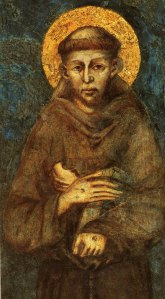 As we noted in last week’s article, Francis expected his brothers to learn by imitation – and to understand that as Francis sought to imitate Christ, so too should the brothers. But in reality, the first generation of Assisi-area brothers simply did what Francis did: daily prayer, work at a local leprosarium, go to local churches to participate in Eucharist, eat, pray again, witness to the local Umbrian people near Assisi, and live a life in community. You have to remember this was all new. Prior to this “Franciscan moment” the spiritual journey of medieval people consisted of being a monk or cloistered nun behind the walls of the monastery, being a priest and living close to the sacraments and the Scriptures, or being a lay person and hoping the other groups were praying for you. And then along comes this different, new, intriguing way of being spiritual in the world. And it was not set down in writing; it did not come with instructions. But sometimes is borrowed from the past.
  The small band of brothers living at Rivo Torto and later at the Porziuncula, were drawing others to their way of following Christ in the world. And if they expected to find a uniform dress code, posted rules, a great deal of organization, a formation program, or even someone to sit them down and explain what was expected – they were in for a surprise. Francis assumed that his followers would learn by imitation. Giving them rules or structures to follow was not merely difficult for him, it went against the grain of the meaning of minority – to be the lesser brother. The new arrivals simply did what Francis did: daily prayer, work at a local leprosarium, go to local churches to participate in Eucharist, eat, pray again, witness to the local Umbrian people near Assisi, and live a life in community. The brothers had to watch Francis closely and do their best to understand.
  One aspect of Francis’ changing life that has attracted recent attention is the movement of Francis from solitary figure, living a quasi-hermetical life for four to five years, now beginning to live in a growing community of brothers – all of whom are looking to Francis for spiritual and communal leadership. There was something attractive about Francis, his way of following the gospel, and perhaps the recent “commissioning” by Pope Innocent III gave a certain cache of legitimacy to this way of being Christian in the world. Eventually many people came to join the Franciscan movement, which soon enough became a religio and eventually an ordo, but those demarcations are eight to ten years in the future ahead of the Spring of 1209.
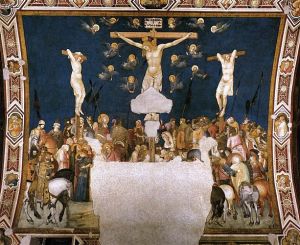 One of the famous pieces of Franciscan art can be found in the left transept of the Lower Church of San Francesco in Assisi. It is a fresco done by Pietro Lorenzetti and is one of 17 frescoes he created in the church. This fresco is located lower on the transept wall under Lorenzetti’s masterpiece, The Crucifixion. The fresco is known as Our Lady of the Sunsets.
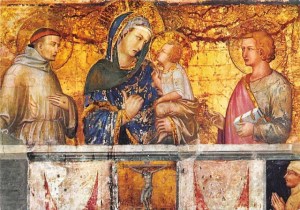 In the scene the Virgin Marry is holding the Child Jesus. The other two figures in the fresco are St. John the Evangelist (right) and St. Francis of Assisi (left), both of whom are looking at what is unfolding in the center of the scene. There Mary and Jesus are focused on each other, and Mary has a unique gesture, holding her thumb up pointing back to Saint Francis.
 friarmusings