In the early summer of 1219, Francis left Assisi and traveled to Egypt, meeting with the Sultan of Egypt, Al-Malik al-Kamil. According to the Franciscan chronicler Jordan of Giano, informed by an eyewitness, a prophetess living in the Holy Land who was known as “the Tongue-that-Proclaims-the-Truth” declared to the friars: “Come back, come back, for the order is troubled by the absence of Brother Francis; it is divided and in the process of destroying itself.” Thus in May of 1220, the Poor Man of Assisi returned to Italy, where problems had been multiplying in his absence. In a prior article we mentioned some of the problems that had arisen, which Francis addressed. He then considered the future of the Franciscan movement. In September, 1220, he formally resigned his role as minister of the brothers. Continue reading
Category Archives: St Francisof Assisi
After the Crusades
In our previous three articles we described Francis’ part of the 5th Crusade and his meeting with the Sultan of Egypt, Al-Malik al-Kamil. We know that Francis was away at a time when the community began to grow rapidly – and not just around Assisi, but in many other parts of Italy, Spain, France, and the Germanic nations as well. While Francis was away, what happened to the friars he left behind?
Francis had delegated his powers to two vicars during his absence: Matthew of Narni, who remained in Assisi, and Gregory of Naples, who visited the communities throughout Italy. Another friar, Phillip the Tall, was entrusted with the care of St. Clare and her sisters, the Poor Ladies of San Damiano. They were given very few orders or instructions. This might seem odd, given that religious life in the 13th century was quite ordered and obedience was a topic often written about – even by Francis himself. However, the friars were not technically an ordo, a religious order – they were still a “religious movement” – albeit, a quite famous and rapidly growing one that had the attention of the Pope and the Roman Curia – both in praise and concern.
Francis and the Crusades – Part 3
It is important to recognize why Francis came to Damietta during the Fifth Crusade is just one part of his life. How the experience of the crusade and his meeting with the Sultan of Egypt, Al-Malik al-Kamil, may have changed Francis is a different part of the saint’s life. While the early sources about the life of Francis are uniform in Francis’ zeal for evangelization and his desire for martyrdom, many modern scholars dismiss these as hagiographic (“saint making”) embellishments. The modern desire, especially among Franciscan scholars, seems to ensure that Francis “the peacemaker” arrives on the shore of Egypt in 1201. When one looks outside modern Franciscan scholarship, especially to the current medieval specialist, one gains a different perspective. André Vauchez, a French medievalist noted for his recent and thorough book on Francis, thinks that “some commentators are doubtful today [re: martyrdom], fearing to attribute to their hero a suicidal attitude or irresponsible behavior.” Vauchez goes on to write, that “Contrary to what is sometimes affirmed, the search for martyrdom was not in contradiction with his desire to follow Christ, who died on the cross to open to humanity the way to salvation. To face tribulations and dangers, including the loss of life, in order to spread the Christian faith was, from the beginning, a constitutive element of Franciscan sensibility.” Continue reading
Francis and the Crusades – Part 2
The previous two articles give the background for Francis of Assisi’s mission during the time of the Fifth Crusade. The previous article introduced two key ideas that seemed to be part of a strong spiritual movement in Francis’ time: peregrination pro Christo (“wandering for the sake of Christ”) which we would now call “pilgrimage,” and the long-established idea of Christian martyrdom. We have already seen the friars “wandering for Christ” in their trips throughout central Italy. Continue reading
Francis and the Crusades – Part 1
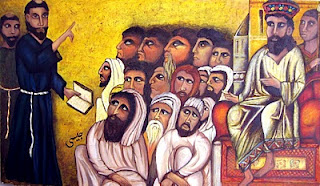
One of the events of Francis’ life that has received scant public attention was his meeting with the sultan of Egypt, Al-Malik al-Kamil in 1219 during the so-called “Fifth Crusade.” This meeting has loomed large in the imagination of the “Franciscan world” because of its effect on the Rule of Life and in the Franciscan charism of missions, but has only recently gained public attention because of the new era of tensions with the Islamic world. People are surprised to learn that Francis was part of a crusade – a claim that scholars argue to no end as they argue so many other aspects of Francis’ life. Each side has generally already taken a view of the little poor man from Assisi: Francis the loyal churchman or Francis the radical reformer. Those views are often revelatory of how the scholar views the Crusades. And as with all things, history has a context.
Francis: the First Missions
An earlier article had discussed the problems with the rapid growth of members within in the fledgling community friars. The period from 1213 to 1216 is the most obscure period in Francis’ life and also one of the periods of explosive growth in the movement as the brotherhood spread well beyond Assisi. How many friars joined the fraternity in those years? It is impossible to say, but we do know this: in 1217 the annual meeting (called a “chapter”) made the decision to send out missions across the Alps into northern Europe, the Baltic states, and to the Crusader States in the eastern Mediterranean. Within Italy, six provinces were established; outside of Italy, five provinces were established: Spain, northern and southern France, Germany, and Syria. Continue reading
Francis and the Word of God
Several weeks ago we described Francis’ love of the Eucharist. For Francis the Eucharist is the primary way in which he sees Christ’s continuing Incarnation in the world. It is the sign of the presence of Christ with the Church in his continuing salvific role. That presence was respected by Francis and was shown by the directions he gave to his own brothers regarding Eucharistic reverence, and that he even directed his missionary brothers to carry pyxes, so if they encountered the Eucharist not properly cared for, they would be able to provide a suitable means to reserve the consecrated hosts.
Francis and the Church
Francis finished his military adventures and time as a prisoner of war in early 1205. It was during the latter part of 1205 into 1206 that Francis chose to “leave the world.” In subsequent years , Francis’ model of following Christ began to attract other men to join him in the emerging way of life – even as the “way of life” was being discovered by Francis himself. Francis modeled the life, prayed with the brothers, exhorted them from time to time, and slowly the life began to take shape.
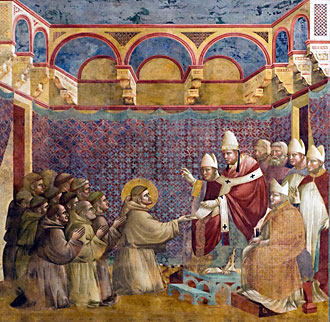
The basic shape of the movement was not all that unique in Francis’ day. There were many other penitential and mendicant movements in the beginning of the 13th century in western Europe. – some scholars tallying 130 others. Interestingly, only one of them exists today: the Franciscan. Why? Most scholars hold that it was because of Francis’ insistence on being “Catholic” and formally part of the Catholic Church. There are several theories as to the reason for that insistence. Like most things it is a complex reason, but likely primary among the reasons is Francis’ love of the Eucharist. But whatever the reasons, it is no surprise that in 1209 Francis and some of his brothers journeyed to Rome to seek an audience in a consistory with Pope Innocent III in order to receive formal recognition of his proposed way of life. Continue reading
Francis and the Eucharist
In our previous installment, speaking of Francis’ unique view of nature, we ended with the idea that Francis “held that the whole world is a sacrament, a sacred thing, a gift; and the sacramental character of the world reminds us of the central sacrament, the Incarnation, continued among us in the seven sacraments of the Church, especially in the Eucharist.” But did Francis have any thoughts specifically on the Eucharist itself?
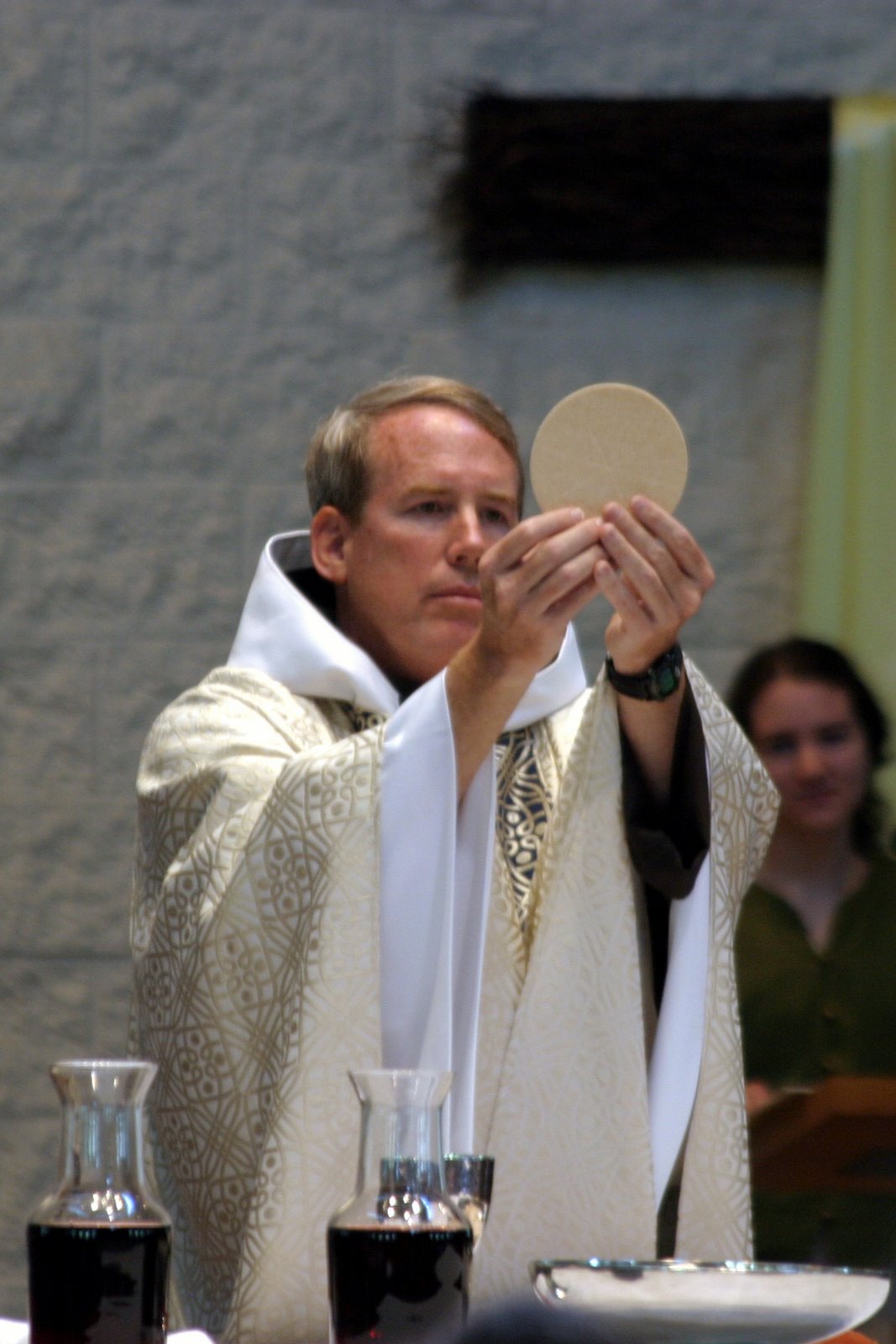
I would wager that most people would guess that in Francis’ own writings he spoke at length about poverty, his love of nature and animals, and other topics for which Francis is so well known in the modern world. Yet, in his own writings, there is perhaps no other topic that he addresses more than the Eucharist. In his Eucharistic writings, Francis expresses a deep view of the continuing Incarnation of Christ in the world, and in that vision is an entire way of life. These writings represent part of the movement of Francis’ mystical life from prayer and devotion in solitude before the cross, to a pattern of communal prayer and devotion in the Mass as well as a devotion to the Eucharist apart from Mass. Continue reading
The Goodness of Creation
Over the last few weeks, we described Francis of Assisi in the role in which he is most popularly recognizable: the lover of nature and animals. Interestingly, this role is not original in the Christian tradition. In a valuable book reviewing the nature stories of Franciscan literature, Edward Armstrong shows that many of Francis’ attitudes have precedents in biblical, early Christian, and medieval ideas about nature. One group of scholars place Francis in the tradition of hermits who retired to wilderness and befriended animals. Others associate him with a theological trend, unfortunately not dominant, which affirms creation as containing intrinsic value. Most see the stories about Francis as having precedents in the already-known lives of saints, although they may have been true of Francis as well. Continue reading