
Photo courtesy of Lucy Cason
Greccio, Italy

Photo courtesy of Lucy Cason
Greccio, Italy
I suspect if I asked most people, “Who is the King?” the answer might well come back “Elvis.” There is just part of us that lives in a pop-culture world. Besides, we Americans aren’t too keen on kings. After all, we fought a Revolutionary War to rid ourselves of English monarchs. Of course, we remain fascinated by them. Just look at the television ratings for royal weddings. Continue reading
As noted two weeks ago the accounts of Francis and the leper were beginning to “evolve” from the first story that appeared in Thomas of Celano’s first book. Some 20 years later, there are additions being made to the story that seem to be less about Francis per se, and more about Francis’ legacy that should be central to the identity of the Order. Thomas of Celano’s second book was written at the behest of the then Minister General, Crescentius. This leader inherited the results of the leadership of the two previous ministers: Elias of Cortona and Haymo of Haversham. This week we will consider Haymo, the Minister General of the Franciscan Order who succeeded Elias. He was elected with a “mandate” to fix what Elias was thought to have “broken.” Continue reading
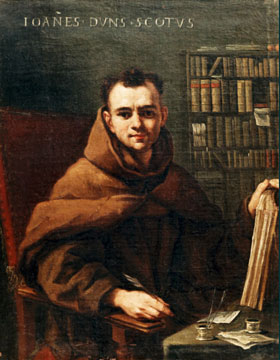 November 8th is the feast day of Blessed John Duns Scotus, a Franciscan friar from Scotland noted for his theological and philosophical work in the high-middle ages (late 13th and early 14th centuries). Scotus’ work was in the generation that followed Thomas of Aquinas and Bonaventure. His work was complex and nuanced, and he is generally considered to be one of the three most important philosopher-theologians of his time. He was given the medieval accolade Doctor Subtilis (Subtle Doctor) for his penetrating and subtle manner of thought. Continue reading
As noted last week the accounts of Francis and the leper were beginning to “evolve” from the first story that appeared in Thomas of Celano’s first book. Some 20 years later, there are additions being made to the story that seem to be less about Francis per se, and more about Francis’ legacy that should be central to the identity of the Order. Thomas of Celano’s second book was written at the behest of the then Minister General, Crescentius. This leader inherited the results of the leadership of the two previous ministers: Elias of Cortona and Haymo of Haversham. This week we will consider Elias.
Born in Bevilia near Assisi, Elias appears to have been one of the earliest companions of Francis. He seems to have joined the growing fraternity in 1211 within two years of it’s beginning. From the first he was given responsibility for leadership, first in Tuscany, then later (1217) to lead a band of missionaries to the Near East. In 1219 he became the first provincial of the then extensive province of Syria. Continue reading
The encounter of St. Francis of Assisi and a leper is an oft-cited account in the life of the saint. As we mentioned several weeks ago there are five sources in which one can read the account. English versions of the sources are available online. The sources are
In last week’s edition we looked, in some detail, at the “first life” by Thomas of Celano. This week, we can try to summarize the other accounts in a more concise manner. Continue reading
The earliest written account of Francis and the Leper occurs in Thomas of Celano’s The First Life (1C) written c.1229. The work was commissioned by Pope Gregory IX who asked Celano to write a vita of the newly canonized saint. Francis died in 1226, was declared a saint in rapid order and by April 1228, Gregory called for a burial church to be built for Francis. The commission to Celano was complementary to the architectural celebration. The vita was written in short order and declared official by Gregory in February 1229. Continue reading
In the previous three posts, we reviewed some historical context and background for our consideration of the accounts of St. Francis and the Leper. When Franciscans recount the story of Francis and the leper, one might presume that they are telling a story from a common core, perhaps even an official recounting of the story as approved by a Minister General of the Order of Friars Minor. Yea… not so much. Every medieval source has its own goal, tone, genre and point of view. And that is especially true in the period beginning some 20 years after Francis’ death (d.1226). In the post-Francis world of Franciscan, as noted in a previous post. The intra-Franciscan factions slowly came to the fore and were readily distinguishable. There was no group that was wrong, but then again, each one emphasized one aspect of “the life” they believed Francis wanted for his religious order. One group believed poverty/destitution was Francis’ intent. Another held up obedience – after all the first vow of obedience was (and still is) to the Pope – and topic Francis most often wrote about. Chastity was not the basis of one of the factions. What about the third group? They were more of the “can’t we all just get along” after all fraternity was paramount. It is 800+ years later and the same discussion continues on. Each group, consciously or not, promoted their own understanding of Francis in the stories they told, the traits they emphasize, their own goals for the narrative and all that makes hagiography different than history. Continue reading
Today is the feast day for St. Pope John XXIII, the pope who called the Second Vatican Council into session. Normally a saint’s feast day is celebrated on the date of his passing. Pope John XXIII died on June 3, 1963; however, his feast is celebrated on October 11th each year, on the anniversary of the opening of Vatican II. His story is well-known and available on many internet sites.
Born Angelo Giuseppe Roncalli in 1881, he was one of 13 children. His youth was spent poor as the son of sharecroppers in a farming village of the Bergamo province in Lombardy. Yet his family was able to provide an education that eventually led to the seminary. Continue reading
…and we continue with some historical context and background for our consideration of the accounts of St. Francis and the Leper.
While Francis was present with them in the years before 1219, the newness and charismatic dynamism of Francis was enough to keep the small group of brothers open to the unfolding vision that God was giving Francis. They took on no special tasks or roles, rather they committed to a certain way of living the Gospel of Jesus Christ. But as seen in the vocational questions above, the world and the Church had true needs, and the Pope especially saw in Francis and his brothers a ready reserve of workers for the vineyards of the Lord. Continue reading

