
The Franciscan Crown Rosary

At our parish in Tampa we have a Gift & Book Store. After shopping in the store, a parishioner sought out the pastor. “Father, your gift store has rosaries that were made by someone who didn’t know the rosary. Were they made in China?” The parishioner had noticed that some rosaries had seven decades of beads in contrast to the traditional five.  It was not a mistake – those rosaries were called “Franciscan Crowns.”

Franciscan-Crown-RosaryThe Franciscan Crown – The Franciscan Crown (or Seraphic Rosary) is a rosary consisting of seven decades in commemoration of the Seven Joys of the Virgin – a tradition of the middle ages:

  • the Annunciation,
  • the Visitation,
  • the Nativity of Jesus,
  • the Adoration of the Magi,
  • the Finding in the Temple,
  • the Resurrection of Jesus, and
  • the Assumption and Coronation of the Virgin.

The Franciscan Crown has also been called the Franciscan Rosary, the Seraphic Rosary or the Rosary of the Seven Joys of Our Lady.

History of the Crown – The Franciscan historian, Father Luke Wadding (1588-1657) dates the origin of the Franciscan Crown to the year 1422. In 1442 an apparition of the Blessed Virgin Mary took place in Assisi, to a Franciscan novice named James. As a child, he had the custom of offering daily the Virgin Mary a crown of roses. When he entered the Friars Minor, he became distressed that he would no longer be able to offer this gift. The Blessed Virgin appeared to him to give him comfort and showed him another daily offering that he might do: to pray every day seven decades of Hail Mary prayers, meditating between each decade on one of the seven joys that she had experienced in her life. Friar James began this devotion, but one day the Director of Novices saw him praying and an angel with him who was weaving a crown of roses, placing a lily of gold between each of the ten roses. When the novice had finished praying, the angel placed the crown upon him. The Director asked Friar James what this vision meant. After hearing the explanation, he told the other friars and soon this devotion spread throughout the Franciscan family.

How to Pray the Franciscan Crown Rosary: The Franciscan Crown Rosary begins quite simply by stating the first Joy and then praying one Our Father and ten Hail Mary’s while meditating upon it. This same procedure is then followed for the other six Joys. It is common practice to add the Glory Be at the end of each decade. It is customary to finish by adding two Hail Mary’s in honor of the 72 years that Our Lady is said to have lived on earth, and one Our Father and Hail Mary for the intentions of the Pope.

Francis and the Leper: Growing Pains

…and we continue with some historical context and background for our consideration of the accounts of St. Francis and the Leper.

By the spring of 1213, four years after the founding of the “order,” Francis’ reputation had risen to the attention of the Italian aristocracy – not just in Assisi but throughout central Italy.  The order was beginning to attract men from the higher social classes. Sons of merchants like Francis, sons of the landed wealthy, sons of ruling households, men with established careers in law, music and the arts, and also ordained priests. They joined the already formed group of men from middle and lower backgrounds and joined in on the muddling through what it meant to follow Christ in the manner of Francis. G.K. Chesterton’s later definition of the Catholic Church – “here comes everybody.” Broadly speaking, apart from their spiritual gifts, these were “company men.” How many friars joined the fraternity in those years?  It is impossible to say, but we do know this: in 1217 the annual meeting (called a “chapter”) made the decision to send out missions across the Alps into northern Europe, the Baltic states, and to the Crusader States in the eastern Mediterranean. Within Italy, six provinces were established; outside of Italy, five provinces were established: Spain, northern and southern France, Germany, and Syria. Some scholars have written that the number of brothers exceeded 700 men. Continue reading →

Controversy: the gathering storm

This coming Sunday is the 27th in Ordinary Time of Year B. The gospel is taken from Mark 10:2-12 and involves a question about divorce whose real intent is to bring Jesus into conflict with what the Pharisees regard as the clear teaching of Holy Scripture. As typical of this section of the Markan gospel it follows the pattern of public engagement (vv.2-9) followed by a more thorough teaching for the disciples in a private setting (vv.10-12). 

Our Sunday gospel takes the form of a controversy story in which the Pharisees’ intent was clear: they were testing (peirazo) Jesus. When this word is used in Mark, it is either Satan (1:13) or the Pharisees (8:11; 10:2; 12:15) who are “testing/tempting” Jesus. Their question begins, “Is it lawful…?” However, they aren’t really asking Jesus to tell them what the law says. They already know what the law says: “When a man, after marrying a woman and having relations with her, is later displeased with her because he finds in her something indecent, and therefore he writes out a bill of divorce and hands it to her, thus dismissing her from his house” (Deuteronomy 24:1) Continue reading →

Francis and the Leper: the growth of the Fraternity

When Franciscans recount the story of Francis and the leper, one might presume that they are telling a story from a common core, perhaps even an official recounting of the story as approved by a Minister General of the Order of Friars Minor. And even if some friars are telling the story from a source different from the “official” record, the different medieval sources used make little difference, yes? Yea… not so much. Every medieval source has its own goal, tone, genre and point of view. And that is especially true in the period beginning some 20 years after Francis’ death (d.1226). Continue reading →

Memorial of Padre Pio

Today is the Feast day of St. Pius of Pietrelcina. The saint began life as Francesco Forgione, born in May 1887 in Pietrelcina, a town and comune in the province of Benevento in the Campania region of southern Italy. He was the son of Grazio Mario Forgione and Maria Giuseppa Di Nunzio, one of five children. His family was pious, attending Mass daily, praying the rosary and fasting with great regularity in honor of Our Lady of Mt. Carmel. By age five, young Francesco stated that his life would be dedicated to God. He was a dutiful son, tending sheep, but also seemed to suffer from illnesses including typhoid fever. Around the age of 10 he told his family that he was beginning to experience visions. He soon became interested in becoming a Capuchin Franciscan. Continue reading →

Francis and the Leper

There are many stories that people remember about Francis of Assisi; in my experience, most of them are from a book, the Fioretti, The Little Flowers, a collection of stories about Francis. It is the name given to the classic collection of popular legends about the life of St. Francis of Assisi and his early companions. The earliest extant copy is from 1390, some 164 years after the death of Francis. Scholars agree that it was probably written earlier, but in any case not within 120 years of Francis’ death. It is a collection of hearsay, colorful anecdotes, stories of miracles and pious examples from the life of Francis. Are the accounts in the Fioretti history? Are the pious fables? Are they just hagiography? Continue reading →

The Stigmata of St. Francis

St. Francis receives the Stigmata (fresco attr...Authorized by Pope Paul V, September 17th is the Feast of the Stigmata of St. Francis of Assisi, a feast day celebrated within the Franciscan communities.

Stigmata, from the Greek word, generically points to a “brand” or a “mark.” It is the common word to describing branding of cattle. In the Christian context it refers to the bodily marks resembling the wounds of the crucified Christ. St. Francis was the first person, historically recorded, who bore the marks of the crucified Christ in his hands, his feet, and in his side. Continue reading →

Deja Vu all over again

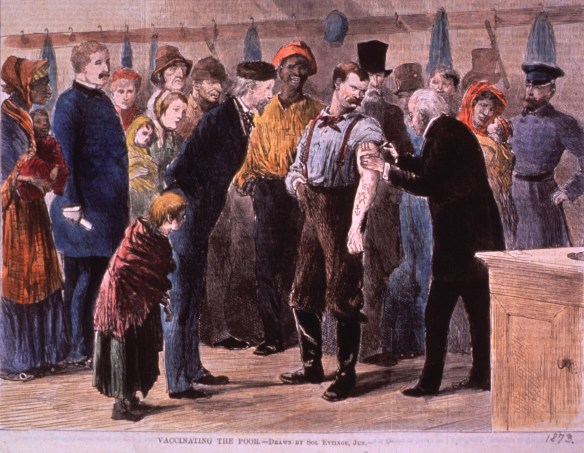
nlm nlmuid-101392773-imgMaggie Astor of the New York Times posted an interesting piece – which was interesting all on its own, but is perhaps more interesting given President Biden’s announced covid-19 mandates and actions – and the inevitable push back against them. Ms. Astor’s point is essentially that we as a nation…. “been there, done that.”  I would have linked to the article, but that was not feasible – and so I present her work.

“As disease and death reigned around them, some Americans declared that they would never get vaccinated and raged at government efforts to compel them. Anti-vaccination groups spread propaganda about terrible side effects and corrupt doctors. State officials tried to ban mandates, and people made fake vaccination certificates to evade inoculation rules already in place. Continue reading →

St. Francis and Fasting

saint-francis-of-assisi-cimabueOf the three traditional Lenten practices: prayer, almsgiving, and fasting, it is the last one that is perhaps the one that is hardest to extract from the historical record. This is for two reasons. First, fasting was part and parcel of medieval Christianity. Second, Francis mentions fasting, but does not expound upon its meaning directly.

The meaning and context of medieval fasting. In the OT there were two kinds of fasts, public and private. The most notable, and only one required by the law of Moses was on the great Day of Atonement, thus fasting was a penitential practice associated with reconciliation from sin. In addition, there are biblical records of public fasts being proclaimed in times of distress, lamentation, and at the prophetic insistence for various situations. The public fasts were generally connected to communal sins and lasted a day. Private fasts were generally acts of penance. Continue reading →

Francis of Assisi and Prayer

When people think of St. Francis of Assisi and prayer, what most likely comes to mind is “The Peace Prayer of St. Francis,” with the memorable line: “Make me an instrument of peace…” It is a moving and noteworthy prayer, certainly in the Franciscan tradition, perhaps inspired by St. Francis, but it dates to 1912 and was first published as a poem in the French spiritual magazine, La Clochette. Later, during World War I, it appeared on the back of a holy card bearing an image of St. Francis and the association of the two became cemented in our minds. Continue reading →