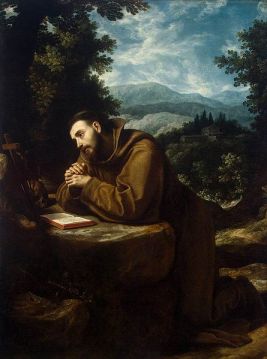
 In the short span of 12 years (1209-1221), the Franciscans had grown from a small, Assisi-based fraternity consisting of Francis and four other brothers, to a large, “multi-national,” religious order with an approved Rule of Life, a Cardinal Protector (who would soon become Pope), and more than 5,000 brothers. There was nothing in Francis’ life that prepared him for leadership of such a far-flung fraternity, which was already spanning the European continent and parts of the Middle East and North Africa. He had been a spoiled dilatant, a would-be knight, a wounded warrior, a solitary figure, living a quasi-hermetical life, and now he was the “leader” of a growing, international community of brothers. In the beginning, things just seemed to unfold, signs appeared along the way, and Francis followed the path in faith. And people followed Francis. Now most Franciscans had never met Francis and Francis’ model of leadership by example, which worked in 1209, but was not the one needed in 1221. And so he stepped down as leader, leaving the Order in the care of the Church – at least as far as discipline and administration. Yet it was also clear that he hoped to preserve a superior authority, of a spiritual type, demonstrated in the way in which he lived the Rule of Life. Continue reading →

 There are many ideas that people hold about what it means to be Franciscan. I was once asked, “Where do you friars keep the animals?” I was living in the Soundview area of the Bronx at the time. The person assumed that our way of life would always be surrounded by furry friends. Later, another person wondered why we were not living out our vow of poverty by spending our day begging for alms? Continue reading
 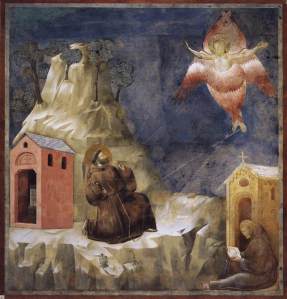 After Francis’ withdrawal from active ministerial leadership of the friars, he witnessed an inevitable evolution of the religious order, which had grown to over 5,000 brothers in 1223 from the humble beginnings in 1209 of Francis and four companions. The evolution of the Order, necessary on a number of levels, also began to change the life of the fraternity. Francis worried that the Spirit of prayer was being compromised and that the necessities of ministry were leading the brothers to increasing ties to material possessions. He lived and suffered in a “Time of Doubt,” as described in the previous article.
  August 11th, is the feast of St. Clare of Assisi. Clare was born July 16, 1194 as Chiara Offreduccio the eldest daughter of Favorino Scifi, Count of Sasso-Rosso and his wife Ortolana. There are many legends of how Clare and Francis met, but it is clear that Clare would have know about Francis and his movement of brothers seeking to embrace Holy Poverty.
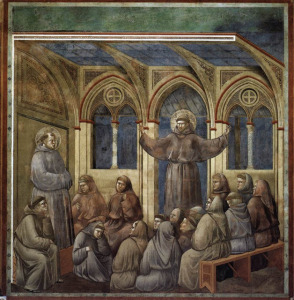 The year is 1221 and at the request of the “cardinal protector” of the friars, Cardinal Hugolino, Francis and several of his brothers have taken up the task of writing a formal rule of life. It was not clear that the Franciscans were actually a “religious order.” When Francis visited Pope Innocent III in 1209, the pope verbally approved (or did he?) a Rule of Life that was written down in few words. In 1216, the 4th Lateran Council ruled that no new religious orders could be formed: all new groups would be absorbed into existing religious orders. Hugolino recognized the uniqueness of the charism of St. Francis and his brothers and was determined that it not be lost to the church.
  The year is 1220 and Francis has just announced his decision to step down as “leader” of the Franciscan brothers. In last week’s installment, I described Francis’ reason for stepping down. Francis had already seen the effects of a vacuum in spiritual authority brought about by his year-long absence while in the Middle East. It is in leaving to his “vicar” and to the Roman Church the care of making decisions of a normative or disciplinary type that he could hope to preserve a superior authority, of a spiritual type, that would only have been diminished in the heat of daily administration.
 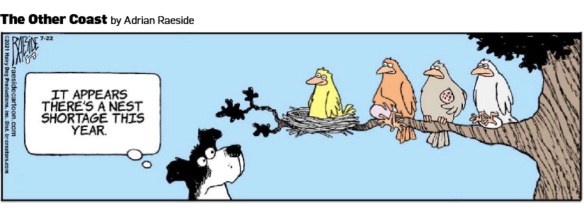 Hardly a day goes by that one cannot hear the phrase “supply chain problems.” There are lots of industry-specific reasons unique to their particular sector but a common contribution seems to be the uptick in demand coming quicker and at higher-than-expected levels – just not enough supply. One hears a lot about the supply chain within the auto industry which affects new car and rental car availability. Here is about as concise an explanation as possible:
  If you have been following the daily gospel readings, you have read about the growing opposition to Jesus. He has been performing miracles, casting out demons, curing the sick, and yet people are hesitant to believe. In some cases, they outright refuse, and in the most extreme, they recognize the supernatural but attribute it to being in league with Satan. The people resist, the authorities accuse, and in today’s gospel it seems as though Jesus’ family wants to see him. Unsaid, but its seems as though they want to have an intervention.
