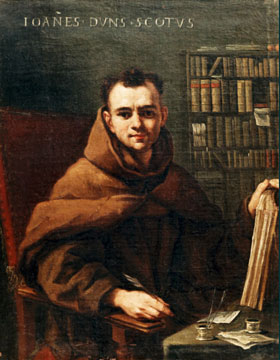
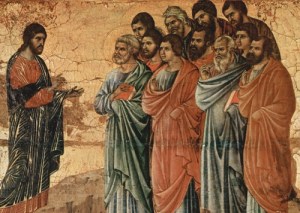
 The reading from today’s gospel (with a few extra verses) and St. Francis of Assisi’s answer to the question.
20 Jesus came with his disciples into the house. Again the crowd gathered, making it impossible for them even to eat. 21 When his relatives heard of this they set out to seize him, for they said, “He is out of his mind.” … 31 His mother and his brothers arrived. Standing outside they sent word to him and called him. 32 crowd seated around him told him, “Your mother and your brothers* [and your sisters] are outside asking for you.” 33 But he said to them in reply, “Who are my mother and [my] brothers?” 34 And looking around at those seated in the circle he said, “Here are my mother and my brothers. 35[For] whoever does the will of God is my brother and sister and mother.” (Mark 3) Continue reading
 Today is the Feast of St. Bonaventure the great Franciscan saint, theologian and provincial minister of the Order in the mid-13th century. There are a special set of
 Years from now I will perhaps look back in my notes at this homily and will need to remind myself what was unique and different about this Solemnity of the Body and Blood of Christ, popularly known as Corpus Christi Sunday. Notes to self: 94 days ago, the World Health Organization declared pandemic status for the covid-19 virus. 87 days ago, the churches of the diocese of St. Petersburg were closed to the public. 79 days ago, a safer-at-home order was declared for the City of Tampa.
 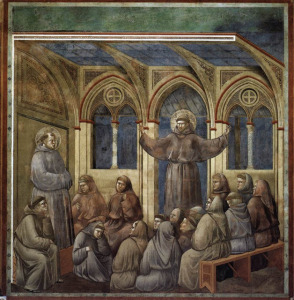 During these last days as the topic of racial justice was omnipresent around us, someone emailed to ask if Francis of Assisi had ever written on race relationships. The short answer is “no.” Francis of Assisi lived in the 13th century growing up in the Umbria region of Italy. His world was provincial and focused on the world in which diversity meant which town you were from and the “other” referred to the “Saracens,” against whom the Crusades were aimed in order to free the Holy Land from Islamic control.
 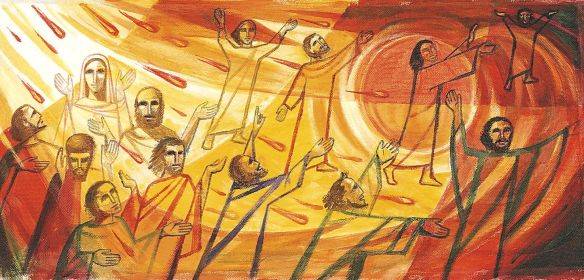 When I was a child growing up in the 1950s Catholic milieu, we prayed “In the Name of the Father, and the Son, and the Holy Ghost.” We didn’t give it a lot of thought. We were kids. We also did not particularly make the connection between the third person of the Trinity and Casper the Friendly Ghost or any of his not-so-friendly counterparts. But at some point, the phrase “Holy Ghost” gave way to “Holy Spirit.”