 1 When Jesus had said this, he raised his eyes to heaven and said, “Father, the hour has come. Give glory to your son, so that your son may glorify you, 2 just as you gave him authority over all people, so that he may give eternal life to all you gave him. 3 Now this is eternal life, that they should know you, the only true God, and the one whom you sent, Jesus Christ. 4 I glorified you on earth by accomplishing the work that you gave me to do. 5 Now glorify me, Father, with you, with the glory that I had with you before the world began. 6 “I revealed your name to those whom you gave me out of the world. They belonged to you, and you gave them to me, and they have kept your word. 7 Now they know that everything you gave me is from you, 8 because the words you gave to me I have given to them, and they accepted them and truly understood that I came from you, and they have believed that you sent me. 9 I pray for them. I do not pray for the world but for the ones you have given me, because they are yours, 10 and everything of mine is yours and everything of yours is mine, and I have been glorified in them. 11 And now I will no longer be in the world, but they are in the world, while I am coming to you.
Introduction. “Jesus’ prayer in John 17:1–26 is the final scene of his farewell meal with his disciples. Since the sixteenth century, the traditional title of this prayer has been ‘Jesus’ high priestly prayer.’” (O’Day, 787) It shares many similarities with farewell speeches in the OT, e.g., Moses in Deuteronomy (31:30-32:47) as the Israelites are entering the promised land and Moses is at the end of his life. Continue reading →

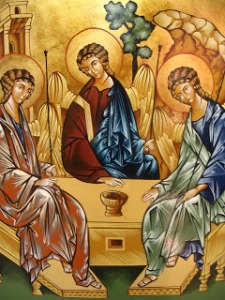 We have all kinds of solemnities, feast days, and other special days in the church year. We commemorate happenings in the life of Christ: Mary’s visit from Gabriel announcing the miraculous child she was to bring into the world. We celebrate the arrival of the Three Kings, the Baptism of our Lord, the Transfiguration when the glory of Christ is revealed, and on Palm Sunday, we celebrate Jesus riding triumphantly into Jerusalem amidst palms and cheers. We celebrate the empty tomb and Resurrection of Easter, the glorious Ascension, the explosive coming of God’s spirit to the church at Pentecost—and then we have Holy Trinity Sunday. And suddenly it is like we have moved from these great events in the life of Christ, and now— tadah!! We are celebrating a…a…a church doctrine. Continue reading
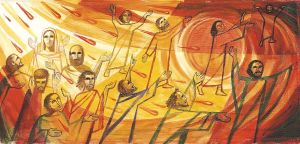 Pentecost Sunday is a day on which we are reminded that the Holy Spirit was promised and has been given. We celebrate the fulfillment of a promise by Jesus that the Advocate, the Paraclete, the one sent by Jesus would come to remind us of all that Jesus taught, to be with us, and to bring to us the power of God. We celebrate this day with three readings – each one of which is filled with mention of the Spirit. The first reading is the account from Acts 2 so familiar to every Christian, 50 days after the Resurrection. We imagine it as a very public event in which the power of the Spirit came with the roar of a great wind, as though tongues of fire, and suddenly the disciples can speak in a way that people from everywhere can understand them. It is as though what happened at the Tower of Babel is undone and finally the world can be united. The Spirit-filled disciples are to be the agents that restore unity to the world.
 They things slow down as a parish approaches summer. That has not been my experience. I am writing this column before things even more busy. There are lots of meetings about one thing or another. Some are meetings that are looking at the “year in review” – some are planning for September 2017 and beyond. Some are planning summer events for the parish. And some are part of life as a Franciscan Friar.
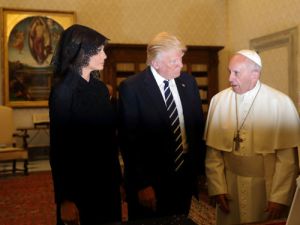 When President Donald Trump recently visited Pope Francis, part of the world’s attention was on Melania and Ivanka Trump as they wore black dresses and veils while meeting the Holy Father. The Holy See does not impose a compulsory dress code, but does suggest a protocol for state visits and hearings with the Pope, both for men and women. In the case of the latter, the protocol requires a long black dress with a high neckline, long sleeves, and a black veil. For historical reasons, however, some Catholic queens or consorts of kings have traditionally been exempted from using black. This is the so-called “privilège du blanc” (privilege of white), a special prerogative granted under the Pope’s criteria.
 When they saw him, they worshiped, but they doubted… (Mt 20:17)
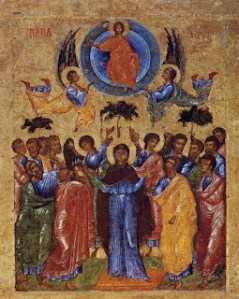 The Ascension of the Lord is a great celebration of the Church. It commemorates the bodily ascension of Jesus into heaven. According to St. Luke it occurred 40 days after the Resurrection (Acts 1:3). It is a feast of great antiquity with liturgies and art of the 4th century already addressing it as a norm of the Church. In the Eastern Church this feast is known in Greek as Analepsis, the “taking up,” and also as the Episozomene, the “salvation from on high,” indicating that by ascending into his glory Christ completed the work of our redemption.
 “Always be ready to give an explanation to anyone who asks you for a reason for your hope, but do it with gentleness and reverence.” (1 Peter 3:15-16)

