
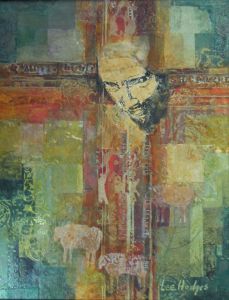
 “I came so that they might have life and have it more abundantly.” So, what do you make of the verse? What generally stands out in the hearing and imagination is “the abundant life.” What does it look like? If we don’t have an idea of what it looks like, how will we know when we have it?
Once upon a time in Kenya, an Englishman visiting the central highlands, discovered a beautiful river. Not too far downstream he came upon the chief of the Kikuyu people enjoying a moment of fishing. The chief had a great spot in the shade, the fishing line was tied around his big toe, and the chief seemed like he was napping more than fishing. Continue reading
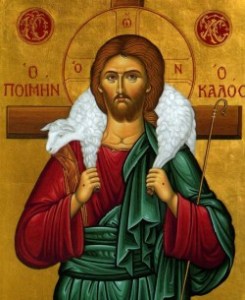 A Theological Summary Verses 17-18 form the conclusion to the discourse. In these verses, the shepherd metaphor is abandoned completely and Jesus speaks directly about his death and relationship with God. These verses focus on three theological themes that are essential to understanding the death of Jesus in John.
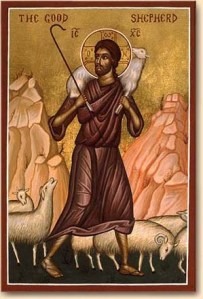 So Jesus said again… It is evident to Jesus that the disciples do not understand, so Jesus offers another explanation. Commentaries have long asked how we are to understand the relationship between vv.1-6 and vv.7-18. Are the latter verses making an allegorical explanation to the already presented parable? The problem with such a view is that characters and imagery has changed. In any case, few people seem to believe that if vv.7-18 are a clarifying or additional explanation, it likely was not any more effective.
  The three saddest words in Scripture, or in our lives, are. “We had hoped….” For these travelers, it is “we had hoped he was the one to redeem Israel.” “We had hoped,” but those hopes were dashed upon the wood of the cross and buried in a tomb. Now they are walking away from the rumors of Resurrection in a slow descent into despair. For years, the power of God had seemed so close. The disciples saw the miracles, heard the preaching, saw Lazarus emerge from the tomb, and so much more. Now it all lays powerless in the tomb. “We had hoped…”
  Our gospel on this 3rd Sunday of Easter is St. Luke’s telling of the two disciples on the road to Emmaus. It is a story about a journey of faith even as it is a journey to faith. The thing about journeys is that you often do not realize that you are on one, or if you do, may not recognize that the nature of the journey has changed. The two disciples had journeyed to Jerusalem with one set of hopes and expectations. They were following Jesus, were in Jerusalem for the events of Holy Week, and saw one journey seemingly end at Golgotha.
  Let’s say that San Francisco is the beginning of the voyage. Sydney, Australia is the destination. At the same moment a tramp steamer, a luxury liner, a submarine, a sailboat, a Lamborghini, a single-engine Cessna, and a Boeing 747 airliner begin the journey. All will try to journey to the same destination. Every journey will be encounter different things along the way: storms, rogue waves, turbulence, trade winds, potholes, headwinds, end-of-the-road, and more. For a time, we might be lost, adrift, or stuck in one place. Every tale of the journey will be different. The lessons learned along the way unique. Not all will make it to Sydney. We hope that most will
  At the beginning of Lent I wrote to you regarding a way to think about Lenten observances – not simply as penitential – “I am giving up….” but as more. I wrote:
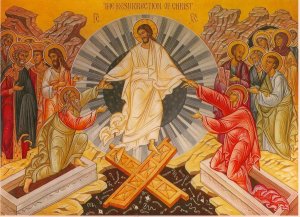 There were so many times in Jesus’ ministry that he told his disciples that on the third day he would be raised from death. Today is the third day. The day when the world changed forever. When His best overcame our worst. When He broke the chains of death and now we are free.

