From my Franciscan brother, Fr. Dan Horan, OFM
Pope’s Homily from Mass with Abuse Victims
1

From my Franciscan brother, Fr. Dan Horan, OFM
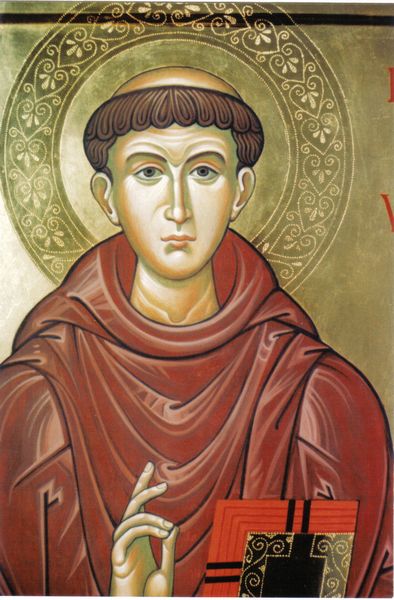 When we Franciscans arrived at Sacred Heart in 2005, we were quite surprised to find that one of the clerestory windows (the ones up high in the nave vault) was Saint Anthony of Padua, a Franciscan contemporary of St. Francis of Assisi. In fact, we Franciscans still have a brief letter, in Francis’ own hand, written to Anthony. Most people know St. Anthony of Padua as the patron saint of lost and stolen articles, but have you ever wondered why he is that particular patron saint? Continue reading
From my Franciscan brother, Dan Horan, OFM.
 The King Is Scourged and Mocked (27:26-31a) The Gospel reading for Palm Sunday of the Lord’s Passion is quite lengthy and so will not be included here. It can be found at the USCCB website: http://www.usccb.org/bible/readings/041314.cfm
Where the religious trial ends by mocking Jesus as the Christ, the secular trial ends with Jesus being mocked as king with a scarlet cloak (a soldier’s cape) parodying the emperor’s purple robe, a reed representing a royal scepter, and the crown of thorns. Jesus is thus enthroned as king, and offered the homage of kneeling which a Hellenistic ruler required. In this scene Matthew continues to redefine what kingship means. If this scene is a coronation, then the cross will be the throne. Continue reading
 Of the three traditional Lenten practices: prayer, almsgiving, and fasting, it is the last one that is perhaps the one that is hardest to extract from the historical record. This is for two reasons. First, fasting was part and parcel of medieval Christianity. Second, Francis mentions fasting, but does not expound upon its meaning directly.
The meaning and context of medieval fasting. In the OT there were two kinds of fasts, public and private. The most notable, and only one required by the law of Moses was on the great Day of Atonement, thus fasting was a penitential practice associated with reconciliation from sin. In addition, there are biblical records of public fasts being proclaimed in times of distress, lamentation, and at the prophetic insistence for various situations. The public fasts were generally connected to communal sins and lasted a day. Private fasts were generally acts of penance. Continue reading
When people think of St. Francis of Assisi and prayer, what most likely comes to mind is “The Peace Prayer of St. Francis,” with the memorable line: “Make me an instrument of peace…” It is a moving and noteworthy prayer, certainly in the Franciscan tradition, perhaps inspired by St. Francis, but it dates to 1912 and was first published as a poem in the French spiritual magazine, La Clochette. Later, during World War I, it appeared on the back of a holy card bearing an image of St. Francis and the association of the two became cemented in our minds. Continue reading
 In Sunday’s gospel Jesus encounters the man born blind. Miraculously Jesus gives him the gift of sight and then the poor guy goes through the wringer of one interrogation after another about it all. The Pharisees have a miracle laid right in their laps, and if you are like me, I am wondering, “Wow, how did they miss that one? How could they be so blind!” Which is of course the question we should ask about them. But what about us? Continue reading
 There are many ideas that people hold about what it means to be Franciscan. I was once asked, “Where do you friars keep the animals?” I was living in the Soundview area of the Bronx at the time. The person assumed that our way of life would always be surrounded by furry friends. Later, another person wondered why we were not living out our vow of poverty by spending our day begging for alms? Continue reading
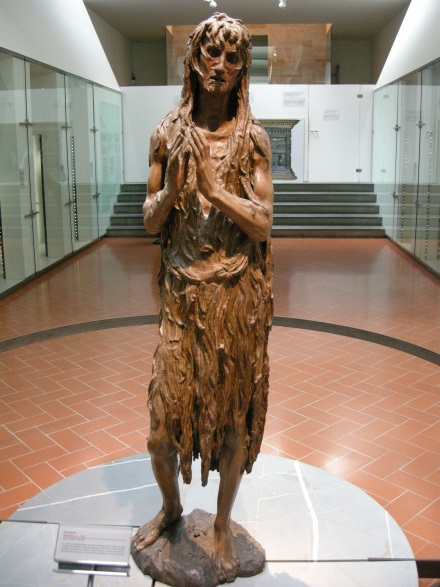 Most people still think of Mary Magdalene as the unnamed sinner (possibly a prostitute) in Luke 7:36-50. Of course we think of her as “the repentant prostitute” because she turns her life around because of the encounter with Jesus. The problem is that for the first 300+ years of the Church, she was only seen as the first witness to the Resurrection. Did you know that Mary Magdalene is mentioned 12 times in the gospels, more than most of the Apostles? She was present at the crucifixion and was the first witness to the Resurrection (John 20 and Mark 16:9). She was the “Apostle to the Apostles,” an honorific that St. Augustine bestowed upon her in the fourth century, and possibly he was but repeating a moniker already in use. Continue reading
 This weekend, my Franciscan brother, Fr. Bill McConville, OFM is preaching at all the Masses as part of the Lenten Parish Mission (which I hope you are planning to attend if you are in the Tampa area). Having a guest homilist is a secret pleasure for a priest – even if you like the whole process of preparation and presentation (which I do). Still, it is a like a holiday that shows up at your door step. Woohoo!! It is a double blessing because I know Fr. Bill well. I know his homily will be great and I will get to listen to it. At least I hope I listen, pay attention, and even more, consider all that Fr. Bill has to say about this wonderful gospel describing the Transfiguration. Continue reading

