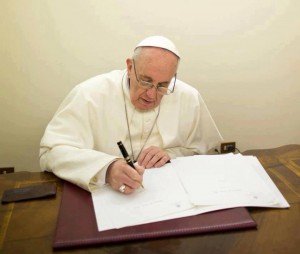
This text is a useful guide for an initial reading of the Encyclical. It will help you to grasp the overall development and identify the basic themes. The first two pages are an overview of Laudato si’ (literally “Be praised” or better, “Praise be to you”). Then for each of the six chapters, there is a one-page summary that gives the argument or main points and some key passages. The numbers in parentheses refer to the paragraphs in the Encyclical.
An overview
“What kind of world do we want to leave to those who come after us, to children who are now growing up?” (160). This question is at the heart of Laudato si’ (Praise be to you), the new Encyclical on the care of the common home by Pope Francis. “This question does not have to do with the environment alone and in isolation; the issue cannot be approached piecemeal.” This leads us to ask ourselves about the meaning of existence and its values at the basis of social life: “What is the purpose of our life in this world? What is the goal of our work and all our efforts? What need does the earth have of us?” “Unless we struggle with these deeper issues – says the Pope – I do not believe that our concern for ecology will produce significant results” (160).
The Encyclical takes its name from the invocation of Saint Francis, “Praise be to you, my Lord”, in his Canticle of the Creatures. It reminds everyone that the earth, our common home “is like a sister with whom we share our life and a beautiful mother who opens her arms to embrace us” (1). People have forgotten that “we ourselves are dust of the earth (cf. Gen 2:7); our very bodies are made up of her elements, we breathe her air and we receive life and refreshment from her waters.” (2).
Now, this earth, mistreated and abused, is lamenting, and its groans join those of all the forsaken of the world. Pope Francis invites us to listen to them, urging each and every one – individuals, families, local communities, nations and the international community – to an “ecological conversion” in the expression of Saint John Paul II. We are invited to “change direction” by taking on the beauty and responsibility of the task of “caring for our common home”. Happily, Pope Francis recognizes that “there is a growing sensitivity to the environment and the need to protect nature, along with a growing concern, both genuine and distressing, for what is happening to our planet” (19). A ray of hope flows through the entire Encyclical, which gives a clear message: “Humanity still has the ability to work together in building our common home” (13). “Men and women are still capable of intervening positively” (58). “All is not lost. Human beings, while capable of the worst, are also capable of rising above themselves, choosing again what is good, and making a new start” (205).
Pope Francis certainly addresses the Catholic faithful, quoting Saint John Paul II: “Christians in their turn ‘realize that their responsibility within creation, and their duty towards nature and the Creator, are an essential part of their faith’“ (64). Pope Francis proposes specially “to enter into dialogue with all people about our common home” (3). The dialogue runs throughout the text and, in ch. 5, it becomes the instrument for addressing and solving problems. From the beginning, Pope Francis recalls that “other Churches and Christian communities – and other religions as well – have also expressed deep concern and offered valuable reflections” on the theme of ecology (7). Indeed, such contributions expressly come in, starting with that of “the beloved Ecumenical Patriarch Bartholomew” (7), extensively cited in paragraphs 8 and 9. At several points, the Pope thanks the protagonists of this effort – individuals as well as associations and institutions. He acknowledges that “the reflections of numerous scientists, philosophers, theologians and civic groups, all […] have enriched the Church’s thinking on these questions” (7). He invites everyone to recognize “the rich contribution which the religions can make towards an integral ecology and the full development of humanity” (62).
The itinerary of the Encyclical is mapped out in para. 15 and is divided into six chapters. It starts by presenting the current situation based on the best scientific findings available today (ch. 1), followed by a review of the Bible and Judeo-Christian tradition (ch. 2). The root of the problems in technocracy and in an excessive self-centeredness of human being are analyzed (ch. 3). The Encyclical then proposes (ch.4) an “integral ecology, which clearly respects its human and social dimensions” (137), inextricably linked to the environmental question. In this perspective, Pope Francis proposes (ch. 5) to initiate an honest dialogue at every level of social, economic and political life, that builds transparent decision-making processes. Recalling that no project can be effective if it is not animated by a formed and responsible conscience (ch. 6), ideas are put forth to aid growth in this direction at the educational, spiritual, ecclesial, political and theological levels. The text ends with two prayers; one offered for sharing with everyone who believes in “God who is the all- powerful Creator” (246), and the other to those who profess faith in Jesus Christ, punctuated by the refrain “Praise be to you!” which opens and closes the Encyclical.
Several main themes run through the text that are addressed from a variety of different perspectives, thus traversing and unifying the text:
– the intimate relationship between the poor and the fragility of the planet,
– the conviction that everything in the world is connected,
– the critique of new paradigms and forms of power derived from technology,
– the call to seek other ways of understanding the economy and progress,
– the value proper to each creature,
– the human meaning of ecology,
– the need for forthright and honest debate,
– the serious responsibility of international and local policy,
– the throwaway culture and the proposal of a new lifestyle (16).
Chapter 1 – What is happening to our common home
The first chapter presents the most recent scientific findings on the environment as a way to listen to the cry of creation, “to become painfully aware, to dare to turn what is happening to the world into our own personal suffering and thus to discover what each of us can do about it” (19). It thus deals with “several aspects of the present ecological crisis” (15).
Pollution and climate change: “Climate change is a global problem with serious implications, environmental, social, economic, political and for the distribution of goods; it represents one of the principal challenges facing humanity in our day” (25). If “the climate is a common good, belonging to all and meant for all” (23), the greatest impact of this change falls on the poorest, but “many of those who possess more resources and economic or political power seem mostly to be concerned with masking the problems or concealing their symptoms” (26). At the same time, “our lack of response to these tragedies involving our brothers and sisters points to the loss of that sense of responsibility for our fellow men and women upon which all civil society is founded” (25).
The issue of water: the Pope clearly states that “access to safe drinkable water is a basic and universal human right, since it is essential to human survival and, as such, is a condition for the exercise of other human rights”. To deprive the poor of access to water means to deny “the right to a life consistent with their inalienable dignity” (30).
Loss of biodiversity: “Each year sees the disappearance of thousands of plant and animal species which we will never know, which our children will never see, because they have been lost forever” (33). They are not just any exploitable “resource”, but have a value in and of themselves. In this perspective “we must be grateful for the praiseworthy efforts being made by scientists and engineers dedicated to finding solutions to man-made problems”, but when human intervention is at the service of finance and consumerism, “it is actually making our earth less rich and beautiful, ever more limited and grey” (34).
Decline in the quality of human life and the breakdown of society: in the framework of an ethics of international relationships, the Encyclical indicates how a “true ‘ecological debt’“ (51), exists in the world, above all in the North with respect to the South. In the face of climate change there are “differentiated responsibilities” (52), and that of the developed countries is greater.
Aware of the profound differences over these issues, Pope Francis shows himself to be deeply affected by the “weak responses” in the face of the drama besetting many peoples and populations. Even though positive examples are not lacking (58), “a complacency and a cheerful recklessness” prevail (59). An adequate culture is lacking (53) as is a willingness to change life style, production and consumption (59), but fortunately efforts are being made “to establish a legal framework which can set clear boundaries and ensure the protection of ecosystems” (53).
Chapter Two – The Gospel of Creation
To face the problems illustrated in the previous chapter, Pope Francis selects Biblical accounts, offering a comprehensive view that comes from the Judeo-Christian tradition and articulates the “tremendous responsibility” (90) of humankind for creation, the intimate connection among all creatures and the fact that “the natural environment is a collective good, the patrimony of all humanity and the responsibility of everyone” (95).
In the Bible, “the God who liberates and saves is the same God who created the universe, and these two divine ways of acting are intimately and inseparably connected” (73). The story of creation is central for reflecting on the relationship between human beings and other creatures and on how sin breaks the equilibrium of all creation in its entirety: “These accounts suggest that human life is grounded in three fundamental and closely intertwined relationships: with God, with our neighbour and with the earth itself. According to the Bible, these three vital relationships have been broken, both outwardly and within us. This rupture is sin” (66).
For this, even if “we Christians have at times incorrectly interpreted the Scriptures, nowadays we must forcefully reject the notion that our being created in God’s image and given dominion over the earth justifies absolute domination over other creatures” (67). Human beings have the responsibility to “‘till and keep’ the garden of the world (cf. Gen 2:15)” (67), knowing that “the ultimate purpose of other creatures is not to be found in us. Rather, all creatures are moving forward, with us and through us, towards a common point of arrival, which is God” (83).
That the human being is not the master of the universe “does not mean to put all living beings on the same level and to deprive human beings of their unique worth and the tremendous responsibility it entails. Nor does it imply a divinization of the earth which would prevent us from working on it and protecting it in its fragility” (90). In this perspective, “every act of cruelty towards any creature is ‘contrary to human dignity’” (92). However, “a sense of deep communion with the rest of nature cannot be real if our hearts lack tenderness, compassion and concern for our fellow human beings” (91). What is needed is the awareness of a universal communion: All of us are “called into being by the one Father. All of us are linked by unseen bonds and together form a kind of universal family, a sublime communion which fills us with a sacred, affectionate and humble respect” (89).
The chapter concludes with the heart of Christian revelation: “The earthly Jesus” with “his tangible and loving relationship with the world” is “risen and glorious, and is present throughout creation by his universal Lordship” (100).
Chapter three – The human roots of the ecological crisis
This chapter gives an analysis of the current situation, “so as to consider not only its symptoms but also its deepest causes” (15), in a dialogue with philosophy and the human sciences.
Reflections on technology are an initial focus of the chapter. The great contribution of technologies to the improvement of living conditions is acknowledged with gratitude. However it gives “those with the knowledge, and especially the economic resources to use them, an impressive dominance over the whole of humanity and the entire world” (104). It is precisely the mentality of technocratic domination that leads to the destruction of nature and the exploitation of people, especially the most vulnerable populations. “The technocratic paradigm also tends to dominate economics and political life” (109), keeping us from recognizing that “by itself the market cannot guarantee integral human development and social inclusion” (109).
“Modernity has been marked by an excessive anthropocentrism” (116): human beings no long recognize their right place with respect to the world and take on a self-centred position, focused exclusively on themselves and on their own power. This results in a “use and throw away” logic that justifies every type of waste, environmental or human, that treats both the other and nature as simple objects and leads to a myriad of forms of domination. It is this mentality that leads to exploiting children, abandoning the elderly, forcing others into slavery, practicing human trafficking and throwing away unborn babies because they do not correspond to what the parents want, of selling “blood diamonds” and the pelts of animals in danger of extinction, and of over-evaluating the capacity of the market to regulate itself. This is also the mentality of the many mafias involved in drug trafficking and trafficking of organs (123).
In this light, the Encyclical addresses two crucial problems of today’s world. Above all work: “any approach to an integral ecology, which by definition does not exclude human beings, needs to take account of the value of labour” (124), because “to stop investing in people, in order to gain greater short-term financial gain, is bad business for society” (128).
The second problem regards the limitations of scientific progress, with clear reference to GMOs (132-136). This is a “complex environmental issue” (135). Even though “in some regions their use has brought about economic growth which has helped to resolve problems, there remain a number of significant difficulties which should not be underestimated” (134), starting from the “productive land being concentrated in the hands of a few owners” (134). Pope Francis thinks particularly of small producers and rural workers, of biodiversity, and the network of ecosystems. Therefore “a broad, responsible scientific and social debate needs to take place, one capable of considering all the available information and of calling things by their name” starting from “lines of independent, interdisciplinary research” (135).
Chapter four – Integral Ecology
The heart of the Encyclical’s proposals is integral ecology as a new paradigm of justice, an ecology “which respects our unique place as human beings in this world and our relationship to our surroundings” (15). In fact, “nature cannot be regarded as something separate from ourselves or as a mere setting in which we live” (139). This holds true in all fields: in economy and politics, in different cultures particularly in those most threatened, and even in every moment of our daily lives.
The integral perspective also brings the ecology of institutions into play: “if everything is related, then the health of a society’s institutions affects the environment and the quality of human life. ‘Every violation of solidarity and civic friendship harms the environment’“ (142).
With many concrete examples, Pope Francis confirms his thinking that “the analysis of environmental problems cannot be separated from the analysis of human, family, work-related and urban contexts, and of how individuals relate to themselves” (141). “We are not faced with two separate crises, one environmental and the other social, but rather one complex crisis which is both social and environmental” (139).
“Human ecology is inseparable from the notion of the common good” (156), but is to be understood in a concrete way: in today’s context, in which, “injustices abound and growing numbers of people are deprived of basic human rights and considered expendable” (158), committing oneself to the common good means to make choices in solidarity based on “a preferential option for the poorest of our brothers and sisters” (158). This is also the best way to leave a sustainable world for future generations, not just by proclaiming these truths, but also by committing to care for the poor of today. Benedict XVI already emphasized this clearly: “In addition to a fairer sense of inter- generational solidarity there is also an urgent moral need for a renewed sense of intra- generational solidarity” (162).
Integral ecology also involves everyday life. The Encyclical gives specific attention to the urban environment. The human being has a great capacity for adaptation and “an admirable creativity and generosity is shown by persons and groups who respond to environmental limitations by alleviating the adverse effects of their surroundings and learning to live productively amid disorder and uncertainty” (148). Nevertheless, a great deal of integral improvement in the quality of human life – public space, housing, transport, etc. – is still needed in order to achieve authentic development (150-154).
Also “the acceptance of our bodies as God’s gift is vital for welcoming and accepting the entire world as a gift from the Father and our common home, whereas thinking that we enjoy absolute power over our own bodies turns, often subtly, into thinking that we enjoy absolute power over creation” (155).
Chapter five – Lines of approach and action
This chapter addresses the question of what we can and must do. Analyses are not enough. We need proposals “for dialogue and action which would involve each of us individually no less than international policy” (15). They will “help us to escape the spiral of self-destruction which currently engulfs us” (163). For Pope Francis it is imperative that practical proposals are not developed in an ideological, superficial or reductionist way. For this, dialogue is essential, a term present in the title of every section of this chapter. “There are certain environmental issues where it is not easy to achieve a broad consensus. […] the Church does not presume to settle scientific questions or to replace politics. But I want to encourage an honest and open debate, so that particular interests or ideologies will not prejudice the common good” (188).
On this basis, Pope Francis is not afraid to judge international dynamics severely: “Recent World Summits on the environment have failed to live up to expectations because, due to lack of political will, they were unable to reach truly meaningful and effective global agreements on the environment” (166). And he asks, “What would induce anyone, at this stage, to hold on to power only to be remembered for their inability to take action when it was urgent and necessary to do so?” (57). Instead, what is needed, as Popes have repeated several times starting with Pacem in terris, are forms and instruments for global governance (175): “an agreement on systems of governance for the whole range of the so-called ‘global commons’“ (174), seeing that “environmental protection cannot be assured solely on the basis of financial calculations of costs and benefits. The environment is one of those goods that cannot be adequately safeguarded or promoted by market forces” (190, citing the Compendium of the Social Doctrine of the Church).
In this fifth chapter, Pope Francis insists on development of honest and transparent decision- making processes, in order to “discern” which policies and business initiatives can bring about “genuine integral development” (185). In particular, a proper environmental impact study of new “business ventures and projects demands transparent political processes involving a free exchange of views. On the other hand, the forms of corruption which conceal the actual environmental impact of a given project in exchange for favours usually produce specious agreements which fail to inform adequately and do not allow for full debate” (182).
The most significant appeal is addressed to those who hold political office, calling them to avoid “a mentality of ‘efficiency’ and ‘immediacy’“ (181) that is so prevalent today: “but if they are courageous, they will attest to their God-given dignity and leave behind a testimony of selfless responsibility” (181).
Chapter six – Ecological education and spirituality
The final chapter invites everyone to the heart of ecological conversion. The roots of the cultural crisis are deep, and it is not easy to reshape habits and behaviour. Education and training are the key challenges: “change is impossible without motivation and a process of education” (15). All educational sectors are involved, primarily “at school, in families, in the media, in catechesis and elsewhere” (213).
The starting point is “to aim for a new lifestyle” (203‐208), which also opens the possibility of “bringing healthy pressure to bear on those who wield political, economic and social power” (206). This is what happens when consumer choices are able to “change the way businesses operate, forcing them to consider their environmental footprint and their patterns of production” (206).
The importance of environmental education cannot be overstated. It is able to affect actions and daily habits, the reduction of water consumption, the sorting of waste and even “turning off unnecessary lights” (211): “An integral ecology is also made up of simple daily gestures which break with the logic of violence, exploitation and selfishness” (230). Everything will be easier when starting with a contemplative outlook that comes from faith: “as believers, we do not look at the world from without but from within, conscious of the bonds with which the Father has linked us with all beings. By developing our individual, God-given capacities, an ecological conversion can inspire us to greater creativity and enthusiasm” (220).
As proposed in Evangelii Gaudium: “sobriety, when lived freely and consciously, is liberating” (223), just as “happiness means knowing how to limit some needs which only diminish us, and being open to the many different possibilities which life can offer” (223). In this way “we must regain the conviction that we need one another, that we have a shared responsibility for others and the world, and that being good and decent are worth it” (229).
The saints accompany us on this journey. Saint Francis, cited several times, is “the example par excellence of care for the vulnerable and of an integral ecology lived out joyfully and authentically” (10). He is the model of “the inseparable bond between concern for nature, justice for the poor, commitment to society, and interior peace” (10). The Encyclical also mentions Saint Benedict, Saint Teresa di Lisieux and Blessed Charles de Foucauld.
Inspired by Laudato si’, the regular examination of conscience – a practice that the Church has always recommended to orient one’s life in light of the relationship with the Lord – should include a new dimension: one ought to reflect seriously on how one has lived in communion, not only with God, with others and with oneself, but also with all creatures and with nature.

 At our parish we have a webpage dedicated to Laudato Si. It is meant to be a place where one can find useful resources to help in reading, contemplating, and considering the vision of Pope Francis regarding the “Care of Our Common Home.” Enjoy!