
 Stewardship in a parish is always a topic best approached cautiously. It shouldn’t be, but it is. People always assume that it is just a $20 word to bring up donations and the need for money. In this musing, I want to talk about Stewardship in two ways: (a) to lead you to online resources that explore the richness of Stewardship, Belonging and Gratitude – the call of who we are to be as Christians in the world. And (b) the easiest way you might ever find to donate to Sacred Heart by not changing a thing in your life. Continue reading
Stewardship and not changing a thing
Reply
 Saint Marguerite Marie Alacoque was a French Roman Catholic Visitation nun and mystic, who promoted devotion to the Sacred Heart of Jesus in its modern form. Today is her feast day
 On Sunday, October 19th, Pope Francis declared John Henry Newman, Mother Giuseppina Vannini, Mother Mariam Thresia Mankidiyan, Sister Dulce Lopes Pontes, and Marguerite Bays Catholic saints. In the west I suspect John Henry Newman is the best known, but here is the briefest of resumes of all five Saints. Of the new saints, one is the first woman born in Brazil; another is from Kerala, India. Five were priests or members of a religious order; one was a Swiss lay woman.
  There is the natural part of us that tends to speak in generalities or platitudes when we attempt to address God or our relationship to God. Unsurprisingly, after all, the core of it all is a mystery. Believers have struggled for centuries to express the ineffable, the mystery of the divine. Yet we still have hopes: “I want to have God first in my life.” So, what does that look like? Ineffable as God is, what does “first in my life” mean in concrete terms? If you don’t have an idea of what it looks like, how will you know when you have arrived? “But do you ever really arrive?” As they say, if you don’t have a destination then any road will get you there.
  I am not normally given to posting op-ed pieces from online sources. But there was an op-ed piece that caught my attention, more specifically, this:
 In a 13th century text called the Il Foretti (The Little Flowers), a story is told about St. Francis in which a brother friar came to him and asked, “Why after you? Why is the whole world coming after you, wanting to see you, to hear you, to follow you?” Some 800 years after the life of St. Francis, this question remains. What is it about this unpretentious figure from the early 13th century that continues to exert such a perennial fascination for Catholics and non-Catholics, believers and agnostics alike? What is it that has made Francis the subject of more books than any other saint? Why has he inspired artists, led ecologists, peace activists, and advocates for the poor to claim him as a patron? Why has he inspired countless tens of thousands of men and women to follow his Rule of Life in religious and secular communities?
 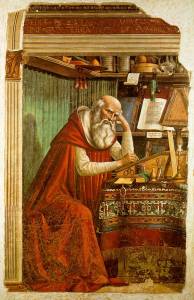 Monday was the Memorial of St. Jerome, best known for his translation the Vulgate Bible. St. Jerome translated from OT Hebrew and NT Greek into Latin. He famously said: “Ignorance of Scripture is ignorance of Christ.” Advice we should all take to heart.
 Last week’s
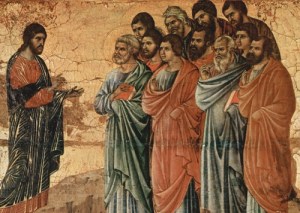
 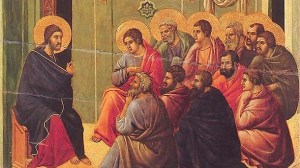 Who are the holy ones of Christianity? Or more pointedly asked, “Who do you consider the holy ones?” In the beginning it was the Apostles, the people who had actually met and lived with Jesus. They saw the miracles, heard the teaching, witnessed the healings, saw the Resurrected Savior, and went to the ends of the earth preaching and baptizing. Surely, they were the holy ones – especially called by Jesus himself!
  Jesus was a master of the story form known as parables. One of the most memorable parables can be found in Luke: the story of Lazarus and the Rich man (Luke 16:19-31). The parable starts simply enough: “There was a rich man who dressed in purple garments and fine linen and dined sumptuously each day. And lying at his door was a poor man named Lazarus, covered with sores.” Very quickly in the parable the two men die. The unnamed rich man goes to a fiery afterlife of torment while Lazarus rests in the arms of Abraham, awaiting the day when Jesus will open the gates of Heaven for the faithful.
  friarmusings