Faith in Action

UmbrellaSummer sun and an extended drought had left the surrounding fields parched, dusty, and brown. As they tended their wilting crops, the local folks daily searched the sky for any sign of relief. Days turned into arid weeks and still no rain came.

The ministers of the local churches announced that there would be a special service to pray for rain on the following Saturday. They requested that everyone bring an object of faith for inspiration. At the appointed hour, everyone turned out, filling the town square with anxious faces and hopeful hearts. The ministers were touched to see the variety of objects clutched in prayerful hands; prayer books, Bibles, crosses, rosaries, etc.

Just as the hour of prayer was concluding, and as if by some divine cue, a soft rain began to fall. Cheers swept the crowd as they held their treasured objects high in gratitude and praise. From the middle of the crowd, one faith symbol seemed to overshadow all the others; a child had brought an umbrella.  (from Southern author and poet Laverne W. Hall)

Darkness, Candles, and Things Unsaid

Easter Vigil at Sacred HeartI am always amazed at the sayings that are attributed to St. Francis of Assisi.  Today, I was asked if the following saying was from Francis: “All the darkness in the world cannot extinguish the light of a single candle.”  Nice, but at first blush it does not possess the language or sense of language for which Francis is known. The language is not even particularly medieval, but then maybe this is just a modernized version of the saint’s words.

If you search the internet, you will find this “quote” has pretty wide distribution and uniform attributed to St. Francis.  Most have no citation; but some do.  The only source given was “The Little Flowers of St. Francis.”  You can find the Little Flowers in volume 3 (pp. 566-658) of Francis of Assisi: Early Documents  –  Armstrong, Regis, J.A. Wayne Hellmann, and William Short, eds. (New York: New City Press, 1999–2004).

What you can’t find is the quote, or an account for which the quote could be a reduction. I could be wrong.  If someone has the specific citation (text and chapter) that would be an interesting thing to know.   I know I should just let these things go, but…. let the saint speak for himself … I’m just saying.

On Mission and Crossing Over Boundaries

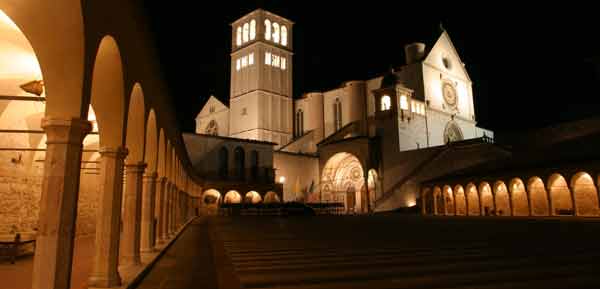
saint-francis-of-assisi-cimabueAmong founders of religious orders, Francis of Assisi is the first who consciously included mission ad gentes (to the people of the world) as part of the order’s Rule of Life. Francis was clear about the ad gentes nature of mission in the Franciscan tradition: “But I tell you in truth that the Lord chose and sent the brothers for the benefit and salvation of the souls of all people in the whole world and they should be received not only in the land of the believers, but also in that of non-believers.” (Assisi Compilation, 108)

Clearly Francis held to the idea of the universality of mission, yet some people might find Francis’ distinction of the world as the twined categories of believer and non-believer to be somehow less than welcoming or out of sorts with our sensibility of what it means to be Franciscan. Yet note how Chapter 16 of the “Early Rule” (1221 CE) is named by Francis: “Chapter XVI: Those going among the Saracens and other Nonbelievers.” I mention this as a way of pointing you back to the first reflection where it was noted that the way you think about Jesus, church, when and how God’s reign is fully inaugurated, the nature of salvation, how the Church values human beings, and the role and value of culture – all these things affect the way in which one understands and carries out mission. As questions, these six topics remain present, even urgent, in every age because how they are answered is how Christianity finds its concrete identity as it constitutes itself in fidelity to Jesus’ mission. Continue reading

Marks of holiness

Saint Francis of Assisi and scenes of his life...


I have to admit that in counseling conversations, pastoral settings, preaching, and a variety of teaching settings (RCIA, Bible study, etc.) I often return to the topic of the formation of moral conscience. I have even written about it here and here in this blog.


About two years, ago while preaching on the formation of moral conscience, I mentioned health care reform as a topic about which the bishops were teaching at the moment. The topic of health care per se was in the news, but the primary point of my reference was to indicate how often when our bishops speak and teach, we praise them or criticize them based on our already-held opinion of the topic. And I use the word “opinion” pointedly as it is my experience that most people do not form their conscience as described in the Catechism (§1776-1803). Such formation was the real point of the homily – with the challenge being to operate as Christians, not in the realm of opinion, but in the sphere of the formed moral conscience. We are called to do such, but do we do it? Often all I must do is to ask if they have prayed about it or asked the Holy Spirit for wisdom on the topic/decision. Lingering silence is often the answer. Continue reading

Immigration: The Formation of Conscience

he_qi_road_to_emmausThere are strong emotions at the mention of immigration reform.  There is no shortage of opinions in the news, blogs, rallies, calls to legislators, and the like.  As people of faith we are called not to simply have an opinion on the matter, but rather to form our consciences on the matter (Catechism §1776-1803).  The formation of conscience means to take the matter into prayer, to read and reflect on the way Scripture addresses the issue directly or indirectly, to seek the counsel of the Church, and a host of other actions.  There is no shortage of opinions, but I do wonder how many take the time and effort to form our consciences?  The Church is quite strong on this formation, even teaching that, “A human being must always obey the certain judgment of his [formed] conscience.” (§1790)  That is an amazing responsibility that the Church asks of us. Continue reading

Racial Blues

In truth, I really could not think of a good title. But I guess that is OK. They aren’t my words. They point to the words of Fr. Bryan Massingale, a priest of the Diocese of Milwaukee and a professor of theology at Marquette University. Take five minutes and read his reflection on the trial of George Zimmerman for taking the life of Trayvon Martin.  “When profiling is “reasonable,” injustice becomes excusable

And after reading his reflection, take a lifetime to reflect.

Winner the Pooh, Rabbit, Martha and Mary

A Very Merry Pooh Year

Patrica Datchuck Sanchez had an interesting beginning to her commentary on the Martha and Mary story in Luke’s gospel:

Convinced that there is a discernible wisdom in A.A. Milne’s Winnie the Pooh (Dell Pub. Co., New York: 1926), I consulted the portly bear for a lesson in hospitality, the central theme of today’s first reading and gospel. Edward Bear, known to his friends as Winnie the Pooh, or Pooh for short, decided to visit Rabbit. As he drew nearer to Rabbit’s home, Pooh began to hum. “Aha”, he said, “Rabbit means Company and Company means Food and Listening-to-Me-Humming!” When he called out, “Is anybody at home?” he heard a scuffling noise and then silence. He called again, more loudly, “Is anybody home?” No!, said a voice and then added, “You needn’t shout so loud. I heard you quite well the first time!” “Oh, bother!” said Pooh. “Isn’t there anybody home at all?” The answer came back, “Nobody!”

There is, perhaps, at times, a little of Pooh and Rabbit in all of us. Pooh regarded hospitality as an opportunity for food, fun and attention. Rabbit saw it as a bothersome chore he’d rather forego.

Perusing Scripture

English: old greek papyrus

Greek papyrus (Photo credit: Wikipedia)

“Peruse” is an interesting word, according to Merriam-Webster it has an original meaning (15th century): to examine or consider with attention and in detail : study.  That makes sense given its derivative from Middle English in which “per” meant completely.  But “peruse” acquired a different meaning over time:  to look over or through in a casual or cursory manner.  Etymology studies only indicate the shift in meaning in the 20th century (some argue for 19th century) – not the reasons why.  If I had to offer an uninformed guess, it would be because the word sounds “casual” and so people, not realizing the actual meaning, began to use “peruse” in a different, almost opposite way from its original meaning. Words can be like that. Continue reading

Rules

We are promised that whenever two or three are gathered in Jesus’ name, there He will be among us.  I have always suspected when the number is more than a billion world-wide, you better have rules. Rules are necessary – even helpful, but we always need to remember the basis of the rule or things get confusing when people interpret rules in differing ways. I suspect a lot of church arguments fall in this category. Believe it or not, the most common “church rule” question I receive is “how many times a day can I receive Eucharist.”  There is a set number and conditions – I will leave you the details to research on-line.  But when you find the rule (if you do) will you find the basis for the rule? Continue reading

When the clay fights back…

earthen-vessels

We hold this treasure in earthen vessels, that the surpassing power may be of God and not from us. (2 Cor 7; NAB)

I have a friend who “throws” clay pots.  She swears that sometimes as the clay is spinning and she lovingly tries to give shape to the clay – the clay begins to fight back and seek a shape other than what she intends.  I suspect that God sometimes has that same reaction with us.

My friend adapts and will work with whatever notion the clay seems to intend, be it a good idea or no. I suspect God is the same way; the potter never abandons us, never gives up trying to shape us to the fullness of what He intends for us.

Everything indeed is for you, so that the grace bestowed in abundance on more and more people may cause the thanksgiving to overflow for the glory of God (2 Cor 15).