
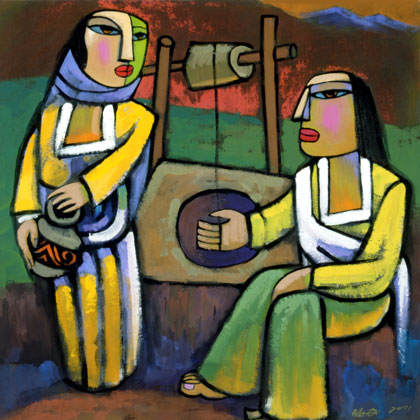
The Samaritan Women: some background

SamaritanWomanAtTheWellWho are the Samaritans? In John 4:4-42, Jesus’ ministry enters a new stage. He leaves the confines of traditional Ju­daism and turns to those whom his Jewish contemporaries reckoned as outsiders and ene­mies: the Samaritans. The breach between Jews and Samaritans can be traced to the Assyrian occupation of northern Palestine (721 BCE; see 2 Kings 17), but the most intense rivalry began about 200 BCE. The source of the enmity between Jews and Samaritans was a dispute about the correct location of the cultic center (cf. John 4:20). The Samaritans built a shrine on Mt. Gerizim during the Persian period and claimed that this shrine, not the Jerusalem Temple, was the proper place of worship. The shrine at Mt. Gerizim was destroyed by Jewish troops in 128 BCE, but the schism between Jews and Samaritans continued (cf. John 4:9).

When Jesus meets the Samaritan woman at the well, he meets someone who stands in marked contrast to all that has come before in this gospel. When Jesus spoke with Nicodemus (3:1-21), he spoke with a named male of the Jewish religious establishment, a “teacher of Israel.” When Jesus speaks to the Samaritan woman, he speaks with an unnamed female of an enemy people. Continue reading →

The Samaritan Women: a context

SamaritanWomanAtTheWellJohn 4:5-42 5 So he came to a town of Samaria called Sychar, near the plot of land that Jacob had given to his son Joseph. 6 Jacob’s well was there. Jesus, tired from his journey, sat down there at the well. It was about noon.

7 A woman of Samaria came to draw water. Jesus said to her, “Give me a drink.” 8 His disciples had gone into the town to buy food. 9 The Samaritan woman said to him, “How can you, a Jew, ask me, a Samaritan woman, for a drink?” (For Jews use nothing in common with Samaritans.) 10 Jesus answered and said to her, “If you knew the gift of God and who is saying to you, ‘Give me a drink,’ you would have asked him and he would have given you living water.” 11 (The woman) said to him, “Sir, you do not even have a bucket and the cistern is deep; where then can you get this living water? 12 Are you greater than our father Jacob, who gave us this cistern and drank from it himself with his children and his flocks?” 13 Jesus answered and said to her, “Everyone who drinks this water will be thirsty again; 14 but whoever drinks the water I shall give will never thirst; the water I shall give will become in him a spring of water welling up to eternal life.” 15 The woman said to him, “Sir, give me this water, so that I may not be thirsty or have to keep coming here to draw water.” Continue reading →

Transfiguration: voices

TransfigVoice from the Cloud. 34 While he was still speaking, a cloud came and cast a shadow over them, and they became frightened when they entered the cloud. 35 Then from the cloud came a voice that said, “This is my chosen Son; listen to him.” 36 After the voice had spoken, Jesus was found alone. They fell silent and did not at that time tell anyone what they had seen.

Clouds also serve in Luke and Acts as in other biblical accounts to manifest and conceal the presence of God (Exod 16:10; 19:9; 24:15–18; 33:9–11). Daniel foresees that the Son of Man will come to the Ancient of Days with the clouds of heaven (Dan 7:13). So, too, Jesus would be taken up in a cloud (Acts 1:9) and return on the clouds (Luke 21:27; cf. 1 Thess 4:17; Rev 1:7; 14:14). Continue reading →

Transfiguration: prophets and apostles

TransfigMoses and Elijah. 30 And behold, two men were conversing with him, Moses and Elijah, 31 who appeared in glory and spoke of his exodus that he was going to accomplish in Jerusalem.

The presence of Elijah and Moses has been much discussed by various scholars. (1) Do they represent the different kinds of life endings (burial versus being taken up to God)? (2) Is their presence an indication of endorsement by great prophets and wonderworkers of old? (3) Is Jesus the fulfillment of the law (Moses) and the prophets (Elijah) – and so listen to him? (4) Or is it that Moses points to the expected great-prophet-like Moses, while Elijah suggests the eschaton’s (end days) arrival – roles fulfilled in Jesus. Continue reading →

Transfiguration: change

TransfigThe Transfiguration. 29 While he was praying his face changed in appearance and his clothing became dazzling white.

Both Matthew and Mark starkly report: “And he was transfigured (metamorphōth) before them.” The underlying Greek word means to “transform, change completely.” Luke uses the more mundane heteron (change) and limits the description to his face. All the accounts agree that the clothing became a brilliant white; Luke using the word that sometimes describes the white flash of lightning. Continue reading →

Transfiguration: prayer

TransfigThe transfiguration scene is composed of the following elements: (1) Jesus’ withdrawal to the mountain to pray with the three disciples (v. 28), (2) the transfiguration (v. 29), (3) the appearance of Moses and Elijah (vv. 30–33a), (4) Peter’s response (v. 33b), (5) the voice from the cloud (vv. 34–35), and (6) the disciples’ response.

Praying on the Mountain. 28 About eight days after he said this, he took Peter, John, and James and went up the mountain to pray. Continue reading →

Transfiguration: context

Transfig28 About eight days after he said this, he took Peter, John, and James and went up the mountain to pray. 29 While he was praying his face changed in appearance and his clothing became dazzling white. 30 And behold, two men were conversing with him, Moses and Elijah, 31 who appeared in glory and spoke of his exodus that he was going to accomplish in Jerusalem. 32 Peter and his companions had been overcome by sleep, but becoming fully awake, they saw his glory and the two men standing with him. 33 As they were about to part from him, Peter said to Jesus, “Master, it is good that we are here; let us make three tents, one for you, one for Moses, and one for Elijah.” But he did not know what he was saying. 34 While he was still speaking, a cloud came and cast a shadow over them, and they became frightened when they entered the cloud. 35 Then from the cloud came a voice that said, “This is my chosen Son; listen to him.” 36 After the voice had spoken, Jesus was found alone. They fell silent and did not at that time tell anyone what they had seen. (Luke 9:28-36) Continue reading →

Testing: the third

temptation_of_christThe Third Test. ” 9 Then he led him to Jerusalem, made him stand on the parapet of the temple, and said to him, “If you are the Son of God, throw yourself down from here, 10 for it is written: ‘He will command his angels concerning you, to guard you,’ 11 and: ‘With their hands they will support you, lest you dash your foot against a stone.’” 12 Jesus said to him in reply, “It also says, ‘You shall not put the Lord, your God, to the test.’” 13 When the devil had finished every temptation, he departed from him for a time. Continue reading →

Testing: the second

temptation_of_christThe Second Temptation. 5 Then he took him up and showed him all the kingdoms of the world in a single instant. 6 The devil said to him, “I shall give to you all this power and their glory; for it has been handed over to me, and I may give it to whomever I wish. 7 All this will be yours, if you worship me.” 8 Jesus said to him in reply, “It is written: ‘You shall worship the Lord, your God, and him alone shall you serve.’” Continue reading →

Testing: the first

temptation_of_christThe First Test. 1 Filled with the holy Spirit, Jesus returned from the Jordan and was led by the Spirit into the desert 2 for forty days, to be tempted by the devil. He ate nothing during those days, and when they were over he was hungry. 3 The devil said to him, “If you are the Son of God, command this stone to become bread.” 4 Jesus answered him, “It is written, ‘One does not live by bread alone.’” Continue reading →