Annunciations

TheAnnunciationSimilar, yet… In many respects our gospel (Luke 1:26-38) is similar to the annunciation of the birth of John. The angel Gabriel appears to announce the birth of the child, and the annunciation follows the pattern of birth annunciations in the OT: The angel says, “Do not be afraid,” calls the recipient of the vision by name, assures him or her of God’s favor, announces the birth of the child, discloses the name of the child to be born, and reveals the future role of the child in language drawn from the Scriptures. After their respective announcements, Zechariah and Mary each ask a question, a sign is given, and the scene closes with a departure. The similarity of structure and content between the two scenes invites the reader to consider the differences between them all the more closely. For example, the first announcement came as an answer to fervent prayer; the second was completely unanticipated. John would be born to parents past the age of child bearing, but the miracle of Jesus’ birth would be even greater. Jesus would be born to a virgin. The announcement of Jesus’ future role also shows that at every point Jesus would be even greater than his forerunner. Watch how these nuances are developed in the course of the details of this scene. Note this narrative comparison also punctuates the beginning of Mark’s gospel which has no infancy narrative: John the Baptist is not the Christ, not Elijah, not the prophet to come, and not worthy to loosen the strap of the sandal of the one who is to come. Continue reading →

The Annunciation – context

TheAnnunciationLuke 1:26-38  26 In the sixth month, the angel Gabriel was sent from God to a town of Galilee called Nazareth, 27 to a virgin betrothed to a man named Joseph, of the house of David, and the virgin’s name was Mary. 28 And coming to her, he said, “Hail, favored one! The Lord is with you.” 29 But she was greatly troubled at what was said and pondered what sort of greeting this might be. 30 Then the angel said to her, “Do not be afraid, Mary, for you have found favor with God. 31 Behold, you will conceive in your womb and bear a son, and you shall name him Jesus. 32 He will be great and will be called Son of the Most High, and the Lord God will give him the throne of David his father, 33 and he will rule over the house of Jacob forever, and of his kingdom there will be no end.” 34 But Mary said to the angel, “How can this be, since I have no relations with a man?” 35 And the angel said to her in reply, “The holy Spirit will come upon you, and the power of the Most High will overshadow you. Therefore the child to be born will be called holy, the Son of God. 36 And behold, Elizabeth, your relative, has also conceived a son in her old age, and this is the sixth month for her who was called barren; 37 for nothing will be impossible for God.” 38 Mary said, “Behold, I am the handmaid of the Lord. May it be done to me according to your word.” Then the angel departed from her.

Context. From the beginning of the Gospel according to Luke:

1:1 Since many have undertaken to compile a narrative of the events that have been fulfilled among us, 2 just as those who were eyewitnesses from the beginning and ministers of the word have handed them down to us, 3 I too have decided, after investigating everything accurately anew, to write it down in an orderly sequence for you, most excellent Theophilus, 4 so that you may realize the certainty of the teachings you have received.

The preface to the Gospel of Luke’s begins with the Greek (epeidēper) indicating a formal and important undertaking. And well Luke should write such as he intends to write of the things that God has fulfilled among the believers (among us). It establishes that the good news is already planted – not only in that others have already written their gospels – but that this is living tradition (handed down) among the community. These things have been fulfilled by God and part of his faithfulness to his promises.

Luke 1:5-2:52 forms the section referred to as the “Infancy Narratives.” Luke’s account of the conception, birth, and infancy of Jesus is one of his finest narratives. The Gospel of Mark, one of Luke’s sources does not have an infancy narrative to guide him. The Gospel of Matthew has an infancy narrative, but there is every indication that Luke and Matthew had no knowledge of each other’s work. Rather, they composed their accounts separately at a time when the church was reflecting back beyond Jesus’ public ministry to his earthly beginnings.

The traditional preaching outline began with Jesus’ baptism (as is evident in the sermons of Peter and Paul in Acts, and in the structure of Mark’s Gospel). The infancy stories were added to the front of that outline to serve as a prologue to the main narrative. A prologue announces the themes to be pursued in the body of the work. Both Luke and Matthew proclaim the good news in advance in a kind of mini-gospel based on the birth and infancy of Jesus. If Luke’s infancy narrative had been lost before his Gospel began to circulate, we wouldn’t know it had existed, because there are no clear references back to these chapters in the later account of the public ministry. But the reverse is not true — there are many references forward to the later developments. What we know about the infant Jesus comes from the teaching of the adult Jesus and the early church’s reflection on his life, death, and resurrection. Who is this child? He is Messiah and Lord (Acts 2:36). What does his coming mean? He will save his people from their sins (Luke 24:47). A reader’s understanding of the prologue depends on his or her understanding of the rest of the book. It means much more when read a second or third time after the entire book has been read. The infancy narrative grows in meaning the more the life, death, and resurrection of Jesus resound in the faith of the reader.

The immediate context of our passage is one of announcements:

  • Luke 1:5-25: Announcement of John’s birth
  • Luke 1:26-38: The Annunciation of Jesus’ birth

The next scene opens as though it will continue to tell of the birth of the child promised to Zechariah and Elizabeth. Instead, it tells of a greater miracle and the birth of one who would be even greater than John.

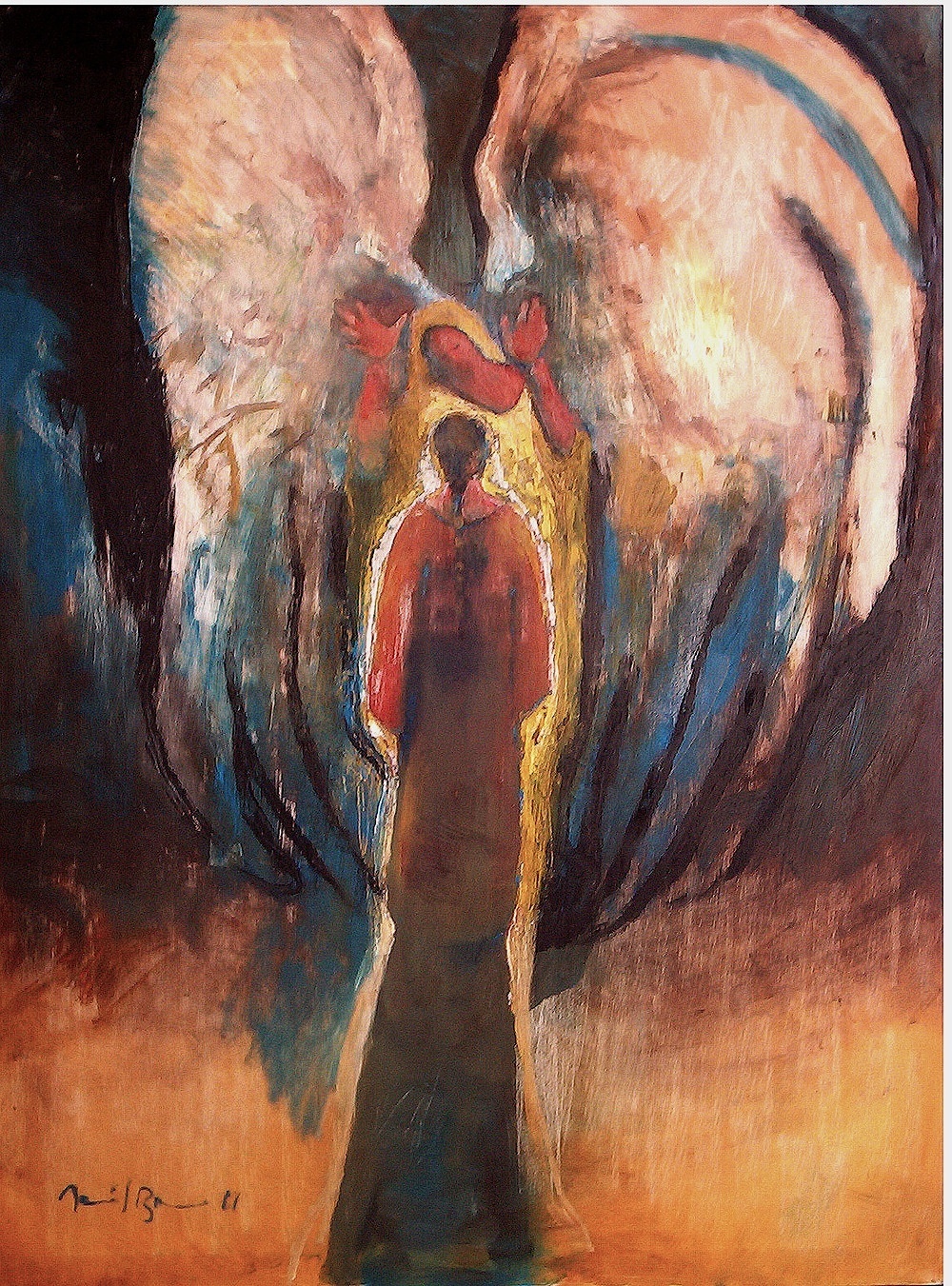
Photo credit: “The Annunciation” by Daniel Bonnell

What can you say about yourself?

john-the-baptistThe questioners from Jerusalem were in a difficult position. So far all they had elicited from John had been a string of denials; they had no positive statement to put in their report. Yet John was preaching, drawing crowds in the wilderness, and baptizing. They must have something to say about him. So they turn the matter over to John. Instead of making another suggestion they ask him what he thinks about himself. They must have some answer to take back to those who had sent them. Continue reading →

The Testimony of John

john-the-baptistJohn’s testimony to Jesus will lead others to faith, but it is also offered as evidence in a trial. John’s interrogators in this passage are not curious passersby, but are a delegation sent by official Judaism (vv. 19, 22). The expression “the Jews” (hoi Ioudaioi, v. 19) occurs repeatedly in the Fourth Gospel and has a wide range of meanings. Its most common usage, as in v.19, is as a synonym for the Jewish religious establishment, which is the source of most of the opposition to Jesus’ ministry in John. Here it likely refers to representative from Jerusalem leadership who quite naturally are going to make inquiries about what may well be a new religious movement – especially if there are messianic claims. There was a history of such movements and claims leading to religious disappointment and political ruin. Once John the Baptist acquired a following, the questions were sure to come. The first one was simple and straight forward. Continue reading →

An Interlude

prologue-johnVerses 9-18 are not part of our gospel reading for this 3rd Sunday in Advent (Year B), but let us at least summarize its content

The Word Incarnate (1:9–14) Attention is now fastened on the incarnation. Two points receive special emphasis: one is the astonishing fact that the Word of God, true God as he is, took upon him human nature, and the other is the even more astonishing fact that when he did this, people would have nothing to do with him. John is concerned that we should miss neither the good news of the incarnation of God, nor the tragedy of the human rejection of God. Continue reading →

Sent from God

john-the-baptistA man named John was sent from God (v.6) Into this overarching narrative of the grand plan of salvation, we have the curious insertion of John the Baptist. We should note that this fourth gospel never uses the moniker “the Baptist” or “the Baptizer” – in fact John is never called the “forerunner” or “herald.” John has one role and one role only: witness (v.7). Leon Morris suggests that this is a response to a late 1st century controversy about the role and place of John the Baptist in the story of Christianity. “We should recall that some had baptized in John’s name as far afield as Ephesus (Acts 19:3), and they may have gone further. The great Apollos is first introduced as one who “knew only the baptism of John” (Acts 18:25). Our author does not enter directly into controversy with such people, but he insists more than any of the other Evangelists on the subordinate place of the Baptist. One of the aims of this Gospel plainly was to show how clearly and consistently John had pointed people to Jesus.” (Morris, 78) John the Evangelist does not directly confront the claims of the Baptist’s followers, but he insists more than any of the other Evangelists on the subordinate place of the Baptist. One of the aims of this Gospel plainly was to show how clearly and consistently John the Baptist had pointed people to Jesus. Continue reading →

The Word Made Flesh

prologue-johnJesus was not born into a time of theological vacuum. Jewish theology was robust and with a history of succeeding and competing rabbinic schools. The followers of Jesus and the people of his time were Jews who were raised and lived this theology. It provided the framework for their daily lives and shaped their expectations about the Messiah, the Anointed One, who was to come. Among the gospels, John’s is the writings whose work expresses the fulfillment of those expectations and provides the theology for those that would follow Jesus. The basis of the theology is evident from the opening: John 1:1 “In the beginning was the Word, and the Word was with God, and Word was God…” Continue reading →

Context in the 4th Gospel

prologue-johnJohn the Evangelist has deftly changed the narrative presented in the Synoptic Gospels. Here in the fourth gospel the story of Jesus is not ultimately a story about Jesus; it is the story of God as God reveals God’s self in the person of Jesus. Thus the narrative is well placed in Advent at the head of the liturgical year: “In the beginning…” Continue reading →

Context and Advent

prologue-johnThe prologue and beginning of the Gospel according to John appears on the 3rd Sunday of Advent (Year B) as well as the gospel for the Mass on Christmas during the day (all years) and in some small part on the 3rd Sunday of Christmas (all years). In all the uses John the Evangelist is orienting the reader of the gospel with a fusion of traditional materials: a hymn about the pre-existing Word of God, John the Baptist, as well as many OT images. The goal of the fusion is most powerfully seen in the closing verses of the Prologue (vv.14-18) in which the language about God and Word (v.1) become the language about Father and Son (v.17). The story of the Word becomes identical with the story of Jesus. The Word becoming flesh (v.14) is the defining event of human history in which the relationship of God and humanity is forever changed in the Incarnation. The Incarnation means that people can see, hear, and know God in ways never before possible. Such is the effect of the divine light in the world. What came to be through him was life, and this life was the light of the human race (vv.3-4) Continue reading →

To give testimony…

john-the-baptistThe 3rd Sunday in Advent continues to feature John the Baptist as the herald and forerunner of the Messiah. The Reading for the Third Sunday of Lent in John 1:6-8, 19-28 (shown in italics) – but it seemed good to me to also show the more continuous context of the Gospel according to John:

1 In the beginning was the Word, and the Word was with God, and the Word was God. 2 He was in the beginning with God. 3 All things came to be through him, and without him nothing came to be. What came to be 4 through him was life, and this life was the light of the human race; 5 the light shines in the darkness, and the darkness has not overcome it. 6 A man named John was sent from God. 7 He came for testimony, to testify to the light, so that all might believe through him. 8 He was not the light, but came to testify to the light. Continue reading →