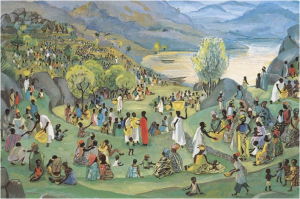
 It is a well know gospel – the miraculous feeding of the multitudes. St. John estimates the size of the crow as 5,000 counting only the men. The location of the event is somewhere on the shore of the Sea of Galilee on a “mountain” but then the same word can be used for “hillside.” The Christian community still remembered the location and shared it with the 4th century pilgrims. Today, there is the Church of the Multiplications on the traditional site that is maintained and served by Benedictine Monks. It is a site near Capernaum on the north side of the Sea of Galilee (St. Luke says it was in Bethsaida Julias, not too far away where the northern branch of the Jordan enters the Sea).
I recently visited the Church of the Multiplications and would note that it is about 2 miles from Capernaum to the northeast along the lake and about 2 miles from Bethsaida (not Julias) to the southwest also along the lake. I mention this in passing to note that villages were nearby – not that 5,000 people were going to head to the local market for dinner, but so often people imagine this place as a remote wilderness. But is actually quite verdant, on the lake, and with villages nearby.
When I was at the holy site, I was moved to remember a homily from some 30 years ago. The priest proclaimed that there was no miracle as we would understand it, but that the “real miracle” was that the people were inspired by the willingness of the young boy to give up the food that he had brought with him. His example, moved them to open up their satchels and share their food, ensuring everyone was well fed and there were still 12 wicker baskets of left overs. I am sure the priest meant well, was emphasizing the ecclesiological (“things church”) nature of Church as community, and was calling our local community to share with those in need. All well and truly good, but…. no miracle?
Did you known that this miracle is the only one that is included in all four canonical gospels? (Matthew 14:13-21; Mark 6:31-44; Luke 9:12-17; John 6:1-14). So, yes, the Church is communal in essence – just check out the Acts of the Apostle. Yes, the OT and NT alike call upon us to share with the poor (the orphan, the widow, the alien and the stranger among us). But Scripture says it was a miracle, every Gospel writer includes it in their accounts, so count me in the “it was a miracle” camp. Can I get an “Amen?”
But then there is something about the young man – and his willingness to share.
There is a story told in Kenya about an mchoro (literally a trash person). This old man slept on the streets and scavenged among the trash heaps and dumps to eek out an existence. Then he would sit with his begging bowl on the streets of Nairobi, dodging the police, and depending on the kindness of strangers.
The word on the street was that the Supreme Chief of his tribe was coming and would pass by his “usual spot” on one of the avenues. The old man knew of the compassion and generosity of the Chief and so ready with his “speech.” The day grew longer, the sun baked the city, and it was not until late in the day that the chief and his entourage passed by.
The old man gave the prepared speech and asked for help. Instead, the chief, extended his hand and asked the old man to give him something. The old man was surprised, stunned, but the chief is the chief, and when the chief asks…. And so, reluctantly, he reached into his satchel and gave the chief three Kenyan samosas he had received from a stranger. These were half of what would have been his dinner that night. “Asanti sana” (thank you) said the chief and went on his way.
Downcast and forlorn, the man returned to his usual sleeping place on the street. He was hungry, it was late, and time to eat the remaining three samosas. When he reached in, his hand found a samosa – at least shaped like one – only it was hard like a rock. He pulled it out. It was a rock of gold! He put his back in twice more – and retrieved two other rocks of gold.
Then the truth of the matter came to his mind. The three samosas given to the chief had returned to him three rocks of gold. “What a fool I’ve been,” he exclaimed regretfully. “If only I had known. I would have given him everything.”
Some 2,000 years ago, there was a young boy who generously gave everything – and from that gift, however small, Jesus worked a miracle that fed the 5,000. Some 2,000 years ago, I wonder if there were 4,999 who thought to themselves, “What a fool I’ve been. If only I had known. I would have given him everything.”
It’s 2,000 years later. We are a Eucharist people, called to live the words of St. Francis of Assisi: “Therefore hold back nothing of yourselves for yourselves, so that He who gives himself totally to you may receive you totally.”
And in doing so, Christ will work miracles through your gifts.
Amen

 There are lots of things about our Faith that I heard/inherited/was taught. The classic from the Baltimore Catechism was (Q.) Why did God make you? (A.) God made me to know Him, to love Him, and to serve Him in this world, and to be happy with Him forever in heaven. I have known the answer to that question for more than 60 years. It is a great question and Sr. Mary Lawrence assured me it was the perfect answer. Continue reading
  When I was fourth grade I suffered a long series of ear infections and operations that temporarily left my hearing very reduced, some days, virtually deaf. I missed a lot of school that year and when I did return to class there were two things that still stand out in my memory: (a) I had to sit in the front of the class directly in front of the teacher so that I could maximize the chance of hearing her, and (b) I had to stay behind during recess for extra lessons or studying for all that I had missed.
  The first reading today is from the Book of Deuteronomy, an account of the last words of the prophet Moses to the people at the end of their 40-year trek in the wilderness – from slavery in Egypt to the freedom of the promise land. His words are to the people who long ago made the decision to stay, to fight, to endure the years of struggle, the ones who remained.
 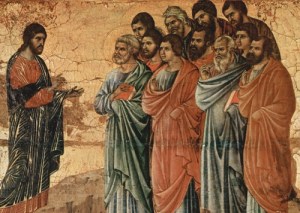 Today’s gospel is the last part of the “Bread of Life Discourse” from the Gospel of John. The disciples who have heard Jesus’ preaching, experienced his healing power, seen him command the stormy seas, witnessed the miracles, and hope him to be the promised Messiah – in today’s account we discover that, for some, Jesus’ claim that he is the “bread come down from heaven is a breaking point. “This saying is hard; who can accept it?…As a result of this, many of his disciples returned to their former way of life and no longer accompanied him.” For some it was all a bridge too far, the last straw, and with no reason to stay, they left. For some, there was motivation, desire, a reason to remain. I think we have all been there at some point in our lives. What is the difference between those who stay and those who go?
 It is with profound sadness that all of us in the parish encountered the news released in the Pennsylvania Grand Jury report on sexual abuse with the diocese of their state. The opening words of the Washington Post report are as stark and horrific as possible: “More than 300 Catholic priests across Pennsylvania sexually abused children over seven decades, protected by a hierarchy of church leaders who covered it up, according to a sweeping grand jury report.” I am reminded of the words of
  I am sometimes given to modifying a homily after having already given it during Mass. Sometimes the genesis is a connected thought, sometimes a comment from a parishioner, and sometimes it is just the Holy Spirit… Here was one of today’s diversions from the original homily –
  “Come away by yourselves to a deserted place and rest a while.”
 The year was 1968. It was the year we first orbited the moon, the 747 jet liner made its commercial debut, the average rent for a three-bedroom house was $130/month, milk was $0.34/gallon, Dr. Martin Luther King, Jr and Robert Kennedy were assassinated, Intel corporation was founded, the Beatles released the White Album, zip lock bags were first sold, and the infamous Big Mac debuted at the golden arches for a whopping $0.49.
 Part of our task as faithful Christians and citizens of the world is to engage the deep and probing questions that the great thinkers, wisdom figures, and commentators raise. Perhaps no question is more penetrating, more challenging, and more important than that offered by the amateur philosopher, Tina Turner: “What’s love got to do, got to do with it? What’s love but a second-hand emotion?” It is the question for the ages.
 friarmusings