 These days there is no shortage of devices to take photographs and videos. If you have a camera, you have a digital record. It is kinda’ nice that it is so easy to build an album of memories: a newborn, the baptism, the first bicycle ride without training wheels, pictures of the school years, shots of dropping that young adult at college, the wedding, and the pictures of the newborn. At every stage there you can watch the person become the person – part from their parents, part from their own independent life. It is a record of the many mantles being passed on as the child takes on the mantle of adult.
A mantle – a loose sleeveless garment worn over other clothes, or so says the dictionary. Figuratively, the cloak symbolizes preeminence or authority, as in accepting the mantle of leadership or responsibility. When Elijah went over to him and threw his cloak over him. Elisha left the oxen, ran after Elijah” we see the beginning of a period of preparation for Elisha’s eventual taking on the full mantle of the prophet, the servant of the Word of God. (2 Kings 2) It makes for quite the picture.
Somewhere in your collection of pictures, I bet there is one of you and your baptismal gown. I love that part of the baptismal liturgy that comes after the pouring of the baptismal waters: You have put on Christ; in Him you have been baptized. See in this white garment, the outward sign of the inner dignity given you. And with the help of family and friends, may you bring that dignity unstained in to everlasting life. It is an Elijah-Elisha moment: the mantle begins to be passed from parent-to-child. The child will follow the parent as they grow. The parent has that mantle to teach, form, mold, and shape the person the child will be. It is a great responsibility, a wondrous undertaking. It is a mantle we all wear in one way or another as we prepare ourselves and the generation that follows.
There are many “mantles.” How is it that we wear that mantle of our faith in our homes, families, places of work, or parish? Perhaps we wear it loosely, and without a great deal of thought, except during the time we spend at church on Sunday. Maybe we wear it boldly…. but comes the time when that mantle of responsibility begins to weigh upon us, then we feel its constraints, its burden, and its demands. Perhaps in that moment we lay it to one side for a moment. It might be the briefest of times when the words around us are cruel, racists, judgmental, or other-than-what-we-deeply-believe. In our silence when we don’t want to rock the boat, upset someone, or bear the brunt of the next wave of prejudicial utterances. It is then that mantle is worn loosely to the point of falling aside.
In our baptism and profession of faith, have been given a responsibility to speak as though a prophet – like Elijah, like St. Paul, like so many before us
- to speak truth to power,
- to speak hope into a situation of despair,
- to be joyful among the world’s tears, or
- to reach out to embrace those in the world deemed un-huggable.
And, yes, there are times when those prophetic moments are the cross when are called to pick up. Just last week, we heard Jesus say: “If anyone wishes to come after me, he must deny himself and take up his cross daily and follow me.” Not just pick it up and endure it, but “follow.”
Sometimes the call comes to us as it did to St. Paul – uninvited, yet compelling. Sometimes, in our enthusiasm, we proclaim: “I will follow you wherever you go.” Sometimes that is what we want to be able to say to Jesus… and yet we are challenged to be honest with ourselves: are there limits to what we will do in following Jesus? Perhaps our answer is “Yes, Lord…. But here’s the thing… once I get my career on track, my family established, my education complete…” And the thing is that we don’t even know what God would ask of us. Maybe it is to get a career on track in order to be witness in the world of business. Or be married and instill within the family deep true Christian values that can withstand the witness of secular values.
The call begins in the waters of baptism with the mantle of faith laid on our shoulders. Here these many years later, it is good to take off our mantle and take a closer look at it. I can pause to consider the mantles of my baptism, my Franciscan vows, my priestly life, the mantle of my role in by family – and so many more. They all combine into one.
But at the core, the question remains, “Is it the mantle of our baptism in Christ?” Or is it a multi-colored cloak in which we have a little of this, a little of that, having pieced together “what works for me.” Having pieced together, what does not take away my options, my choices, my freedom. Isn’t that what St Paul says? We are “called for freedom” …and then interestingly he does not give us list of choices. He describes the freedom of Christ as service to one another through love. “For the whole law is fulfilled in one statement, namely, ‘You shall love your neighbor as yourself.’”
Anslem of Canterbury, some 1000 years ago, wrote that if our idea of freedom is as a matter of choice, however true, it is an impoverished understanding of freedom. To be free is to have no barriers, no obstacles, nothing that burdens you in your journey to God. To be free is to arrive before God and to realize, you have no choice at all. There is only love.
And maybe that is the intense urgency in Jesus’ command to “Follow me” – every delay or side trip – in their own way – is love delayed. “Yes Lord, I will follow…but here’s the thing… once I get this other task started/completed/whatever – then I will more fully love you.”
We are called to follow. We have no idea about the journey to which we are called. But we do know that despite its ups and downs, it will be a journey of love. And so we take up the mantle and we follow the Christ.
It is a mantle of love – it is the white garment that is but the outward sign of the great dignity given us. May we bring that dignity unstained into ever-lasting life. Now won’t that be a picture for the album of our lives?

 Re-posted from last year….
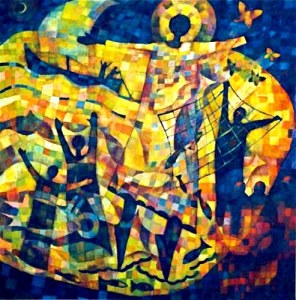 “I have come to set the earth on fire, and how I wish it were already blazing!” It probably seems that way in California this year. There have been 3,624 wildfires so far this year in that state. The Soberanes Fire in Monterey County is only 50% contained and has already consumed almost 70,000 acres, killed one person, and destroyed 57 homes. Jesus’ words are far too present and real.
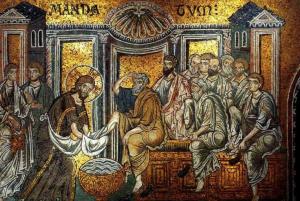 “By faith…” Abraham went out from a land not his own to a place he and Sarah were to inherit. And in that long journey they continued to move forward, against all odds and sense, but always in faith. That journey was not only of faith, but also of service. Three weeks ago our first reading was an example of how Abraham and Sarah welcomed three travelers with hospitality – and this but adds to the accounts of Abraham’s service – to his family and clan, to Lot and his family, to the King of Salem, and so many others. The story of Abraham’s life is a story told in the outlines of faith and in the outlines of service as discipleship.
  I am away from the parish doing an appeal for
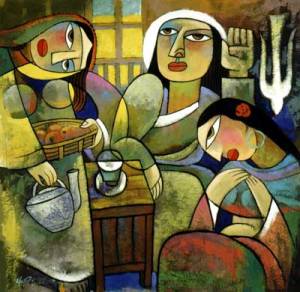 Let me confess to you: I have never much liked the story of Martha and Mary. Maybe it is because there is a part of me that likes “to do,” to see measurable progress, and know we are moving ahead. Don’t get me wrong, I treasure my quite time, but… Most of my life I have heard that the point of this story was that Mary’s attention to Jesus’ teaching is better and more important that what Martha is doing – the work of hospitality. The women in Kenya heard it that way and it rubbed them the wrong way. They quickly pointed out the biblical importance of their work: “Do not neglect hospitality, for through it some have unknowingly entertained angels.” (Hebrews 13:2) They also could have just stayed here in the Gospel of Luke were hospitality is evangelical. In the end, these women felt that they story undervalues or dismissed their efforts to be welcoming, hospitable and to serve.
 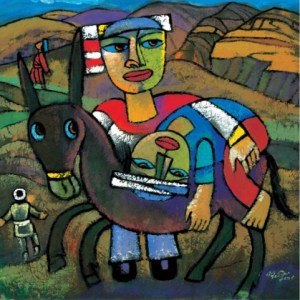 “Go and do likewise.” This seems like a pretty clear command from Jesus. You just heard the parable of the Good Samaritan, so what is it that you are to go and do likewise? Clearly the context for the parable is Jesus’ effort to tease out the scholar of the law what it means to love God and to love one’s neighbor – that’s the theory of it, but what are practical elements of the divine command? The scholar of the law never gets to that “because he wished to justify himself.” He asks Jesus, “And who is my neighbor?” And that is where the proverbial rubber hits the road. Even if the scholar figures out who his neighbor is, there are the practical matters of “doing.” Jesus words punctuate the ending: “Go and do likewise.”
 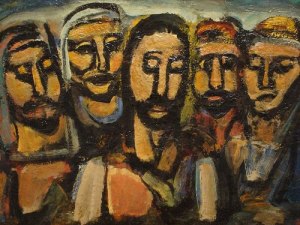 “The Lord appointed seventy-two others whom he sent ahead of him in pairs to every town and place he himself to visit.” –Luke 10:1
 It is June in Florida and we have begun our annual vigil to see if our luck holds and again we will dodge a hurricane. Hurricanes are an expected natural disaster endemic to our State. Sadly, perhaps we also have reached a point where we wait for the next unnatural disaster; the next Nickel Mine School, Columbine, Aurora, San Bernardino, Sandy Hook/Newtown, Virginia Tech, Umpqua Community, Boston, Ft. Hood, Navy Yard Washington DC, or Orlando.
  friarmusings