Mindfulness

The angled image of Hurricane Charley was take...Blessed are those servants whom the master finds vigilant on his arrival.” (Luke 12:37).

The underlying Greek word “vigilant” is also used in the parable of the “Wise and Foolish Virgins” who fall asleep when the bridegroom is coming.  It is the same root word used when Jesus admonishes the apostles sleeping the in Garden of Gethsemane.  These and other passages always bring out the worry wart in me.  People, good people, at the gate to the wedding banquet, present with the Lord while he prays – and they are asleep, not paying attention, or distracted. What about me? Am I wasting time, working on the wrong things? Am I asleep at the switch, or unprepared and without a clue? Am I vigilant about my faith? Hmm…, am I vigilant about my faith? Continue reading

Buidling New Barns

Thoughts on Luke 12:31-21, the 18th Sunday of Ordinary Time


Inheritance and riches being stored up – certainly two strong images from this Sunday’s gospel. Themes not uncommon in the gospels. St. Luke also tells the story of the man who comes to Jesus and asks, “Good teacher, what must I do to inherit eternal life?”  After learning from the man that he had followed all the commandments Jesus tells him, “There is still one thing left for you: sell all that you have and distribute it to the poor, and you will have a treasure in heaven. (Luke 18) It is a recurring message from Jesus that wealth, riches – in themselves not bad – just have a way of getting in the way of the true inheritance. The man goes away sad – he just can’t let go of his wealth, can’t let go of the one thing that keeps him from following Jesus. He is likely a good person – both in his own mind and in the thoughts of others – yet there is a hidden, unseen greed operative in his life. A covert greed that has become, as St. Paul says, an idolatry keeping him away from true and right worship. Continue reading

The choices we make

all-kinds-doorsThere was a time in the history of the Franciscans where we were a raucous, contentious, squabbling bunch – each group claimed to know St. Francis’ real intention about the way to follow Christ. The minister general of the day, St. Bonaventure, gathered the friars together- and like Moses, gave a sermon that was not too mysterious or too arcane. In a way, he simply told them that to truly follow the intention of St. Francis they had to choose. Choose what each friar would become as a result of their choices and, just as important, consider what the world becomes because of their choices. They were becoming a religious order noted for internal to fighting.  And because of it, the world was become darker because of their example of following Christ. Continue reading

Dr. Sheldon Cooper, Mystery of a Kiss, and the Eucharist

Sheldon CopperIn seminary, one of my theology professors (not Dr. Sheldon Cooper – although that would have been interesting….) offered that the Johannine “And the Word became flesh” becomes the starting point of most Christological heresy if one attempts to explain “how.”  Eventually the limitations of language and human fumbling will eventually lead to the heterodox expression of faith. Continue reading

Holy Trinity Sunday – why we celebrate

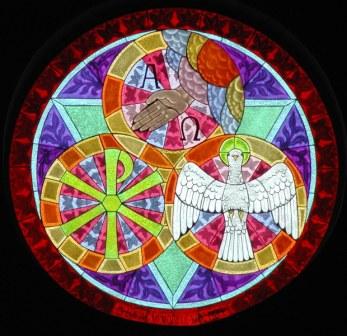
HolyTrinityWindowWe have all kinds of solemnities, feast days, and other special days in the church year. We commemorate happenings in the life of Christ: Mary’s visit from Gabriel announcing the miraculous child she was to bear into the world. We celebrate the arrival of the Three Kings, the Baptism of our Lord, the Transfiguration when the glory of Christ is revealed, and on Palm Sunday, we celebrate Jesus riding triumphant into Jerusalem amidst palms and cheers. We celebrate the empty tomb and Resurrection of Easter, the glorious Ascension, the explosive coming of God’s spirit to the church at Pentecost … and then we have Holy Trinity Sunday.  And suddenly it is like we have moved from these great events in the life of Christ, and now…. tadah!!  We are celebrating a …..a….. a church doctrine. Continue reading

…each in his own language

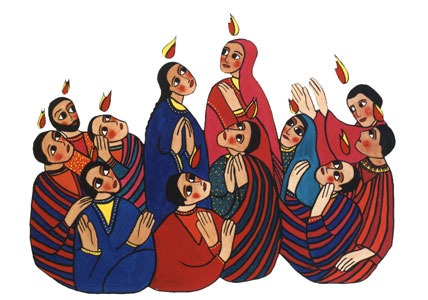
Pentecost3The description of the first Pentecost in the Acts of the Apostles tells us that when devout Jews from many different nations heard the Spirit-inspired proclamation of the gospel by the disciples, “each one heard them speaking in his own language.”  The outpouring of the Spirit of God united this very diverse group of people in a powerful moment of God’s self-revelation.  Such is the power of Spirit.

Continue reading

The dangerous memory

dangerous_memoryI have been musing about memory this week because I had a wonderful two days in Atlanta with my dad’s side of the family – all the cousins and their children.  It was all a walk down memory lane especially with my cousin Frank.  Although at times I wondered if we walked the same lane – but then he has had the advantage of all the things that can trigger memory:  people, places, sights, sounds, smells, and all the rest. It did seem that the longer I was around the family, the more I recalled, and made more memory connections. More and more, a whole range of memories came to ready recall – out of storage somewhere in the misty past of memory. Continue reading

The Son of Man glorified…

The Gospel for the Fifth Week of Easter: John 13:31-35

31 When [Judas] had left, Jesus said, “Now is the Son of Man glorified, and God is glorified in him. 32 (If God is glorified in him,) God will also glorify him in himself, and he will glorify him at once. 33 My children, I will be with you only a little while longer. You will look for me, and as I told the Jews, ‘Where I go you cannot come,’ so now I say it to you. 34 I give you a new commandment: love one another. As I have loved you, so you also should love one another. 35 This is how all will know that you are my disciples, if you have love for one another.”

Introduction

Perhaps we should place this short gospel passage in context. The public ministry of Jesus has drawn to a close with Chapter 12.  Here in Chapter 13 begins the “private ministry” of Jesus preparing his disciples for his impending death.  John 13:1-17:26 is characterized by Jesus’ being alone with his disciples before his betrayal and arrest. While there may have been others present, such as those who were serving the meal, the focus is on the Twelve (so also Mt 26:20; Mk 14:17;  Lk 22:14). The section begins with an account of Jesus washing the disciples’ feet and the prediction of Judas’ betrayal (13:1-30). Then there is a lengthy section known as the farewell discourse, which consists of teachings (13:31–16:33) and a concluding prayer by Jesus (17:1-26). Continue reading

On being spiritual but not religious….

From Rabbi David Wolpe (Time.com, March 21)

“Spirituality is an emotion. Religion is an obligation. Spirituality soothes. Religion mobilizes. Spirituality is satisfied with itself. Religion is dissatisfied with the world. Religions create aid organizations….[T]he largest U.S.-based international relief and development organization…is World Vision, a Seattle-based Christian group.”

Certainly, not the last word on the topic, but certainly something to think about…