What the heck – part 2

In yesterday’s post, we recounted the story of the Queen of Judah, Athaliah, and the murderous manner is which she captured the Throne of King David. She reigned for seven years and profaned the Temple with worship of other gods. Eventually her grandson Joash (or Jehoash), the only one to escape her murderous escapades, emerged from hiding and became, at age 7, the light of rebellion and restoration of right worship in the Temple. Continue reading

Apostle of the Blessed Sacrament

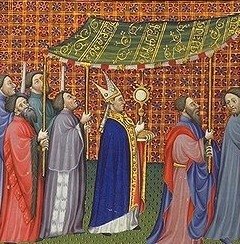
This weekend the Church celebrates the Solemnity of the Body and Blood of Christ, a feast perhaps better known by the Latin Corpus Christi. At its core, the solemnity is a celebration of the Tradition and belief in the Eucharist as the Real Presence of the Body and Blood of Jesus Christ. Many folks wonder why this celebration is not part of Holy Thursday, and it was, mixed in with other themes, e.g., institution of the priesthood. And, all this occurs in the shadow of Good Friday. The placement of the celebration was not one that necessarily lends itself to a joyful celebration. Continue reading

The Will of God

When you consider the “Our Father” (or “the Lord’s Prayer” if you prefer), is there a particular part that stands out for you? I have never asked the question of people and parishioners, but based on other conversations, I suspect that “Forgive us our trespasses as we forgive others…” is a passage that particularly stands out. It reminds us of what grace and mercy we have received and the too-many-times we fail to be as merciful to others. Continue reading

What the heck?

The first reading for today is from the 2nd Book of Kings. I think “what the heck….” is a good first response once you have completed your read. I wonder if I commissioned a poll in which the average person on the street heard the reading and then asked its source, given two choices, which they’d pick? My poll would offer (a) Games of Thrones and (b) The Book of Kings. I am guessing Games of Thrones would win because only the hard core fans remember the names and most people would wonder if the Book of Kings was a real thing…. I mean the names did not sound as though from the English monarchy. Continue reading

Feeding the people

This coming Sunday the Church celebrates The Solemnity of Corpus Christi. In yesterday’s post we find the apostles hesitating and falling back on the ways of the world when faced with the enormity of feeding more than 5,000 people.

The feeding of the five thousand had a meaning for the early church in the responsibility of the leaders to feed the flock, particularly with preaching and the Eucharist. This is the one miracle, apart from the resurrection, recounted in all four Gospels. Luke shares the story with the other gospel writers, but does not include Mark’s mention of the compassion of Jesus for the people or the messianic allusion (Mark 6:34). However, the abundance of good stands as a two-fold lesson to the Twelve: abundance is found not in the power to purchase with money, but in the power of the Lord; and, those who give receive back even more extravagantly. Both lessons reinforce what they have learned on their own journey. Continue reading

Our heroes

Today’s first reading is from the Wisdom of Ben Sira also known as Ecclesiasticus, a book that is part of the canon of the Old Testament for Catholics and Orthodox, but not for Protestant or Reformed denominations. Why? That’s a topic for another post. The contents of the Wisdom of Ben Sira are of a discursive nature, not easily divided into separate parts, but most scholars agree that Chapters 1–43 deal largely with moral instruction; 44:1–50:24 contain a eulogy of the heroes of Israel – our reading is drawn from this section. There are two appendixes in which the author expresses his gratitude to God (51:1–12), and invites the unschooled to acquire true wisdom (51:13–30). Continue reading

Our faith and the enormity of the problem faced

This coming Sunday the Church celebrates The Solemnity of Corpus Christi. In yesterday’s post we find the apostles hesitating and falling back on the ways of the world. When faced with the enormity of feeding more than 5,000 they fall back on sensible courses of action. 13 He said to them, ‘Give them some food yourselves.’ They replied, ‘Five loaves and two fish are all we have, unless we ourselves go and buy food for all these people.’ Continue reading

The Mantle Passes

In the first reading today we witness the passing of the mantle (אַדֶּרֶת addreth in Hebrew) from Elijah to Elisha. What is a mantle? Although there are variations of the meaning of mantle in the Bible, the main idea is that of a covering such as a cloak or covering as outerwear appearing in the OT (e.g. Joshua 7:21) and NT (e.g. Hebrews 1:12, in the Greek). In biblical times, a mantle was typically a large, loosely fitting garment made of animal skin, probably sheepskin. Several people are mentioned as wearing a mantle, including Job (Job 1:20) and Ezra (Ezra 9:5). The mantle served the practical purpose of keeping people warm and protecting them from the elements. It also served a symbolic purpose, in the case of the prophets, showing they were wrapped in God’s authority – a sign of their calling from God (1 Kings 19:13). Continue reading

A lesson of mission forgotten?

This coming Sunday the Church celebrates The Solemnity of Corpus Christi. In yesterday’s post we catch a glimpse of a moment of respite for the apostles after their mission that gives way to crowds of people

12 As the day was drawing to a close, the Twelve approached him and said, ‘Dismiss the crowd so that they can go to the surrounding villages and farms and find lodging and provisions; for we are in a deserted place here.’ 13 He said to them, ‘Give them some food yourselves.’ They replied, ‘Five loaves and two fish are all we have, unless we ourselves go and buy food for all these people.’ 14 Now the men there numbered about five thousand.

Continue reading

The Whirlwind

Every now and again, someone in the Sacrament of Confession will mention a sin, and comment, “I know it’s wrong, but no one is hurt except me.”

In yesterday’s first reading we heard the first part of the story of King Ahab and Queen Jezebel conspiring to dispossess Naboth the Jezreelite of his vineyard in Jezreel located next to the palace of the King. It is a tale of Shakespearean intrigue, malice, and evil doing. And now for the rest of the story. Continue reading