
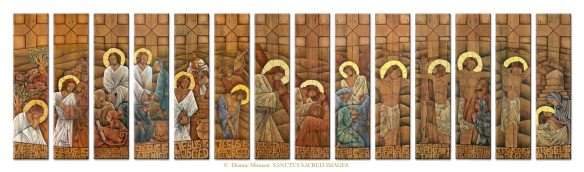
When Holy Land pilgrims returned home, they often brought back a bit of Palestine. In addition to relics, the pilgrims also brought back the desire to re-create scenes from the Holy Land in order to share their experiences with those unable to visit the holy places firsthand. When the Holy Land was closed to western visitors, European replicas of the sacred sites became increasingly popular. Outside of Jerusalem, the tradition of walking the via sacra in commemoration of Christ’s passion, death, and burial with “stations” is mentioned as early as the twelfth century and all of the references point to an outdoor celebration. There was no standard celebration of the via sacra. Depending on the location there were as few as seven and as many as 42 stations. Interestingly, in the beginning, the customary route apparently was the reverse of ours, starting with Calvary and ending at Pilate’s house – and included many other stops that are no longer considered part of the Via Dolorosa (“Sorrowful Way”).
The second test
This coming Sunday is the first Sunday in Lent and the gospel is the temptation/testing of Jesus in the desert. From the mundane of concerns about daily bread, we are taken to the lofty heights.
5 Then he took him up and showed him all the kingdoms of the world in a single instant. 6 The devil said to him, “I shall give to you all this power and their glory; for it has been handed over to me, and I may give it to whomever I wish. 7 All this will be yours, if you worship me.” 8 Jesus said to him in reply, “It is written: ‘You shall worship the Lord, your God, and him alone shall you serve.’”
What’s next in your Lenten journey?
Ash Wednesday has come and gone. I hope you were able to celebrate. Lent has begun and you’ve “40 days” in the journey. So…what’s next? Take some time today and make a plan (if you have not already). Don’t let this time quickly recede in the Lenten “rear view mirror.” If you blink again, it will be Holy Week and the “best of intentions” will have to wait for another year. So… what is your plan for Lent? And I ask about “your plan” because each of us are called to be intentional in our life of prayer and to create a place and space in our life to be in relationship with God. This is especially true in the Season of Lent. Now that Ash Wednesday has passed, what is your Lenten plan to make room in your life to be filled with God’s grace? How about a Lenten checklist to help you get started? Continue reading
The first test
This coming Sunday is the first Sunday in Lent and the gospel is the temptation/testing of Jesus in the desert. Jesus has been fasting for forty days. He is hungry and vulnerable – and in a weakened physical and mental state.
1 Filled with the Holy Spirit, Jesus returned from the Jordan and was led by the Spirit into the desert 2 for forty days, to be tempted by the devil. He ate nothing during those days, and when they were over he was hungry. 3 The devil said to him, “If you are the Son of God, command this stone to become bread.” 4 Jesus answered him, “It is written, ‘One does not live by bread alone.’”
All in the name
In Italian, Lent is quaresima or forty (days). In German, it is Fastenzeit or time for bodily restraint. Our English word comes from an older Anglo-Saxon word for spring—len(c)ten—whence our Lent. Italian tells us how long it will last (with its symbolic overtones). German tells us what to do in that time. But English tells us what is supposed to happen, that is, we are supposed to experience a springtime of faith, a time of growth and new life.
The background of Jesus’ temptations
This coming Sunday is the first Sunday in Lent and the gospel is the temptation/testing of Jesus in the desert. Before immersing ourselves in the details of the three temptations, perhaps an overview of their OT background would help locate our gospel in context.
The First Temptation (4:3-4): If you are the Son of God, command this stone to become bread. The response is from Deuteronomy 8:3: “It is written, ‘One does not live by bread alone.’” The context in Deuteronomy is that Moses reminds the people of Israel that God tested them in the wilderness by hunger, but he fed them with manna in order to make them understand that one does not live by bread alone. Continue reading
The nature of temptation
This coming Sunday is the first Sunday in Lent and the gospel is the temptation/testing of Jesus in the desert. An earlier post today addressed the background of testing/temptation in a broad Scriptural way. This second post narrows that thread to consider the NT witness to the temptation from the four gospels. As well there is short section on temptation and the human will. Continue reading
More precious than gold
Just last Friday, the first reading was from the Letter of James, in which he admonished the faithful to endure: “Indeed we call blessed those who have persevered” (James 5:11). In yesterday’s first reading we listened to the opening passage from the First Letter of Peter: “although now for a little while you may have to suffer through various trials” (1 Peter 1:6). And today we hear the letter’s continuation. Continue reading
Testing and temptation
This coming Sunday is the first Sunday in Lent and the gospel is the temptation/testing of Jesus in the desert. As often noted, Luke writes with a narrative intent. This is true also for the account of the temptations. Luke 4:1–13 presents a number of key elements linking it to surrounding material, helping to ensure its interpretation as a bridge scene moving Jesus from his reception of the Spirit at his baptism to his public ministry. The most obvious such bridges include references to the other worldly (3:21–22; 4:5), the setting of the wilderness in the vicinity of the Jordan (3:2–3, 4, 21; 4:1, 14), the Holy Spirit (3:22; 4:1, 1, 14, 16), Jesus’ sonship (3:22, 38; 4:3, 9, 41 – If you are the Son of God), the attention to the meaning of Jesus’ mission, and Jesus’ encounter with hostile forces – human and spiritual (4:2–13, 22–30, 33–36). Continue reading
In the wilderness
This coming Sunday is the first Sunday in Lent, Lectionary Cycle C. The season of Lent has its own end and purpose, so we should not expect continuity from the previous week that was part of Ordinary Time. Last Sunday the gospel was part of Lukan “Sermon on the Plain.” Depending on the calendar year and the celebration of Easter we might have an early or late start to Lent. We’ll hear the opening verses of the “Sermon” on the sixth Sunday of Ordinary Time, but it is not unusual to not celebrate the 7th and 8th Sundays which carry lots of the details. This year (2022) we did celebrate those two Sundays. (Note: in 2016 we had a very early Easter and so even the 6th Sunday was not celebrated.) Continue reading