
 Today’s gospel serves as a bridge between the Johannine account of the public ministry of Jesus and beginning of his passion and glorification. The verses close out the section of John’s gospel referred to as the “Book of Signs”
- Changing water into wine at Cana (John 2:1-11)
- Healing the royal official’s son in Capernaum (John 4:46-54)
- Healing the paralytic at Bethesda (John 5:1-15)
- Feeding the 5,000 (John 6:5-14)
- Jesus’ walking on water (John 6:16-24)
- Healing the man blind from birth (John 9:1-7)
- The raising of Lazarus (John 11:1-45)
It also includes the notable “I am” statements: living water, bread of life, Good Shepherd, and more… Continue reading
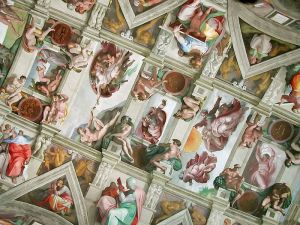 If you have been a visitor to Rome and to the Vatican – no doubt you have been present in the Sistine Chapel. Originally known as the Cappella Magna (‘Great Chapel’), the chapel takes its name from Pope Sixtus IV, who restored it between 1473 and 1481. Since that time, the chapel has served as a place of both religious and functionary papal activity. Today, it is the site of the papal conclave, the process by which a new pope is selected. The fame of the Sistine Chapel lies mainly in the frescos that decorate the interior, most particularly the Sistine Chapel ceiling and The Last Judgment, both by Michelangelo.
 It’s a late December day in Jerusalem. Jesus is walking in the Temple area, and as usual, he’s drawing a crowd during the Feast of the Dedication (better known to us as Hanukkah). The people have come with a question. Perhaps they’ve heard one of Jesus’s enigmatic parables, or witnessed one of his miracles. Or maybe they just want to trap him into saying something they consider blasphemous. Whatever the motive, they ask: “How long will you keep us in suspense? If you are the Christ, tell us plainly.”
 This coming Sunday is the
  After having graduated from the US Naval Academy – the first cauldron of forming leaders for the Navy and Marine Corp – and after finishing nuclear power training and submarine school, I reported as a bright shiny Ensign to my first submarine! I was ready to be a deep-diving, backing down full at crush depth, denizen of the deep – “Run Silent, Run Deep” and “Hunt for Red October” all rolled into one.
 St. Francis of Assisi is the patron saint of Italy, merchants, stowaways, ecology, but most famously, of animals. If one searches the internet, you can easily find all kinds of pious, ecologically insightful, and often amazingly-modern sounding quotes from St. Francis. And they are inevitably without a citation from one of Francis’ writings or at least a later Franciscan source writing about Francis. As I noted in the beginning of this series, Francis has always been reinvented and marketed as needed. Perhaps the one book most responsible for casting Francis as the lover of animals and nature is a collection of stories – many miraculous and all very saintly – that first appeared in 1390 in Tuscany: the Fioretti (The Little Flowers). It should be noted that this is about 160 years after Francis’ death.
 Today’s
 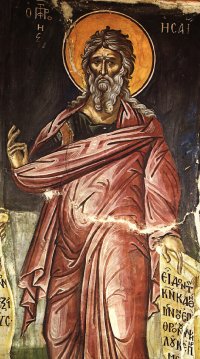 Isaiah, one of the greatest of the prophets, appeared at a critical moment in Israel’s history. To say that his ministry was part of one of the most complicated periods, is an understatement. During his time, the promised land had already split asunder. The people were no longer ruled under Jerusalem and the throne of David. Most of the tribes of Jacob formed the Northern Kingdom (referred to as Israel in this period) with the remaining tribes still loyal to Jerusalem and the throne of David – referred to as Judah.
 friarmusings