
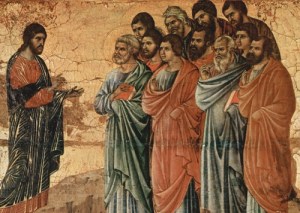
 Next Sunday is the celebration of the 14th Sunday in Ordinary Time. You can read a complete commentary on the Gospel here.
25 At that time Jesus said in reply, “I give praise to you, Father, Lord of heaven and earth, for although you have hidden these things from the wise and the learned you have revealed them to the childlike. 26 Yes, Father, such has been your gracious will. 27 All things have been handed over to me by my Father. No one knows the Son except the Father, and no one knows the Father except the Son and anyone to whom the Son wishes to reveal him. 28 “Come to me, all you who labor and are burdened, and I will give you rest. 29 Take my yoke upon you and learn from me, for I am meek and humble of heart; and you will find rest for your selves. 30 For my yoke is easy, and my burden light.” (Matthew 11:25-30) Continue reading
 The readings from daily Mass this week past should have been labeled “King and Prophet week.” Every day the first readings was a narrative about one of the Kings of Israel or Judah, a summary of their reign, and the proclamation of the prophets which came before them with the living Word of God. Prophets like Amos, Isaiah, and Jeremiah; as well as prophets whose names are unfamiliar to us; and prophets whose names were not recorded in Sacred Scripture. Kings that might not be familiar to you, but are a cast of the Good, the Bad, and the Ugly. Two of the best were part of the narrative: Hezekiah and Josiah – kings held in almost the same esteem as King David – godly men who understood their role as leader – to lead the people of God more deeply into the covenant life and promises of God. Two of the worst were recounted: Hoshea the last of the northern kings and Zedekiah, the last of the Kings of Judah. They ruled with iniquity as had most of their predecessors. When they disappeared into exile, the time of Kings passed and all of Israel and Judah followed int exile, the promised land lost.
  Here is an interesting link to an AP-wire story by Lolita Bador on how the pandemic is affection naval deployments: “The two U.S. warships in the Middle East weren’t aiming to break a record. But when the coronavirus made ship stops in foreign countries too risky, the USS Dwight D. Eisenhower and the USS San Jacinto were ordered to keep moving and avoid all port visits. On Thursday, as they steamed through the North Arabian Sea, they notched their 161st consecutive day at sea, breaking the previous Navy record of 160 days. And they’re on pace to crush it, since they won’t hit land again until they get home to Virginia later this year.” You can find the entire article
  Sunday is a day when it is easy to find a priest if you want to mention, ask, or chat about something. Most topics are simple and straight forward, but once in a while someone asks a question that is very different from the others. It is then that the conversation is too important to have on the sidewalk but is better suited to a moment when time is more available and others are not waiting to chat or to simply offer their greetings.
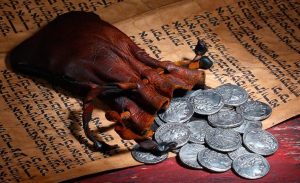 When was the last time you used the word “iniquity?” Admittedly, it is not one of those words that leaps to one’s mind. It sounds somewhat archaic and perhaps reserved to a fire-and-brimstone preacher. Iniquity is not exactly the same as sin. Iniquity describes something as being wicked or immoral in nature or character. It is not an action like sin, but rather the character of the action”. We have a hint of that in the phrase “the iniquity of my sin” (Psalms 32:5). Iniquity can be described as the essence of wrongdoing or evil.
  In
In  For the first 70 days of the pandemic when the area church’s shutdown, my days were long and demanding for a whole variety of reasons. Eventually we hit the steady-state of a new normal. I took a breath and decided to take up reading. I had long had Jared Diamond’s “Collapse” on my “I want to get around to reading” list. The promo for the book is “Environmental damage, climate change, globalization, rapid population growth, and unwise political choices were all factors in the demise of societies around the world, but some found solutions and persisted.” In other words, why did some societies collapse while other survived. It is not a short read, not overly academic, but was an engaging narrative even if “slow” at times.
 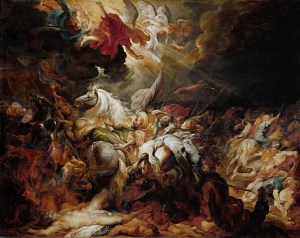 The image is of a painting by Peter Paul Rubens (17th c.), “The Defeat of Sennacherib.” King Sennacherib was the King of Assyria who attempted to conquer Judah and capture Jerusalem in the 7th century BCE. You can read a summary of the encounter with King Hezekiah of Judah in the
 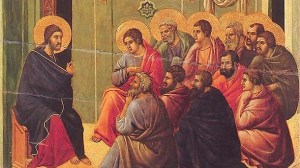 Next Sunday is the celebration of the
  friarmusings