
 24 When the crowd saw that neither Jesus nor his disciples were there, they themselves got into boats and came to Capernaum looking for Jesus. 25 And when they found him across the sea they said to him, “Rabbi, when did you get here?” 26 Jesus answered them and said, “Amen, amen, I say to you, you are looking for me not because you saw signs but because you ate the loaves and were filled. 27 Do not work for food that perishes but for the food that endures for eternal life, which the Son of Man will give you. For on him the Father, God, has set his seal.” 28 So they said to him, “What can we do to accomplish the works of God?” 29 Jesus answered and said to them, “This is the work of God, that you believe in the one he sent.” 30 So they said to him, “What sign can you do, that we may see and believe in you? What can you do? 31 Our ancestors ate manna in the desert, as it is written: ‘He gave them bread from heaven to eat.’” 32 So Jesus said to them, “Amen, amen, I say to you, it was not Moses who gave the bread from heaven; my Father gives you the true bread from heaven. 33 For the bread of God is that which comes down from heaven and gives life to the world.” 34 So they said to him, “Sir, give us this bread always.” 35 Jesus said to them, “I am the bread of life; whoever comes to me will never hunger, and whoever believes in me will never thirst. (John 6:24-35) Continue reading
…that you believe: context
Reply
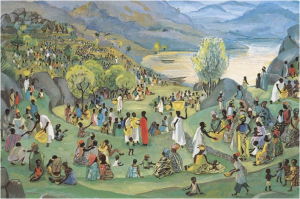 This week the daily gospels from Monday (May 6) through Friday (May 10) are taken from John 6 – the great Eucharistic Discourse. Elsewhere I have posted commentaries on this remarkable chapter and will reprise the posts over the course of the week. There are two contexts for this week’s series of daily Gospels: (1) the miraculous as signs and (2) the people’s reaction to the sign. In other gospels the miraculous feeding presents the sign, here, there is a more expansive explanation of the sign by Jesus. The intent seems focused on explaining the theological and Christological significance of Jesus’ action. All of this is as you might expect for a gospel written some 20-30 years after St. Mark’s narrative.
  This coming Sunday marks the
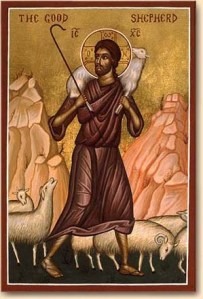
 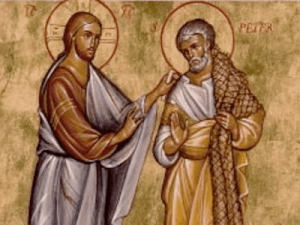 We have a new mayor here in Tampa. Mayor Castor has been in public service for the majority of her adult years, served as Chief of Police and more. There are lots of folks that already knew what kind of leader she will be. Fulfilling positions of leadership is always at the forefront of organizations, politics, and more. It is always a good question for the Church. I have lived during the pontificates of seven popes and in my lifetime we have certainly had a wide variety of types and styles of leaders. In our history, we have had 266 of popes. We have had some spectacularly amazing leaders, saints in the making, and we have had some spectacularly horrific leaders, who would have been quite at home in Game of Thrones (so I hear, I actually haven’t seen it…). All took up the Keys of Peter, with the same job description given Peter: feed my sheep; tend my lambs. The Pope is the most visible of leaders in the Church, but not the only ones with that same job description. The simple mandate, “feed my sheep; tend my lambs” applies to priests, pastors, parents, principals, police, and anyone who would lead – anyone who would answer the call to minister in the Holy Name of Jesus.
  This year is a year of transition for the parish. There are things we do so very well – such as our Lenten, Holy Week, and Easter celebrations. I have been around 12 years now, and these really were the best ever. We have had so many people make a point of sharing how moved they were by the celebrations. One person came up to me after Holy Thursday and simply said, “Wow, wow, wow…” What makes it so moving for people? Everyone is different, but what is constant is the behind the scene work of dedicated people and their ministries: the Décor and Environment Committee, Readers, Eucharistic Ministers, Altar Servers, Ushers, Choir, Faith Formation/RCIA, the Knights, the parish staff, volunteers who pass out palms, greet people and a million other things. So many people are moved by the Eucharistic Procession on Holy Thursday – behind the scene are staff who recruit TPD for traffic safety, who go to the Franklin Street businesses to let them know, who visit the hotels to make sure they know our Holy Week schedule – so many little things – all that make the big thing the amazing thing.
  From time to time some Christians tell other Christians that their baptism was not valid because it was not done by full immersion, the only way Jesus authorized people to be baptized. The claims sometimes go on to claim that “sprinkling” was an invention of the Catholic Church in the 4th century when people began to flood into the church and it was just more efficient that the required full immersion.
  Jesus answered and said to [Nicodemus], “Amen, amen, I say to you, no one can see the kingdom of God without being born from above.” (John 2:3)
 This coming Sunday marks the
 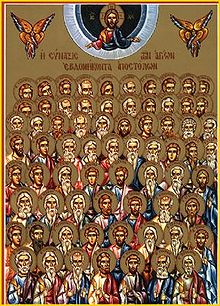 On the evening of that first day of the week, when the doors were locked, where the disciples were, for fear of the Jews, Jesus came and stood in their midst and said to them, “Peace be with you.” (John 20:19)
 As a liturgical season, Lent is rather straightforward. It is kinda’ easy to write about. There is Ash Wednesday to dramatically mark its beginning, and we all know we are moving relentlessly towards Easter. We count the days even as we mark Lent’s beginning. The Ashes make a visible mark upon us, reminding us that we are dust and to dust we shall return – but that is not the end of the story. We are reminded to repent and believe in the Gospel – but that is not the end goal. We are encouraged to pray, fast, and give alms – but those practices are meant to make room in our lives for God that we too may rise to the newness of life at Eastertide.
  friarmusings