 In Luke’ narrative there is no account of the Resurrection; there in only the empty tomb – which is not the source of faith for people in Luke’s rendering of the gospel. Rather, in Luke’s gospel it is the empty tomb and the encounter with the person of the Risen Jesus. The empty tomb is what Jesus had said would happen “on the third day.” The event of its discovery points back to Jesus’ word. A word mostly fully realized later in the ‘breaking of the bread.”
Luke 24:13 Now that very day two of them were going to a village seven miles from Jerusalem called Emmaus,14 and they were conversing about all the things that had occurred.15 And it happened that while they were conversing and debating, Jesus himself drew near and walked with them,16 but their eyes were prevented from recognizing him.17 He asked them, “What are you discussing as you walk along?” They stopped, looking downcast.18 One of them, named Cleopas, said to him in reply, “Are you the only visitor to Jerusalem who does not know of the things that have taken place there in these days?”19 And he replied to them, “What sort of things?” They said to him, “The things that happened to Jesus the Nazarene, who was a prophet mighty in deed and word before God and all the people,20 how our chief priests and rulers both handed him over to a sentence of death and crucified him.21 But we were hoping that he would be the one to redeem Israel; and besides all this, it is now the third day since this took place. Continue reading →

 Forgiveness is one of those fundamental lessons we try to teach our kids from an early age: when siblings bicker or hurt each other, or if friends break a toy. And at the same time, we should ever be aware that we have not exactly mastered the art of forgiveness. The ability to forgive is a learning experience that often takes a lifetime. It’s not easy, but perhaps it’s not meant to be easy. Showing compassion and understanding in a world through which we cautiously pass takes an open heart instead of the guarded one we often carry. Continue reading
  12 Then I turned to see whose voice it was that spoke to me, and when I turned, I saw seven gold lampstands 13 and in the midst of the lampstands one like a son of man, wearing an ankle-length robe, with a gold sash around his chest. (Rev 1:12-13)
 This coming Sunday marks the
  In my
In my 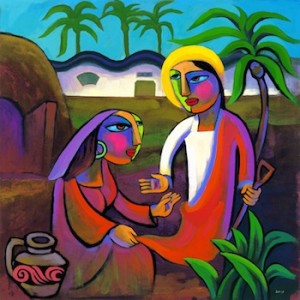 8 Then [Mary Magdalene and the other Mary] went away quickly from the tomb, fearful yet overjoyed, and ran to announce this to his disciples. 9 And behold, Jesus met them on their way and greeted them. They approached, embraced his feet, and did him homage. 10 Then Jesus said to them, “Do not be afraid. Go tell my brothers to go to Galilee, and there they will see me.”
  On the first day of the week, Mary of Magdala came to the tomb early in the morning, while it was still dark, and saw the stone removed from the tomb. So she ran and went to Simon Peter and to the other disciple whom Jesus loved, and told them, “They have taken the Lord from the tomb, and we don’t know where they put him.” So Peter and the other disciple went out and came to the tomb. They both ran, but the other disciple ran faster than Peter and arrived at the tomb first; he bent down and saw the burial cloths there, but did not go in. When Simon Peter arrived after him, he went into the tomb and saw the burial cloths there, and the cloth that had covered his head, not with the burial cloths but rolled up in a separate place. Then the other disciple also went in, the one who had arrived at the tomb first, and he saw and believed. For they did not yet understand the Scripture that he had to rise from the dead. (John 20:1-9)
 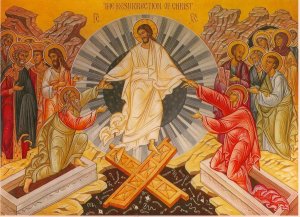 In the Book of Job, chapter 14, Job is pondering the deeper things of life. He is asking the age old question in the face of pending or possible death? Will a person, once dead, live again? (יִ֫חְיֶ֥ה cf. Job 14:14). The question has now been answered. The tomb is empty. The defining conviction of Christian hope is that because Jesus was raised from the dead, the grave is not the final reality of human experience. “Why do you seek the living one among the dead? He is risen.
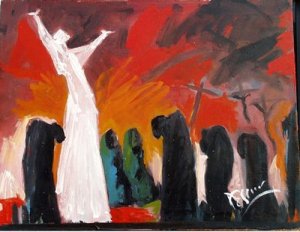 “Death, be not proud, though some have called thee Mighty and dreadful, for thou are not so; For those whom thou think’st thou dost overthrow Die not, poor Death…. One short sleep past, we wake eternally, And death shall be no more, Death, thou shalt die.” So wrote the 17th century poet John Donne about the freedom from the seemingly unsurpassable power of death and the promise of new life, eternal life at the core of our Easter celebrations.
  friarmusings