 This past Saturday morning our children’s sacramental preparation program held a morning retreat for our kids making their first Reconciliation. A part of the morning is called “Friar Time” in which the kids and their parents have a 20-25 minute space of time with the pastor (that’s me…). We use the time to have a final chat about the sacrament and to put them at ease about the upcoming celebration.
During one of the sessions I was asking the kids, “What if, during confession, one of you tells me something that is just ‘eye-opening’ and really unusual… can I tell your parents?” Of course, the point of the question is to assure the kids about the sanctity of the sacrament and the confessional seal. After a short back-and-forth, I mentioned that as a practical matter, priests are really good about not remembering what was said in the confessional. We hear a lot and it all just gets mixed in and lost.
At that point, a beautiful young girl offered, “Well then we need younger priests who can remember things!”
Mom and dad dropped their chins to their chest in the classic “she did not just say that did she” move. Meanwhile, the rest of us broke out laughing.
Where’s Art Linkletter when you need him?
 The New Creation Week. Many scholars have noted that repeats the theme of Creation as he begins the narrative of the Gospel. Where the synoptic gospels focus on the events at the beginning of Jesus’ public life, John seems to assume that the reader is familiar with those accounts and calls our attention to the ways in which people respond in faith to him – yet, at the same time, unlike the other gospel writers, places the beginning events on a timeline. The beginning is the testimony of John the Baptist (v.15) On the “next day” (John 1:29), the Baptist testifies to the more powerful, promised baptism of the Son of God.
 There are lots of different new years to celebrate. The Western world celebrated two weeks ago. The Chinese New Year is Tuesday, February 5. It is the year of the pig in case you are interested. Lots of different dates around the world – and all are based on some different calendar, event and spirituality – and all have very different ways to celebrate.
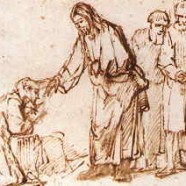 “Lord, if you wish, you can make me clean.” Jesus stretched out his hand, touched him, and said, “I do will it. Be made clean.” (Luke 5:12-13)
 The Theology of History. It is interesting to note that Luke relates no encounter between Jesus and John. In fact, before we are told about Jesus’ baptism, we are informed that John has been put in prison! A traditional way of understanding this order of events is that Luke (the rhetorical historian) divides history into three separate and distinct eras. The first is the time of the prophets, which includes John the Baptist. That era ends with the imprisonment of John. John will no longer be in the picture. After that, the time of Jesus begins with a statement in our text about: (1) the opening of the heaven, (2) the coming down of the Holy Spirit in a visible form (dove); and (3) heavenly speech. This era of Jesus ends with his ascension — related only in Luke & Acts. Jesus will no longer be in the picture. After that, the time of the Holy Spirit (or the Church) begins with a statement in Acts 2:1-4 about (1) something coming “from heaven,” (2) the coming down of the Holy Spirit in a visible form (tongues of fire), and (3) heavenly speech.

