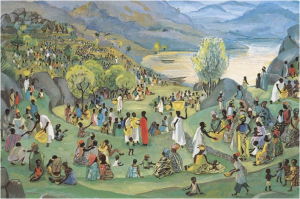
 It is a well know gospel – the miraculous feeding of the multitudes. St. John estimates the size of the crow as 5,000 counting only the men. The location of the event is somewhere on the shore of the Sea of Galilee on a “mountain” but then the same word can be used for “hillside.” The Christian community still remembered the location and shared it with the 4th century pilgrims. Today, there is the Church of the Multiplications on the traditional site that is maintained and served by Benedictine Monks. It is a site near Capernaum on the north side of the Sea of Galilee (St. Luke says it was in Bethsaida Julias, not too far away where the northern branch of the Jordan enters the Sea).
I recently visited the Church of the Multiplications and would note that it is about 2 miles from Capernaum to the northeast along the lake and about 2 miles from Bethsaida (not Julias) to the southwest also along the lake. I mention this in passing to note that villages were nearby – not that 5,000 people were going to head to the local market for dinner, but so often people imagine this place as a remote wilderness. But is actually quite verdant, on the lake, and with villages nearby.
When I was at the holy site, I was moved to remember a homily from some 30 years ago. The priest proclaimed that there was no miracle as we would understand it, but that the “real miracle” was that the people were inspired by the willingness of the young boy to give up the food that he had brought with him. His example, moved them to open up their satchels and share their food, ensuring everyone was well fed and there were still 12 wicker baskets of left overs. I am sure the priest meant well, was emphasizing the ecclesiological (“things church”) nature of Church as community, and was calling our local community to share with those in need. All well and truly good, but…. no miracle?
Did you known that this miracle is the only one that is included in all four canonical gospels? (Matthew 14:13-21; Mark 6:31-44; Luke 9:12-17; John 6:1-14). So, yes, the Church is communal in essence – just check out the Acts of the Apostle. Yes, the OT and NT alike call upon us to share with the poor (the orphan, the widow, the alien and the stranger among us). But Scripture says it was a miracle, every Gospel writer includes it in their accounts, so count me in the “it was a miracle” camp. Can I get an “Amen?”
But then there is something about the young man – and his willingness to share.
There is a story told in Kenya about an mchoro (literally a trash person). This old man slept on the streets and scavenged among the trash heaps and dumps to eek out an existence. Then he would sit with his begging bowl on the streets of Nairobi, dodging the police, and depending on the kindness of strangers.
The word on the street was that the Supreme Chief of his tribe was coming and would pass by his “usual spot” on one of the avenues. The old man knew of the compassion and generosity of the Chief and so ready with his “speech.” The day grew longer, the sun baked the city, and it was not until late in the day that the chief and his entourage passed by.
The old man gave the prepared speech and asked for help. Instead, the chief, extended his hand and asked the old man to give him something. The old man was surprised, stunned, but the chief is the chief, and when the chief asks…. And so, reluctantly, he reached into his satchel and gave the chief three Kenyan samosas he had received from a stranger. These were half of what would have been his dinner that night. “Asanti sana” (thank you) said the chief and went on his way.
Downcast and forlorn, the man returned to his usual sleeping place on the street. He was hungry, it was late, and time to eat the remaining three samosas. When he reached in, his hand found a samosa – at least shaped like one – only it was hard like a rock. He pulled it out. It was a rock of gold! He put his back in twice more – and retrieved two other rocks of gold.
Then the truth of the matter came to his mind. The three samosas given to the chief had returned to him three rocks of gold. “What a fool I’ve been,” he exclaimed regretfully. “If only I had known. I would have given him everything.”
Some 2,000 years ago, there was a young boy who generously gave everything – and from that gift, however small, Jesus worked a miracle that fed the 5,000. Some 2,000 years ago, I wonder if there were 4,999 who thought to themselves, “What a fool I’ve been. If only I had known. I would have given him everything.”
It’s 2,000 years later. We are a Eucharist people, called to live the words of St. Francis of Assisi: “Therefore hold back nothing of yourselves for yourselves, so that He who gives himself totally to you may receive you totally.”
And in doing so, Christ will work miracles through your gifts.
Amen

 For What Are You Working? 27 Do not work for food that perishes but for the food that endures for eternal life, which the Son of Man will give you. For on him the Father, God, has set his seal.” 28 So they said to him, “What can we do to accomplish the works of God?” 29 Jesus answered and said to them, “This is the work of God, that you believe in the one he sent.”
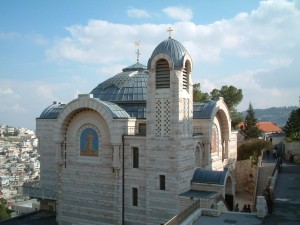 Last weekend was the first since my return from a pilgrimage to Israel. In addition to the “welcome back” greetings, there were lots of questions in the category of “what was it like?” That encompasses questions of weather, geography, culture, cuisine, accommodations, crowds, places, history, and a myriad of other inquiries. Perhaps the inquiry that was most common was something akin to, “What did you find most surprising?” And there are several responses to that question. But let me share one with you.
  In medieval Europe, a bell rang every evening at a fixed hour, and townspeople were required by law to cover or extinguish their hearth fires. It was the “cover fire” bell, or, as it was referred to in Anglo-French, coverfeu (from the French verb meaning “to cover,” and the word for “fire”). By the time the English version, curfew, appeared, the authorities no longer regulated hearth fires, but an evening bell continued to be rung for various purposes—whether to signal the close of day, an evening burial, or enforcement of some other evening regulation. This “bell ringing at evening” became the first English sense of curfew. Not infrequently, the regulation signaled by the curfew involved regulating people’s movement in the streets, and this led to the modern senses of the word.
 friarmusings