 Matthew 21:33–43 33 “Hear another parable. There was a landowner who planted a vineyard, put a hedge around it, dug a wine press in it, and built a tower. Then he leased it to tenants and went on a journey. 34 When vintage time drew near, he sent his servants to the tenants to obtain his produce. 35 But the tenants seized the servants and one they beat, another they killed, and a third they stoned. 36 Again he sent other servants, more numerous than the first ones, but they treated them in the same way. 37 Finally, he sent his son to them, thinking, ‘They will respect my son.’ 38 But when the tenants saw the son, they said to one another, ‘This is the heir. Come, let us kill him and acquire his inheritance.’ 39 They seized him, threw him out of the vineyard, and killed him. 40 What will the owner of the vineyard do to those tenants when he comes?” 41 They answered him, “He will put those wretched men to a wretched death and lease his vineyard to other tenants who will give him the produce at the proper times.” 42 Jesus said to them, “Did you never read in the scriptures: ‘The stone that the builders rejected has become the cornerstone; by the Lord has this been done, and it is wonderful in our eyes’? 43 Therefore, I say to you, the kingdom of God will be taken away from you and given to a people that will produce its fruit. Continue reading →

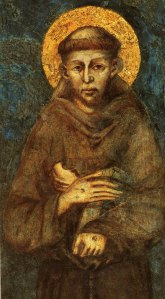 As we enter into the celebration of the Transitus and the Feast of St. Francis of Assisi, I thought it good to point the interested reader to a “page” of posts about St. Francis that were part of a series I did several years ago. You can find the complete list here.
 In Bible Study, we are blessed to have a participant who teaches biblical Hebrew at the college and graduate level. She always brings interesting insights into the origin of Hebrew words and expressions. For example, there a root word in Hebrew that is used to form the words for “neighbor”, “friend,” and “enemy.” Suddenly the expression, “Hold your friends close and your enemies closer” has a bit more depth – and in either case, they are neighbors. So, when Jesus responds to the questions, “…and who is my neighbor?” Then the we see the challenge – to cross over to embrace the other. That challenge is even in the very word “Hebrew” which comes from the Semitic word “a’piru” – those who cross over.
  Their Answer. The question that Jesus posed is now filled out: the chief priests and elders are required to adjudicate between the two brothers. For “doing the will of” God distinguishes mere profession from active compliance, and so here it suitably distinguishes between the attitudes of the two sons. Jesus’ question thus allows only one reasonable answer, which the Jewish leaders duly provide, but, like David in his response to Nathan’s parable (2 Sam 12:5–7), in so doing they provide Jesus with the ammunition he needs to mount an attack in v. 32 on their own inconsistency. First, however, he spells out its consequences.
  I like writing – even if it is a struggle at times. There is something—I don’t know— compelling about it when the germ of a thought begins to take shape and forms itself into a more complete thought. The preparation of a homily is often like that. You sit with the readings for the coming Sunday and let one or more points rise to the surface. Some ideas will be interesting, some will make the list for some future weekend, and every once in a while, the idea is just self-evident. The homily has a beginning, a pointed end, and a clear pathway to get from one to the other. In those moments, it just seems to flow.
  friarmusings