
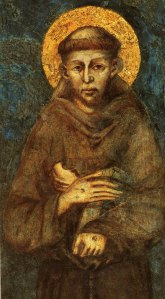
 St. Francis of Assisi is the patron saint of Italy, merchants, stowaways, ecology, but most famously, of animals. If one searches the internet, you can easily find all kinds of pious, ecologically insightful, and often amazingly-modern sounding quotes from St. Francis. And they are inevitably without a citation from one of Francis’ writings or at least a later Franciscan source writing about Francis. As I noted in the beginning of this series, Francis has always been reinvented and marketed as needed. Perhaps the one book most responsible for casting Francis as the lover of animals and nature is a collection of stories – many miraculous and all very saintly – that first appeared in 1390 in Tuscany: the Fioretti (The Little Flowers). It should be noted that this is about 160 years after Francis’ death.
But can we say about St. Francis, the patron saint of animals? Continue reading

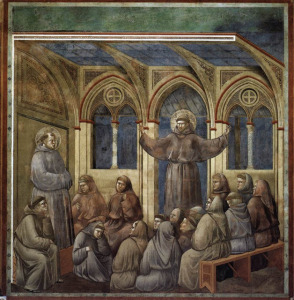
 As we noted in last week’s article, Francis expected his brothers to learn by imitation – and to understand that as Francis sought to imitate Christ, so too should the brothers. But in reality, the first generation of Assisi-area brothers simply did what Francis did: daily prayer, work at a local leprosarium, go to local churches to participate in Eucharist, eat, pray again, witness to the local Umbrian people near Assisi, and live a life in community. You have to remember this was all new. Prior to this “Franciscan moment” the spiritual journey of medieval people consisted of being a monk or cloistered nun behind the walls of the monastery, being a priest and living close to the sacraments and the Scriptures, or being a lay person and hoping the other groups were praying for you. And then along comes this different, new, intriguing way of being spiritual in the world. And it was not set down in writing; it did not come with instructions. But sometimes is borrowed from the past.
  One aspect of Francis’ changing life that has attracted recent attention is the movement of Francis from solitary figure, living a quasi-hermetical life for four to five years, now beginning to live in a growing community of brothers – all of whom are looking to Francis for spiritual and communal leadership. There was something attractive about Francis, his way of following the gospel, and perhaps the recent “commissioning” by Pope Innocent III gave a certain cache of legitimacy to this way of being Christian in the world. Eventually many people came to join the Franciscan movement, which soon enough became a religio and eventually an ordo, but those demarcations are eight to ten years in the future ahead of the Spring of 1209.
 It is later in the autumn of 1206 that with his decision to “leave the world” Francis began to be aware of the powerful Divine Presence in his life through, his work among the lepers near Assisi, and his habit of taking refuge in churches for prayer and rebuilding the structures. At San Damiano he encountered the consoling presence of the Savior who had suffered and died for him. It was a presence he soon came to recognize in other churches: “And the Lord granted me such faith in churches that I would pray simply and say: We adore you, Lord Jesus Christ, in all your churches throughout the world, and we bless you, because by your Holy Cross, you have redeemed the world.” (Testament 4-7). Francis was at the beginnings of an inner peace.
 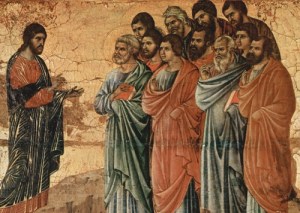 The reading from today’s gospel (with a few extra verses) and St. Francis of Assisi’s answer to the question.
 friarmusings