
In 1 Kings 19 we have Elijah the prophet on the run from the wrath of Queen Jezebel who has sent an army to track down and kill Elijah. He is hiding in cave wondering where is God in all this
Then the LORD said: Go out and stand on the mountain before the LORD; the LORD will pass by. There was a strong and violent wind rending the mountains and crushing rocks before the LORD—but the LORD was not in the wind; after the wind, an earthquake—but the LORD was not in the earthquake; after the earthquake, fire—but the LORD was not in the fire; after the fire, a light silent sound.” (1 Kings 19;11-12)
That is the New American Bible (NAB) translation. The other translations are quite similar, but the very last phrase has a lot of subtle variations: “a still small voice”, “a low whisper” and others. The Hebrew word used demā·mā primarily means “a hush” or “a whisper.”
That comes to mind in today’s first reading from Isaiah: “While from behind, a voice shall sound in your ears: ‘This is the way; walk in it,’ when you would turn to the right or to the left.”
May we always and ever be open to that still small voice that speaks to us to keep us on the path of righteousness.
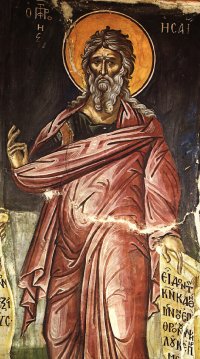 Isaiah, one of the greatest of the prophets, appeared at a critical moment in Israel’s history. To say that his ministry was part of one of the most complicated periods, is an understatement. During his time, the promised land had already split asunder. The people were no longer ruled under Jerusalem and the throne of David. Most of the tribes of Jacob formed the Northern Kingdom (referred to as Israel in this period) with the remaining tribes still loyal to Jerusalem and the throne of David – referred to as Judah.
 This 15th Week of Ordinary Time (2020) the first readings in the daily Masses are from the Book of the Prophet Isaiah. With other prophetic works, to talk about the writings are to talk about the prophet themselves. Isaiah calls for more nuance in that the prophet was a person of the 8th century BCE who preached to Judah (the southern kingdom) and its capital Jerusalem. It was during a particularly turbulent era of three Judaean kings and four Assyrian kings. The later who sought to overrun the western Fertile Crescent that also included the Kingdoms of Israel (north) and Judea (south). Isaiah provides more than enough “markers” for us to know with certainty that he exercised his prophetic ministry from 740-701 BCE.
 Over the Christmas season, the gospels we proclaim are so familiar, so memorable, that perhaps we a prone to listen to the other readings as but prelude to the story of the Christ Child. Prelude they are indeed, but they in themselves are also the powerful Word of God come to us. Perhaps none more powerful than the Prophet Isaiah or St. Paul. This week we hear Isaiah mightily proclaim: “I, the LORD, have called you for the victory of justice, I have grasped you by the hand; I formed you, and set you as a covenant of the people.” (Is 42:6) While they are indeed prophecy pointing to Jesus and his mission, they are also words proclaimed to us, to the baptized, those thus commissioned and sent into the world for the victory of justice.
 We are challenged – or we should be – when the prophet Isaiah tells us: “It is too little, the LORD says, for you to be my servant…. I will make you a light to the nations, that my salvation may reach to the ends of the earth.” A servant can be present, silently present, taking it all in, but never part of the conversation. Yes, we are called to be servants, but we are also called to be more. Called to moments in our lives, when the virtues already shine through, but we also called to testify. Called to testify as did John the Baptist, “Now I have seen and testified that he is the Son of God.” And not in whispered voices, but loud and proud in the public square. We are called to testify!!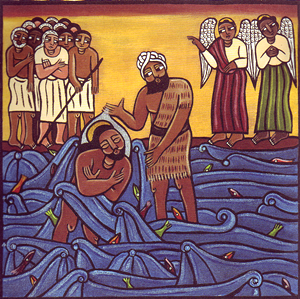

 friarmusings