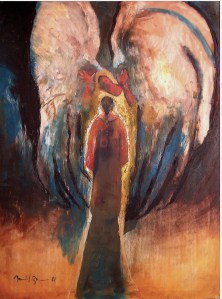
 Luke 1:26-38 26 In the sixth month, the angel Gabriel was sent from God to a town of Galilee called Nazareth, 27 to a virgin betrothed to a man named Joseph, of the house of David, and the virgin’s name was Mary. 28 And coming to her, he said, “Hail, favored one! The Lord is with you.” 29 But she was greatly troubled at what was said and pondered what sort of greeting this might be. 30 Then the angel said to her, “Do not be afraid, Mary, for you have found favor with God. 31 Behold, you will conceive in your womb and bear a son, and you shall name him Jesus. 32 He will be great and will be called Son of the Most High, and the Lord God will give him the throne of David his father, 33 and he will rule over the house of Jacob forever, and of his kingdom there will be no end.” 34 But Mary said to the angel, “How can this be, since I have no relations with a man?” 35 And the angel said to her in reply, “The holy Spirit will come upon you, and the power of the Most High will overshadow you. Therefore the child to be born will be called holy, the Son of God. 36 And behold, Elizabeth, your relative, has also conceived a son in her old age, and this is the sixth month for her who was called barren; 37 for nothing will be impossible for God.” 38 Mary said, “Behold, I am the handmaid of the Lord. May it be done to me according to your word.” Then the angel departed from her.
Context. From the beginning of the Gospel according to Luke:
1:1 Since many have undertaken to compile a narrative of the events that have been fulfilled among us, 2 just as those who were eyewitnesses from the beginning and ministers of the word have handed them down to us, 3 I too have decided, after investigating everything accurately anew, to write it down in an orderly sequence for you, most excellent Theophilus, 4 so that you may realize the certainty of the teachings you have received.
The preface to the Gospel of Luke’s begins with the Greek (epeidēper) indicating a formal and important undertaking. And well Luke should write such as he intends to write of the things that God has fulfilled among the believers (among us). It establishes that the good news is already planted – not only in that others have already written their gospels – but that this is living tradition (handed down) among the community. These things have been fulfilled by God and part of his faithfulness to his promises.
Luke 1:5-2:52 forms the section referred to as the “Infancy Narratives.” Luke’s account of the conception, birth, and infancy of Jesus is one of his finest narratives. The Gospel of Mark, one of Luke’s sources does not have an infancy narrative to guide him. The Gospel of Matthew has an infancy narrative, but there is every indication that Luke and Matthew had no knowledge of each other’s work. Rather, they composed their accounts separately at a time when the church was reflecting back beyond Jesus’ public ministry to his earthly beginnings.
The traditional preaching outline began with Jesus’ baptism (as is evident in the sermons of Peter and Paul in Acts, and in the structure of Mark’s Gospel). The infancy stories were added to the front of that outline to serve as a prologue to the main narrative. A prologue announces the themes to be pursued in the body of the work. Both Luke and Matthew proclaim the good news in advance in a kind of mini-gospel based on the birth and infancy of Jesus. If Luke’s infancy narrative had been lost before his Gospel began to circulate, we wouldn’t know it had existed, because there are no clear references back to these chapters in the later account of the public ministry. But the reverse is not true — there are many references forward to the later developments. What we know about the infant Jesus comes from the teaching of the adult Jesus and the early church’s reflection on his life, death, and resurrection. Who is this child? He is Messiah and Lord (Acts 2:36). What does his coming mean? He will save his people from their sins (Luke 24:47). A reader’s understanding of the prologue depends on his or her understanding of the rest of the book. It means much more when read a second or third time after the entire book has been read. The infancy narrative grows in meaning the more the life, death, and resurrection of Jesus resound in the faith of the reader.
The immediate context of our passage is one of announcements:
- Luke 1:5-25: Announcement of John’s birth
- Luke 1:26-38: The Annunciation of Jesus’ birth
The next scene opens as though it will continue to tell of the birth of the child promised to Zechariah and Elizabeth. Instead, it tells of a greater miracle and the birth of one who would be even greater than John.
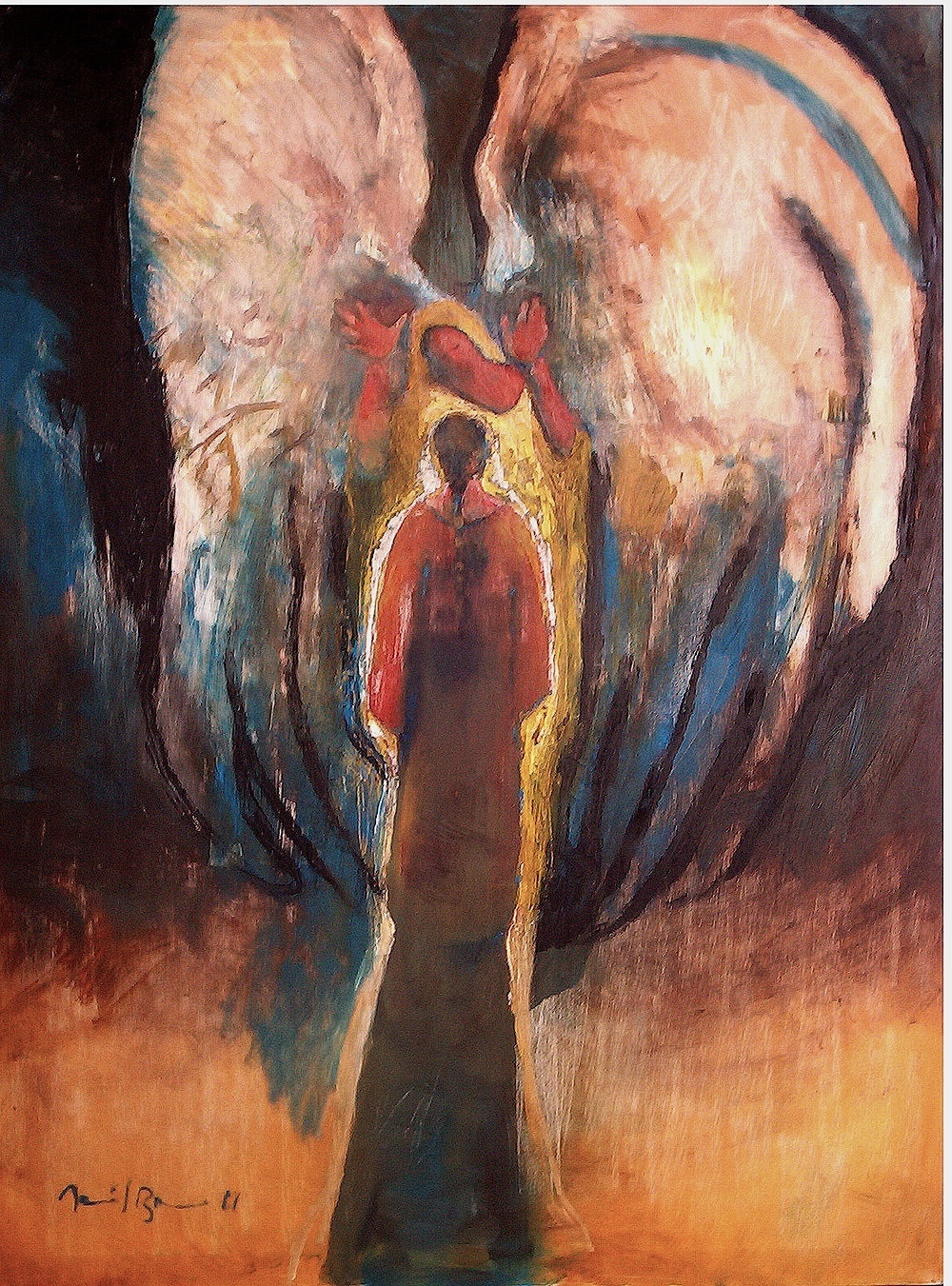
Photo credit: “The Annunciation” by Daniel Bonnell

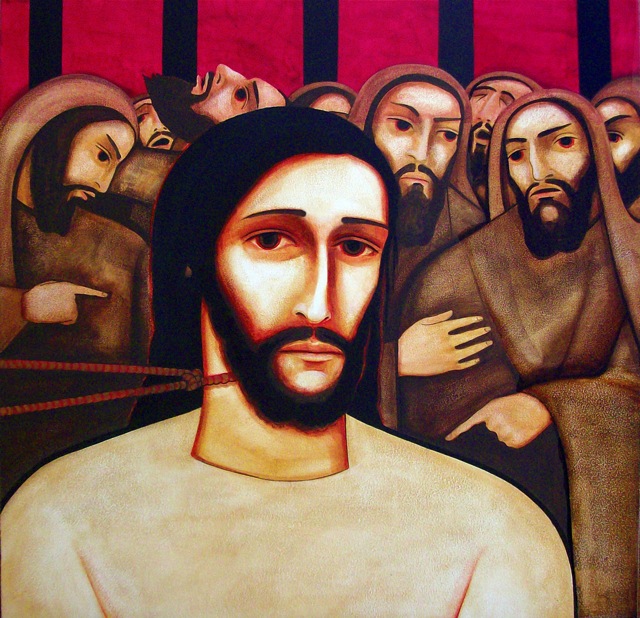 53 They led Jesus away to the high priest, and all the chief priests and the elders and the scribes came together. 54 Peter followed him at a distance into the high priest’s courtyard and was seated with the guards, warming himself at the fire. 55 The chief priests and the entire Sanhedrin kept trying to obtain testimony against Jesus in order to put him to death, but they found none. 56 Many gave false witness against him, but their testimony did not agree. 57 Some took the stand and testified falsely against him, alleging, 58 “We heard him say, ‘I will destroy this temple made with hands and within three days I will build another not made with hands.’” 59 Even so their testimony did not agree. 60 The high priest rose before the assembly and questioned Jesus, saying, “Have you no answer? What are these men testifying against you?” 61 But he was silent and answered nothing. Again the high priest asked him and said to him, “Are you the Messiah, the son of the Blessed One?” 62 Then Jesus answered, “I am; and ‘you will see the Son of Man seated at the right hand of the Power and coming with the clouds of heaven.’” 63 At that the high priest tore his garments and said, “What further need have we of witnesses? 64 You have heard the blasphemy. What do you think?” They all condemned him as deserving to die. 65 Some began to spit on him. They blindfolded him and struck him and said to him, “Prophesy!” And the guards greeted him with blows. Continue reading

.jpg) Command these stones… Jesus is challenged to show that he qualifies as Messiah by change the stones into loaves of bread. In the Lukan version (Lk 4:3) the challenge is “stone” and “load.” Without entering the argument of whose version is more the original, what is clear is that the stones/loaves are a challenge to satisfy more than just Jesus’ hunger. Jesus is tempted to use his divine power for his own advantage to accomplish God’s will rather than to trust in his Father’s plan.
Command these stones… Jesus is challenged to show that he qualifies as Messiah by change the stones into loaves of bread. In the Lukan version (Lk 4:3) the challenge is “stone” and “load.” Without entering the argument of whose version is more the original, what is clear is that the stones/loaves are a challenge to satisfy more than just Jesus’ hunger. Jesus is tempted to use his divine power for his own advantage to accomplish God’s will rather than to trust in his Father’s plan. friarmusings