
“So the LORD passed before him [Moses] and proclaimed: ‘The LORD, the LORD, a merciful and gracious God, slow to anger and rich in kindness and fidelity, continuing his kindness for a thousand generations, and forgiving wickedness, rebellion, and sin; yet not declaring the guilty guiltless, but bringing punishment for their parents’ wickedness on the children and children’s children to the third and fourth generation.’” (Exodus 34:6–7)
Today is the Memorial of Saints Martha, Mary, and Lazarus. There are two gospel options. A reading from John 11 recounting the scene around the death and raising of Lazarus, or a passage from Luke 10 recounting the story of Martha and Mary during a visit by Jesus. In both passages there are lots of questions asked of Jesus. I am reminded of a passage from St. John of the Cross’ Ascent of Mt. Carmel in which St. John offers:
“In giving us His Son, His only Word (for He possesses no other), He has spoken everything to us at once in this sole Word—and He has no more to say… because what He spoke before to the prophets in parts, He has now spoken all at once by giving us the All who is His Son. Therefore, anyone who now wants to question God or desires some vision or revelation is not only acting foolishly but is also offending Him, by not fixing his eyes entirely on Christ and by living with the desire for some other novelty. For if God wished to speak a word, it was no other than His Son. He is the complete Word, and there is no more to be said.…” (Book 2, Chapter 22)
The author goes on to explain that in the person of Jesus all that is knowable about God that we can comprehend has been given to us in the person of Jesus.
Continue reading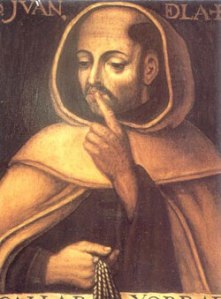 St. John of the Cross (San Juan de la Cruz) was born John de Yepes, the youngest child of a poor family from Toledo, Spain in 1542. He entered the Carmelite monastery in 1563, went on to study theology at the famous University of Salamanca in 1564, and was ordained to the priesthood in 1567. Dissatisfied with the laxity of his order, he considered becoming a hermit but was persuaded by St. Teresa of Avila to remain a Carmelite and work for the reform of the order. Not all Carmelites were pleased with his reforming activities, and he was actually imprisoned on order of a superior and subjected to great hardship for 9 months before escaping. His efforts led to the establishment of the
  friarmusings