A Life of Lasting Joy

In the gospel reading today we encounter a well known scene. It is Sunday morning in the first light of the day, the third day since the crucifixion. Mary Magdalene is there to complete the burial rituals to honor the corpse of Jesus – only to discover an empty tomb. She was already grieving, carrying that pain and loss until the completion of the Sabbath, and now this – someone has taken the body of Jesus; a final insult and desecration. It is too much. She is in tears.

She encounters two angels who ask her why she is crying. There is no reaction to the encounter itself. She is taken in her grief. She shows no concern for angels, but only asks where someone might have moved the body. They have no answer and so she moves on encountering a person she takes to be the gardener. Like the disciples on the road to Emmaus, or Peter and the disciples later at the Sea of Galilee, she doesn’t recognize Jesus,

Continue reading

Resurrection Faith

Today’s gospel from St. Matthew  is familiar to all readers: Jesus has been crucified, died, and laid within a tomb guarded by soldiers and watched by Mary Magdalene and “the other Mary.” The Sabbath has passed and dawn approaches on the first day of a new week.

The gospel accounts of the empty tomb are fairly similar. Women (names and number of women differ) come to the tomb early on Sunday morning. The stone is rolled away and the tomb is empty. Some of the gospels have an angelic messenger who speaks to the women.

There is great diversity in the accounts of the appearances of the risen Christ. It is difficult to harmonize any of them. Perhaps there is a message in that: Our contemporary experiences of the risen Christ will differ. There are those who visibly see a white light and others don’t. There are those who experience Christ in a radical transformation, A “born-again” event in their lives. There are those for whom Christ has been such a reality throughout their lives that they can’t think of a moment when Christ wasn’t present to them or when there was a great turning point in their lives. How the risen Christ comes to people differ – then and now. Our stories about the risen Christ’s presence in our lives differ – and in that lack of uniformity there is witness to the breadth of humanity.  

The woman left the empty tomb “fearful yet overjoyed” only to encounter the Risen Christ telling them: “Do not be afraid.” A good message for us. Resurrection faith does not arise on the basis of evidence, of which the chief priests and soldiers had plenty, but on the basis of the experienced presence of the risen Christ, by testimony of those to whom he appeared, and by his own continuing presence among his disciples – on the Easter morning and in all the days since.

We need to be a people unafraid to proclaim a radical resurrection faith in the present, not just a historical event. We need to tell it with joy!

He is risen! Alleluia!


Image credit: Christ’s Appearance to Mary after the Resurrection | Alexander Ivanov | Russian Museum | PD-US

Apostle to the Apostles

Did you know that Mary Magdalene is mentioned 12 times in the gospels, more than most of the Apostles. She was present at the crucifixion and was the first witness to the Resurrection (John 20 and Mark 16:9). She was the “Apostle to the Apostles”, an honorific that St. Augustine bestowed upon her in the fourth-century, and possibly he was but repeating a moniker already in use.

Mary Magdalene has long been confused with other women in Scripture also named Mary as well as an anonymous women, the unnamed sinner (commonly thought to have been a prostitute) in Luke 7:36-50.  In time, the identities of all these women were conflated into one in the person of “Mary Magdalene, the repentant prostitute.” The first written evidence we have of this conflation  of Mary Magdalene being a repentant prostitute comes from Ephraim the Syrian in the fourth century. Continue reading

Lasting Joy

In the gospel reading today we encounter a well known scene. It is Sunday morning in the first light of the day, the third day since the crucifixion. Mary Magdalene is there to complete the burial rituals to honor the corpse of Jesus – only to discover an empty tomb. She was already grieving, carrying that pain and loss until the completion of the Sabbath, and now this – someone has taken the body of Jesus; a final insult and desecration. It is too much. She is in tears. Continue reading

Apostle to the Apostles

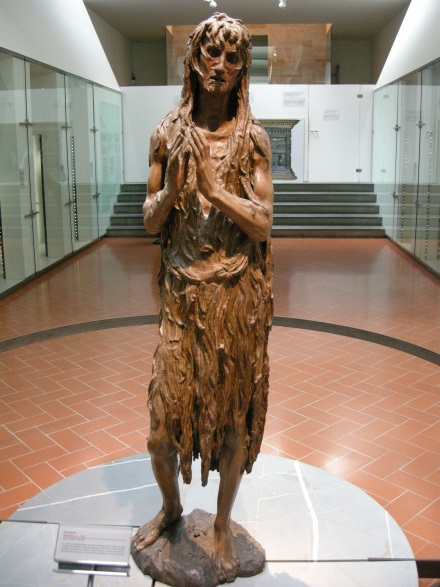
Magdalene Penitent
Donatello
Museo dell’Opera del Duomo – Florence

Did you know that Mary Magdalene is mentioned 12 times in the gospels, more than most of the Apostles. She was present at the crucifixion and was the first witness to the Resurrection (John 20 and Mark 16:9). She was the “Apostle to the Apostles”, an honorific that St. Augustine bestowed upon her in the fourth-century, and possibly he was but repeating a moniker already in use.

Mary Magdalene has long been confused with other women in Scripture also named Mary as well as an anonymous women, the unnamed sinner (commonly thought to have been a prostitute) in Luke 7:36-50.  In time, the identities of all these women were conflated into one in the person of “Mary Magdalene, the repentant prostitute.” The first written evidence we have of this conflation  of Mary Magdalene being a repentant prostitute comes from Ephraim the Syrian in the fourth century. Continue reading

Apostle to the Apostles

Magdalene Penitent
Donatello
Museo dell’Opera del Duomo – Florence

Did you know that Mary Magdalene is mentioned 12 times in the gospels, more than most of the Apostles. She was present at the crucifixion and was the first witness to the Resurrection (John 20 and Mark 16:9). She was the “Apostle to the Apostles”, an honorific that St. Augustine bestowed upon her in the fourth-century, and possibly he was but repeating a moniker already in use.

Mary Magdalene has long been confused with other women in Scripture also named Mary as well as an anonymous women, the unnamed sinner (commonly thought to have been a prostitute) in Luke 7:36-50.  In time, the identities of all these women were conflated into one in the person of “Mary Magdalene, the repentant prostitute.” The first written evidence we have of this conflation  of Mary Magdalene being a repentant prostitute comes from Ephraim the Syrian in the fourth century. Continue reading

Friendship

In Genesis 2 we read the very human descriptions of the role of humankind: “The LORD God then took the man and settled him in the garden of Eden, to cultivate and care for it.” (Gen 2:15)  Seems as though our first “vocation” is as gardener. Gen 2:8 specifically calls it a “garden.”  And the “chief gardener” could be found here and there in His garden: “the LORD God walking about in the garden at the breezy time of the day.” (Gen 3:8)

In today’s Gospel, Mary Magdalene encounters a person she thinks is a gardener. Actually, she’s not wrong. St. Gregory the Great in his sermon on this gospel wrote: “Perhaps this woman was not as mistaken as she appeared to be when she believed that Jesus was a gardener. Was he not spiritually a gardener for her when he planted the fruitful seeds of virtue in her heart by the force of his love?” Continue reading

Fear not and other stories

8 Then [Mary Magdalene and the other Mary] went away quickly from the tomb, fearful yet overjoyed, and ran to announce this to his disciples. 9 And behold, Jesus met them on their way and greeted them. They approached, embraced his feet, and did him homage. 10 Then Jesus said to them, “Do not be afraid. Go tell my brothers to go to Galilee, and there they will see me.”
11 While they were going, some of the guard went into the city and told the chief priests all that had happened. 12 They assembled with the elders and took counsel; then they gave a large sum of money to the soldiers, 13 telling them, “You are to say, ‘His disciples came by night and stole him while we were asleep.’ 14 And if this gets to the ears of the governor, we will satisfy (him) and keep you out of trouble.” 15 The soldiers took the money and did as they were instructed. And this story has circulated among the Jews to the present (day). 16 The eleven disciples went to Galilee, to the mountain to which Jesus had ordered them. (Matthew 28:8-15) Continue reading

The history we write – the lives we lead

MM-DonatelloMost people still think of Mary Magdalene as the unnamed sinner (possibly a prostitute) in Luke 7:36-50.  Of course we think of her as “the repentant prostitute” because she turns her life around because of the encounter with Jesus.  The problem is that for the first 300+ years of the Church, she was only seen as the first witness to the Resurrection.  Did you know that Mary Magdalene is mentioned 12 times in the gospels, more than most of the Apostles?  She was present at the crucifixion and was the first witness to the Resurrection (John 20 and Mark 16:9).  She was the “Apostle to the Apostles,” an honorific that St. Augustine bestowed upon her in the fourth century, and possibly he was but repeating a moniker already in use. Continue reading

Mary Magdalene

Magdalene Penitent
Donatello
Museo dell’Opera del Duomo – Florence

Did you know that Mary Magdalene is mentioned 12 times in the gospels, more than most of the Apostles. She was present at the crucifixion and was the first witness to the Resurrection (John 20 and Mark 16:9). She was the “Apostle to the Apostles”, an honorific that St. Augustine bestowed upon her in the fourth-century, and possibly he was but repeating a moniker already in use.

Mary Magdalene has long been confused with other women in Scripture also named Mary as well as an anonymous women, the unnamed sinner (commonly thought to have been a prostitute) in Luke 7:36-50.  In time, the identities of all these women were conflated into one in the person of “Mary Magdalene, the repentant prostitute.” The first written evidence we have of this conflation  of Mary Magdalene being a repentant prostitute comes from Ephraim the Syrian in the fourth century. Continue reading