
This coming Sunday is the 14th Sunday in Ordinary Time. The stories and accounts of Jesus’ Galilean ministry have undoubtedly reached his hometown of Nazareth. We know from the gospel account that his reception and return is not exactly exuberant. While the text says that they were “astonished” in reference to his teaching in the synagogue, it is ambiguous in meaning. What kind of astonishment is amplified with the following verse: “They said, ‘Where did this man get all this?’” Is the tone of the statement one of wonder at the marvelous exposition and wisdom just offered or is it amazement as in “who does he think he is coming here and trying to teach us – how presumptuous!” Continue reading
Knowing One’s Place
Reply
 The Lord of Miracles (Señor de los Milagros) is an image painted of Jesus Christ that is venerated in Lima, Peru. The image was painted during the 17th century by Benito or Pedro Dalcon, an African taken from what is now Angola to Peru as a slave. An annual procession commemorating the image occurs every October. It is one of the oldest Catholic traditions in Peru. It is one of the largest religious processions in the world.
  Over the last several weeks we have been considering what awaited the men who came to join Francis of Assisi and this growing fraternity of believers seeking to follow Christ more fully in the world. We had mentioned there were no rules, regulations, or even a formation program; there was only Francis and the other brothers. But what drew the men to want to “come and see?” Undoubtedly, as today, a complex of reasons, but key among those reasons was Francis of Assisi’s reputation for holiness and miracles.
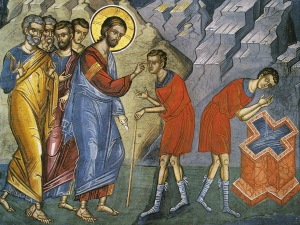 A Man Born Blind: John 9:1-41 1 As he passed by he saw a man blind from birth. 2 His disciples asked him, “Rabbi, who sinned, this man or his parents, that he was born blind?” 3 Jesus answered, “Neither he nor his parents sinned; it is so that the works of God might be made visible through him. 4 We have to do the works of the one who sent me while it is day. Night is coming when no one can work. 5 While I am in the world, I am the light of the world.” (the remainder of the gospel can be read
  Over the last several weeks we have been considering what awaited the men who came to join Francis of Assisi and this growing fraternity of believers seeking to follow Christ more fully in the world. We had mentioned there were no rules, regulations, or even a formation program; there was only Francis and the other brothers. But what drew the men to want to “come and see?” Undoubtedly, as today, a complex of reasons, but key among those reasons was Francis of Assisi’s reputation for holiness and miracles.
  friarmusings