The Rewards of Discipleship

This coming Sunday is the 28th Sunday in Ordinary Time. Earlier (3:35) Jesus had redefined his family. “(For) whoever does the will of God is my brother and sister and mother.” For many of the first believers, following Jesus meant leaving everything behind. What one gained by leaving the biological family behind was the faith-community, those who were doing the will of God

 28 Peter began to say to him, “We have given up everything and followed you.” 29 Jesus said, “Amen, I say to you, there is no one who has given up house or brothers or sisters or mother or father or children or lands for my sake and for the sake of the gospel 30 who will not receive a hundred times more now in this present age: houses and brothers and sisters and mothers and children and lands, with persecutions, and eternal life in the age to come. 31 But many that are first will be last, and (the) last will be first.”

Peter again acts as the spokesman for the Twelve. His response stands in stark contrast to the refusal of the rich man to follow Jesus. The Twelve had abandoned everything in order to follow Jesus (Ch. 1:16–20; 2:14). Lane [371-2] notes that “Jesus’ response defines Christian existence in terms of promise and persecution, and history as the interplay of blessedness and suffering. The contrast between the present age and the age to come is thoroughly Palestinian in character and expresses the tension between promise and fulfillment in the life of faith. The frank recognition of the loss that allegiance to Jesus and the gospel may entail (cf. 13:12f.) is conditioned by the promise that all that is lost in one society (v. 29) will be regained a hundredfold in the new society created by the dynamic of the gospel (v. 30). This reassurance is addressed to any man who suffers loss for Jesus and the gospel. God takes nothing away from a man without restoring it to him in a new and glorious form. Jesus’ reference to the new family which will compensate for the loss sustained in one’s own family finds its preparation in 3:31–35.”

A Final Thought From Brian Stoffregen:

A dictionary definition of “sacrifice” is: “an act of giving up something valued for the sake of something else regarded as more important or worthy.” A key to a sacrifice is giving up something valued. We seldom are confronted with giving up things that we value for the sake of Christ who should be regarded as more important or worthy. How often are things donated to the church, things a family wants to get rid of — something they no longer value? Such giving can’t be called a “sacrifice”.

Frequently testimonies talk about giving the worst things in one’s life in order to follow Jesus, e.g., addictions, swearing, promiscuity, etc. In contrast, Paul’s testimony in Philippians 3:4-11 indicates that he gave up the very best things in his life, the most righteous things in his life, for the sake of the gospel.

What are some things that we value that Christ might ask us to give up in order to follow him? Soccer practices on Sunday? Watching football games on Sunday? Buying a new car?

However, if we are giving such things up only because we expect even greater things from following Christ, then we have probably haven’t given up our most important possession, the control of our own lives and destinies.
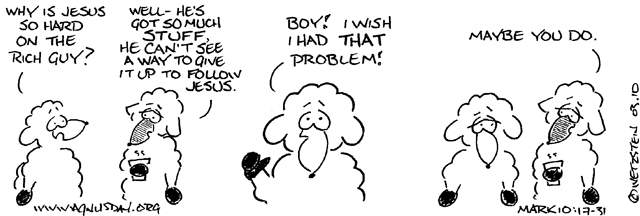
Image credit: Heinrich Hofmann | 1888 | Christ and the Rich Young Ruler | Brigham Young University Museum of Art | PD-US —- cartoon from AgnusDay.org
Problem of Wealth?

This coming Sunday is the 28th Sunday in Ordinary Time. Before we address the question of wealth, the larger question is really “Who can be saved?” The answer in v.21 is clear – human beings cannot save themselves. Just can’t do it. But, nothing is impossible for God. Stoffregen writes: “The answer to ‘how hard?’ is ‘It’s impossible.’ Whenever we make it ‘possible’ to do with enough work or sacrifice, we miss the radical nature of Jesus’ comments; which were especially revolting because (1) it was naturally assumed that the wealthy were closer to God and were more likely to be saved than the common people and (2) it was naturally assumed that those who kept the commandments were closer to God and were more likely to be saved than the common people. The man in our text fulfilled both requirements — but doesn’t enter the kingdom — at least not based on his righteousness or wealth.” Continue reading

The Way Gets Harder

This coming Sunday is the 28th Sunday in Ordinary Time. 21 Jesus, looking at him, loved him and said to him, “You are lacking in one thing. Go, sell what you have, and give to (the) poor and you will have treasure in heaven; then come, follow me.” 22 At that statement his face fell, and he went away sad, for he had many possessions.

Did you know that this is the only place in the gospels of Mark, Matthew, or Luke that Jesus is said to love (agapaō) someone. Then Jesus says, “give it all away and follow me.” When I have told Bible Study groups the uniqueness of this statement of love, it is not uncommon to hear a quip, “And this is love? I’ll take a pass.” It is said in jest, but…. all recognize that suddenly the high bar got very high. Continue reading

The Good

This coming Sunday is the 28th Sunday in Ordinary Time.“Good teacher, what must I do to inherit eternal life?” Jesus answered him, “Why do you call me good? No one is good but God alone.  In the Hebrew Scriptures only God is called “good,” although it was permissible to speak of “the good man” (e.g. Proverbs 12:2 etc.) as a characteristic derived from one’s fidelity to God. But the expression “Good teacher” has no parallel in Scripture or Jewish sources. One can only take it as a true expression of the man’s estimation of Jesus as someone close to God who would teach with wisdom. Continue reading

The Way

This coming Sunday is the 28th Sunday in Ordinary Time.The beginning of the Gospel according to Mark begins with John the Baptist citing Isaiah speaking of the messenger: “he will prepare your way…Prepare the way of the Lord.” (Mark 1:2-3) In both verses the underlying word is hodos. There are other places in Mark when hodos is used and is translated as ‘way” – e.g., “the way of God in accordance with the truth,” and describing Jesus and the apostles “on the way” in 8:27 and 10:32. So it is odd that in 10:17, the same word hodos is translated as journey in the New American Bible (NAB). Continue reading

Inheriting the Kingdom

This coming Sunday is the 28th Sunday in Ordinary Time, lectionary cycle B. Jesus has been consistently teaching his disciples the meaning of the Kingdom in his examples and explanations: greatness means to serve the least among the people (9:36-37).  He has already told them that the path of discipleship will consist, not just of demonstrations of power (healing and casting out demons), but also one in which one “must deny himself, take up his cross, and follow me.” (8:34) At times these lessons have come at the end of a dispute with the Pharisees or scribes as we saw in the previous Sunday gospel. There Jesus tells the disciples about the creative intent of God in the formation of marriage and family (10:2-16) as a means of describing the Kingdom echoed in human experience. Continue reading

Why a “young man”?

In the gospel for today, I always wonder how much to make of the description of the one who questions Jesus as being “a young man.”  There are a number of things one could say about this passage that having nothing to do with the questioner’s age.  The question reveals a fundamental human concern: the pursuit of eternal life or spiritual salvation asked in earnest by someone who is genuinely seeking to understand the path to salvation. Perhaps his use of “gain” and his positive response about the commandments reflects a belief that righteous actions alone can secure eternal life. But these could be asked by someone of any age.  In any case, Jesus calls him to radical discipleship, challenging the man to go beyond rule-following and embrace a more profound, sacrificial commitment. The man “went away sad” as he realized that was a bridge too far. He lacked a  willingness to prioritize God above all else. Continue reading

The Kingdom’s cost

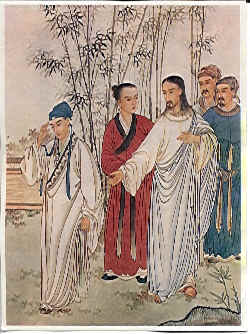
ChineseJesus-rich-manThis coming Sunday is the 28th Sunday in Ordinary Time in Cycle B of the Lectionary. It is a familiar story: “As [Jesus] was setting out on a journey, a man ran up, knelt down before him, and asked him, “Good teacher, what must I do to inherit eternal life?” (Mark 10:17). Matthew refers to him as “a rich young man.”

In this part of Mark’s account, Jesus has been consistently teaching his disciples the meaning of the Kingdom in his examples and explanations: greatness means to serve the least among the people (9:36-37).  He has already told them that the path of discipleship will consist, not just of demonstrations of power (healing and casting out demons), but also one in which one “must deny himself, take up his cross, and follow me.” (8:34) At times these lessons have come at the end of a dispute with the Pharisees or scribes as we saw in the previous Sunday gospel. There Jesus tells the disciples about the creative intent of God in the formation of marriage and family (10:2-16) as a means of describing the Kingdom echoed in human experience. Continue reading

The Wisdom of Riches

Today’s gospel is a familiar one: “Teacher, what good must I do to gain eternal life?” Jesus answers him, citing familiar words from the Commandments. “All of these I have observed. What do I still lack?”  Jesus responds: “If you wish to be perfect, go, sell what you have and give to the poor,…” And the young rich man goes away sad as he had many possessions.

If you wish to be “perfect” – something that echos Matthew 5:48: “So be perfect, just as your heavenly Father is perfect.”  The underlying word translated as “perfect” is the Greek teleios. I am not sure that is the best translation for modern-day English. I would suggest a better understanding would be to use the word “complete.”

Continue reading

The Wisdom of Riches

Today’s gospel is a familiar one: “Teacher, what good must I do to gain eternal life?” Jesus answers him, citing familiar words from the Commandments. “All of these I have observed. What do I still lack?”  Jesus responds: “If you wish to be perfect, go, sell what you have and give to the poor,…” And the young rich man goes away sad as he had many possessions.

Continue reading