
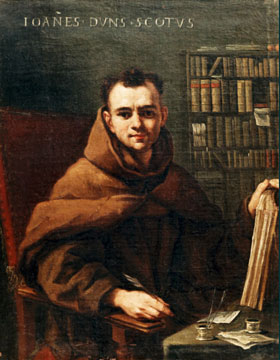
November 8th is the feast day of Blessed John Duns Scotus, a Franciscan friar from Scotland noted for his theological and philosophical work in the high-middle ages (late 13th and early 14th centuries). Scotus’ work was in the generation that followed Thomas of Aquinas and Bonaventure. His work was complex and nuanced, and he is generally considered to be one of the three most important philosopher-theologians of his time. He was given the medieval accolade Doctor Subtilis (Subtle Doctor) for his penetrating and subtle manner of thought.
Continue readingTag Archives: Scotus
The Subtle Doctor
November 8th is the feast day of Blessed John Duns Scotus, a Franciscan friar from Scotland noted for his theological and philosophical work in the high-middle ages (late 13th and early 14th centuries). Scotus’ work was in the generation that followed Thomas of Aquinas and Bonaventure. His work was complex and nuanced, and he is generally considered to be one of the three most important philosopher-theologians of his time. He was given the medieval accolade Doctor Subtilis (Subtle Doctor) for his penetrating and subtle manner of thought. Continue reading
The Subtle Doctor
November 8th is the feast day of Blessed John Duns Scotus, a Franciscan friar from Scotland noted for his theological and philosophical work in the high-middle ages (late 13th and early 14th centuries). Scotus’ work was in the generation that followed Thomas of Aquinas and Bonaventure. His work was complex and nuanced, and he is generally considered to be one of the three most important philosopher-theologians of his time. He was given the medieval accolade Doctor Subtilis (Subtle Doctor) for his penetrating and subtle manner of thought. Continue reading
Coming Soon to Your Life
It is during the month of June when the Supreme Court of the United States (SOCTUS) releases its decisions on the cases it has agreed to hear. There are five cases that are expected to be significant for life in these United States – and for those who carry the mantle “pro-life.” Continue reading
The Franciscan Scotus
November 8th is the feast day of Blessed John Duns Scotus, a Franciscan friar from Scotland noted for his theological and philosophical work in the high-middle ages (late 13th and early 14th centuries). Scotus’ work was in the generation that followed Thomas of Aquinas and Bonaventure. His work was complex and nuanced, and he is generally considered to be one of the three most important philosopher-theologians of his time. He was given the medieval accolade Doctor Subtilis (Subtle Doctor) for his penetrating and subtle manner of thought. Continue reading
A little-known saint
November 8th is the feast day of Blessed John Duns Scotus, a Franciscan friar from Scotland noted for his theological and philosophical work in the high-middle ages (late 13th and early 14th centuries). Scotus’ work was in the generation that followed Thomas of Aquinas and Bonaventure. His work was complex and nuanced, and he is generally considered to be one of the three most important philosopher-theologians of his time. He was given the medieval accolade Doctor Subtilis (Subtle Doctor) for his penetrating and subtle manner of thought. Continue reading
The Franciscan Scotus
November 8th is the feast day of Blessed John Duns Scotus, a Franciscan friar from Scotland noted for his theological and philosophical work in the high-middle ages (late 13th and early 14th centuries). Scotus’ work was in the generation that followed Thomas of Aquinas and Bonaventure. His work was complex and nuanced, and he is generally considered to be one of the three most important philosopher-theologians of his time. He was given the medieval accolade Doctor Subtilis (Subtle Doctor) for his penetrating and subtle manner of thought. Continue reading
Bl. John Duns Scotus
November 8th is the feast day of Blessed John Duns Scotus, a Franciscan friar from Scotland noted for his theological and philosophical work in the high-middle ages (late 13th and early 14th centuries). Scotus’ work was in the generation that followed Thomas of Aquinas and Bonaventure. His work was complex and nuanced, and he is generally considered to be one of the three most important philosopher-theologians of his time. He was given the medieval accolade Doctor Subtilis (Subtle Doctor) for his penetrating and subtle manner of thought. Continue reading
Why the Incarnation?
On November 8th the Church and the Franciscan world celebrates the feast of Blessed John Duns Scotus, a friar and medieval theologian/philosopher. Not a household name, Scotus is best known for his philosophical writings, but it is his theological perspective that has left the most impact. His theological writings on Mary form the basis for how we understand the Feast of the Immaculate Conception and his writings on the preeminence of Christ are the basis for the celebration of the Solemnity of Christ the King.
But it is also his reflection on the primacy of Christ that led to his asking about the Incarnation, or more specifically, why did the Word of God, the second Person of the Holy Trinity, become flesh. “In the beginning was the Word, and the Word was with God, and the Word was God… and the Word became flesh and lived among us and we have seen his glory.” (John 1:1,14) Certainly those verses and others, e.g. Phil 2:5-7, clearly speak to Jesus taking on our humanity, becoming one with us. But it doesn’t necessarily answer why. Continue reading