
Overview
In the year 2024 China built more ships in their own yards – in one year – than the United States built, in total, since the end of World War II. At the end of that war the U.S. had approximately 11,000 logistic and auxiliary vessels – far, far more than we needed for peacetime. Post-war the surplus was sold or given to European allies to “jump start” their economies and shipyards. The same was done for Asian nations – including Japan. Today, China’s shipbuilding capacity is approximately 200 times that of the United States. That reflects the massive expansion of Chinese capacity and near extinction of a once great U.S. capacity. It wasn’t always that way.
This post walks the reader through the history of U.S. shipbuilding from the 1920s up until today. It describes the output as well as the supporting political action needed to build the needed war-time capacity for a two-ocean Navy. It does not take much to imagine the needed capital and political commitment to begin to restore U.S. shipbuilding.
U.S. Shipbuilding – a history
Following World War I and the Great Depression, America’s shipbuilding industry had severely atrophied. Between 1922 and 1937, U.S. shipyards produced almost no oceangoing dry cargo freighters. The few yards that did remain operational were mostly focused on occasional naval cruisers or tankers. In 1937, the United States possessed a mere 10 shipyards with the capacity to construct oceangoing vessels. However, by the conclusion of World War II in 1945, this industrial base had undergone a dramatic expansion, resulting in more than 80 major public and private shipyards operating nationwide to sustain the wartime fleet.
Between 1937 and 1945, U.S. shipyards produced a staggering total of over 14,000 major vessels, including approximately 5,200 large ocean-going merchant ships and nearly 9,000 naval combatants and major auxiliaries (excluding over 50,000 small landing craft).
Merchant and Cargo Fleet Production. Under the strategic direction of the U.S. Maritime Commission, the industry prioritized the production of commercial hulls essential to maintaining the global allied supply chain. This immense industrial effort yielded a total of 5,171 ocean-going merchant vessels, including:
- Liberty Ships: A total of 2,710 built. These standard, mass-produced cargo vessels served as the indispensable backbone of allied wartime logistics.
- Victory Ships: A total of 534 built. As faster and larger successors to the Liberty ship, these were designed to remain competitive in post-war merchant trade.
- Standard Cargo Ships: approximately 700 built. These high-quality, turbine-driven vessels (comprising C1, C2, C3, and C4 designs) were utilized for both cargo transport and various military conversions.
- Tankers: A total of 705 built. This figure includes 525 of the iconic T2 turbo-electric tankers, which were vital for the transport of fuel, oil, and aviation gasoline.
- Minor/Specialized Merchant Hull Types: Approximately 522 built. This diverse category included refrigerated “Reefer” ships, Lakers, barges, and ocean-going tugboats.
Naval Combatant Production. The U.S. Navy underwent a historic expansion to become the most powerful fleet in human history, incorporating thousands of warships into its ranks. Major combat vessels constructed during this period included:
- Aircraft Carriers (All Types): A total of 128 built. This included 22 fleet carriers (CVs), Light Carriers (CVLs) built on smaller hulls often converted from cruiser designs to rapidly put more flight decks into service and smaller escort carriers (CVEs or “jeep carriers”) converted from merchant hulls and primary used to transport aircraft from the U.S. to operating carriers or bases.
- Battleships: A total of 8 built, representing the North Carolina, South Dakota, and Iowa classes. These served as fleet anti-craft platforms as well as shore bombardment ships.
- Cruisers: A total of 48 built, including heavy (CA) and light cruisers (CL/CLAA). As the war in the Pacific progressed cruisers were part of the defence-in-depth screen for the aircraft carriers with enhanced anti-aircraft defense while still retaining surface combat capability.
- Destroyers: A total of 352 built of which 175 were Fletcher class DDs that were the workhorse of fleet picket and anti-aircraft defence.
- Destroyer Escorts: A total of 563 built. These were specialized anti-submarine warships tasked with convoy protection.
- Submarines: A total of 203 built, primarily consisting of Gato, Balao, and Tench-class fleet submarines.
Auxiliary and Small Naval Craft. In addition to frontline combatants, American shipyards produced thousands of secondary and logistical naval hulls to support the fleet:
- Frigates and Corvettes: Approximately 160 built, largely consisting of Tacoma-class patrol frigates.
- Mine Warfare and Patrol Vessels: Over 2,500 built, including minesweepers, sub-chasers, and PT boats.
- Amphibious Warfare Ships: Over 2,500 built, including large ocean-going amphibious vessels such as LSTs (Landing Ship, Tanks) and LSMs.
U.S. Shipbuilding Acts and Programs
The Roosevelt Administration was active as much as 8 years before the war. Early acts served dual purposes of economic stimulation during the Great Depression but also to keep the shipyards open and the skilled labor engaged.
| Program / Act | Year | Core Objective | Key Combatant Impact |
| NIRA Executive Order | 1933 | Depression relief; initial modernization. | Funded USS Enterprise & Yorktown. |
| Vinson-Trammell Act | 1934 | Build up to maximum international treaty ceilings. | 102 replacement warships (Cruisers/DDs/Subs). |
| Second Vinson Act | 1938 | 20% expansion post-treaty collapse. | Shifted focus to Essex-class carriers & fast battleships. |
| 11% Naval Expansion Act | 1940 | Emergency tonnage boost following the fall of France. | Accelerated fast carrier task force components. |
| Two-Ocean Navy Act | 1940 | 70% fleet expansion; global naval dominance. | Laid down the massive fleet that fought from 1942–1945. |
The point of this historical review is to show what was necessary in terms of supporting military operations at distances far from home ports – the dynamic that the U.S. faces in the Indo-China Region – an area that ranges from the Straits of Hormuz to the South China Sea.
U.S. Shipbuilding – 2026
At present, the United States maintains four public naval shipyards alongside approximately eight to nine active private facilities possessing the industrial capacity to construct large, deep-draft ocean-going merchant vessels or major naval combatants.
Public Naval Shipyards (4)
Operating under the direct supervision of the U.S. Navy via NAVSEA, these four public facilities are no longer utilized for new construction. Instead, their operations are dedicated exclusively to the intricate depot-level maintenance, refueling, and modernization of the fleet’s nuclear-powered aircraft carriers and submarines.
- Norfolk Naval Shipyard (NNSY): Located in Portsmouth, VA, this yard manages the maintenance requirements for nuclear carriers and submarines.
- Puget Sound Naval Shipyard & IMF (PSNS): Situated in Bremerton, WA, its primary focus remains nuclear vessel support and carrier maintenance.
- Pearl Harbor Naval Shipyard & IMF (PHNSY): Positioned in Oahu, HI, this facility is strategically vital for Pacific Fleet submarine overhauls.
- Portsmouth Naval Shipyard (PNSY): Located in Kittery, ME, this yard is specialized specifically in submarine modernization and overhaul.
Private Shipyards Capable of Large-Scale New Construction (8–9)
The defense industrial base relies on a highly consolidated group of private defense contractors—primarily dominated by General Dynamics and Huntington Ingalls Industries (HII)—alongside a limited number of commercial shipbuilders.
Naval Combatant Specialists. The following major yards are responsible for the construction of frontline combatants for the U.S. Navy and Coast Guard:
- Newport News Shipbuilding: Located in Newport News, VA, this is the nation’s sole facility capable of constructing nuclear-powered aircraft carriers (the Gerald R. Ford class) and one of only two yards building nuclear-powered submarines.
- General Dynamics Electric Boat: Situated in Groton, CT, this facility is dedicated exclusively to the design and construction of nuclear submarines, including the Virginia and Columbia classes.
- General Dynamics Bath Iron Works: Located in Bath, ME, this yard primarily constructs surface combatants, with a focus on Arleigh Burke-class guided-missile destroyers.
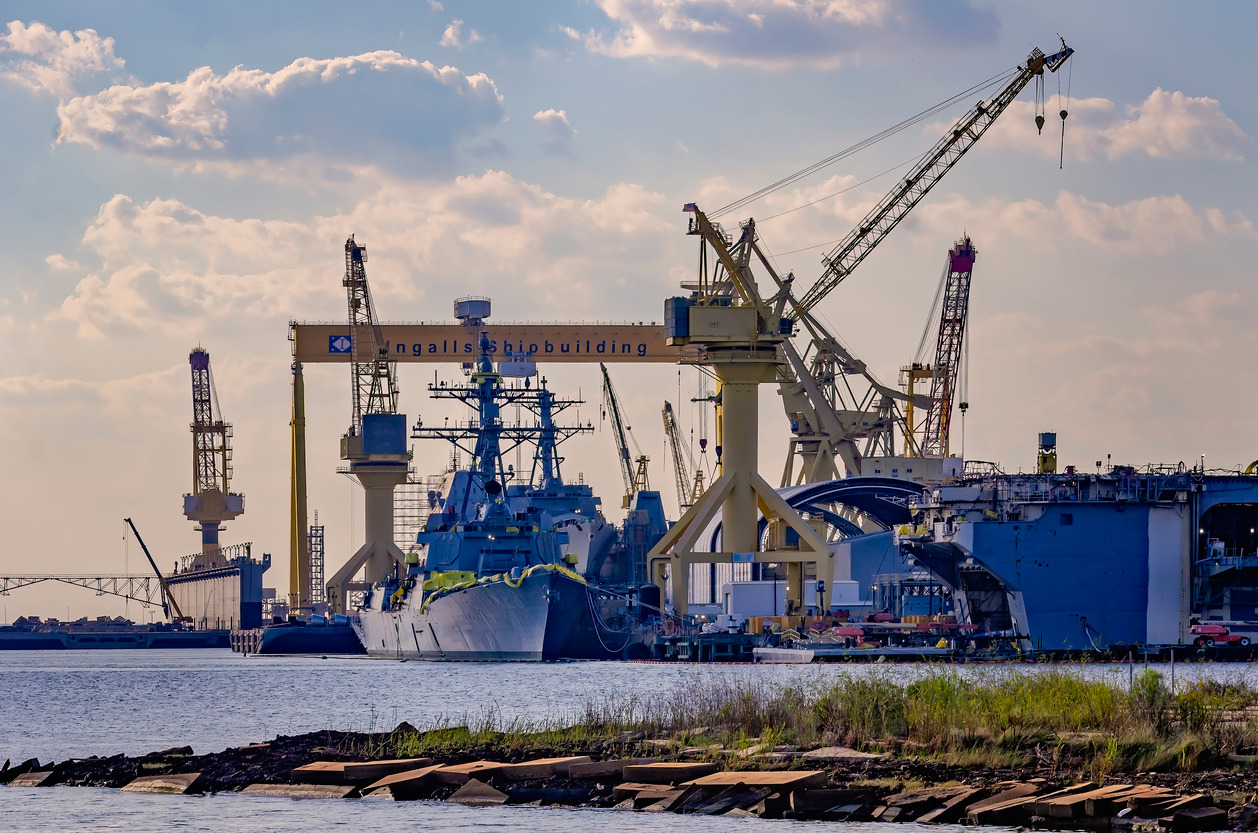
- Ingalls Shipbuilding: Positioned in Pascagoula, MS, this yard builds amphibious assault ships, Arleigh Burke destroyers, and national security cutters for the U.S. Coast Guard.
- Austal USA: Located in Mobile, AL, this facility specializes in aluminum and steel vessels, such as Littoral Combat Ships (LCS), expeditionary fast transports, and Coast Guard cutters.
- Fincantieri Marinette Marine: Situated in Marinette, WI, this yard constructed the Freedom-class LCS and is currently tasked with the production of the Navy’s new Constellation-class guided-missile frigates.
Currently, the United States accounts for less than 1% of the world’s large commercial shipbuilding, producing only 3 to 5 deep-draft merchant vessels annually. As private builders are heavily optimized for the specific requirements of rigid naval contracts, the industry lacks the requisite “surge” capacity or infrastructure to absorb substantial merchant or naval losses during a prolonged geopolitical crisis.
Commercial Cargo & Dual-Use Yards
A select group of only two to three shipyards maintains the industrial infrastructure necessary for the construction of large, ocean-going commercial hulls. These facilities persist largely through the fulfillment of U.S. government auxiliary contracts, bridging the gap between civilian and military requirements.
- General Dynamics NASSCO: San Diego, CA, this yard constructs large commercial product tankers and container ships while simultaneously producing Navy auxiliary supply ships, such as the T-AO fleet oilers.
- Philly Shipyard: Philadelphia, PA, this facility has a historic record of building large commercial container ships and tankers; it was recently acquired by Hanwha Ocean of South Korea to support the production of national-security multi-mission vessels.
- Keppel AmFELS: Brownsville, TX, this yard retains significant large-scale construction capability and occasionally delivers Jones Act-compliant commercial transport vessels to the domestic market.
The Hanwha Group and U.S. Shipbuilding
Hanwha Group has formally concluded its $100 million acquisition of Philly Shipyard, a transaction that signals a fundamental paradigm shift in the revitalization of the nation’s atrophied maritime industrial base through allied foreign investment. Prior to this landmark deal, the Philadelphia facility struggled with inconsistent order books, often delivering fewer than two vessels per year.
In a massive commitment to industrial modernization, Hanwha announced a $5 billion infrastructure plan dedicated to the comprehensive upgrade of the Philadelphia yard. This strategic capital injection will fund the construction of two additional dry docks, three quays, and a state-of-the-art block assembly facility. Through these enhancements, Hanwha aims to scale the yard’s industrial output from 1.5 ships annually to an unprecedented capacity of 10 to 20 vessels per year by 2035.
Central to this revitalization is the implementation of the “Smart Yard” concept, which integrates highly automated South Korean shipbuilding technologies—including robotic welding, automated inspections, and digital twin modeling—to address decades of stagnant productivity in American shipyards. Furthermore, the investment establishes a 36-month apprenticeship program designed to train over 1,000 new shipbuilders, ultimately supporting a workforce of up to 5,000 personnel in Pennsylvania.
This acquisition serves as the cornerstone of a broader $150 billion commitment by South Korea. Acknowledging that the United States lacks the organic capacity to match the industrial shipbuilding scale of China, Washington is increasingly viewing South Korea and Japan as vital industrial lifelines rather than mere trading partners.
While U.S. statutes historically prohibited the foreign construction of naval combatants, Hanwha’s strategy of acquiring and modernizing facilities on American soil effectively circumvents these restrictions while ensuring compliance with “Made in America” mandates. Consequently, the current administration has signaled that Hanwha will play an integral role in the future construction of Navy frigates and nuclear-powered submarines.
Current Initiatives
The administration has announced several major initiatives intended to rebuild and expand U.S. commercial and military shipbuilding capacity, largely in response to concerns about China’s dominance in maritime industry and naval production. The centerpiece is President Donald Trump’s April 2025 executive order, “Restoring America’s Maritime Dominance.” The administration directed multiple federal departments (Defense, Transportation, Commerce, Homeland Security, and Labor) to create a comprehensive strategy for rebuilding U.S. shipbuilding and merchant marine capability – a Maritime Action Plan (MAP). The February 2026-issued MAP focuses on expanding U.S. shipyard capacity, increasing the number of U.S.-built commercial ships, strengthening the maritime workforce, improving Navy and Coast Guard procurement efficiency, revitalizing the U.S.-flag merchant marine and rebuilding maritime supply chains.
Despite the ambitious rhetoric, significant obstacles remain.
- U.S. shipyards lack large-scale commercial production capacity
- Workforce shortages are severe
- Shipbuilding costs in the U.S. remain far higher than in Asia
- Many proposals require congressional appropriations
- Rebuilding industrial supply chains may take a decade or longer
Some analysts have also questioned whether executive actions alone can reverse decades of industrial decline without sustained bipartisan funding and long-term policy continuity.
The Jones Act
The “Jones Act” is the common name for Section 27 of the Merchant Marine Act of 1920, a U.S. federal law governing domestic maritime commerce. The law requires that cargo transported between two U.S. ports must be carried on ships that are built in the U.S., owned by U.S. citizens or U.S. companies, registered (flagged) in the U.S. and crewed primarily by U.S. citizens or permanent residents. The law applies to “cabotage,” meaning domestic shipping between American ports, e.g.: Houston to New York, Los Angeles to Hawaii, Jacksonville to Puerto Rico, Seattle to Alaska, Long Beach to Guam.
The Jones Act was enacted after the First World War because the United States recognized that it lacked a sufficiently strong merchant marine and shipbuilding base to support wartime logistics. Congress concluded that the nation needed a domestic shipbuilding industry, a trained pool of mariners, and a reserve fleet that could support military mobilization – all national security issues. Many defense analysts, shipbuilders, labor unions, and maritime organizations argue that the Jones Act is essential for national security and industrial resilience. Critics argue that the Jones Act substantially increases shipping costs and contributes to inefficiency.
Military Sealift Command
The Military Sealift Command (MSC) is the primary organization responsible for strategic sealift, naval logistics, and ocean transportation for the United States military. It operates one of the world’s largest government-owned auxiliary fleets and is essential to sustaining U.S. global military operations.
MSC operates approximately 130 ships supported by roughly 5,000–5,500 civilian mariners supplemented by additional contract mariners and military personnel. MSC’s fleet is absolutely critical because it carries fuel, ammunition, vehicles, aircraft equipment, supplies, troops and general cargo. Without MSC, the U.S. military could not sustain large overseas operations.
MSC faces several serious challenges today. Many sealift ships are old, some average over 40 years in age which carries increasing maintenance costs as well as needed upgrades in navigation, communications, and security measures. Because of the diminished shipbuilding capability and budgetary constraints, the U.S. has struggled to replace ships quickly or at all.
The U.S. also faces shortages of qualified civilian mariners. Current assessments indicate that sustained wartime activation could exceed available crews. This issue is increasingly viewed as a national-security concern.
Potential conflict scenarios involving Taiwan or the western Pacific create enormous logistics challenges because of vast distances, missile threats, port vulnerability and limited sealift capacity.

