Faith in Action

UmbrellaSummer sun and an extended drought had left the surrounding fields parched, dusty, and brown. As they tended their wilting crops, the local folks daily searched the sky for any sign of relief. Days turned into arid weeks and still no rain came.

The ministers of the local churches announced that there would be a special service to pray for rain on the following Saturday. They requested that everyone bring an object of faith for inspiration. At the appointed hour, everyone turned out, filling the town square with anxious faces and hopeful hearts. The ministers were touched to see the variety of objects clutched in prayerful hands; prayer books, Bibles, crosses, rosaries, etc.

Just as the hour of prayer was concluding, and as if by some divine cue, a soft rain began to fall. Cheers swept the crowd as they held their treasured objects high in gratitude and praise. From the middle of the crowd, one faith symbol seemed to overshadow all the others; a child had brought an umbrella.  (from Southern author and poet Laverne W. Hall)

The Pesistent Widow – Will He Find Faith

01_Persistent_WidowJesus’ Commentary on the Petition.  7 Will not God then secure the rights of his chosen ones who call out to him day and night? Will he be slow to answer them? 8 I tell you, he will see to it that justice is done for them speedily. But when the Son of Man comes, will he find faith on earth?”

Jesus comments make clear the intended parallels: from an unjust judge to God; from the widow to God’s elect.  The term “his chosen ones” (hoi eklektoi), used in Luke-Acts only here, echoes texts such as Isa. 42:1; 43:20; 65:9, 15, 22; Ps. 105:6, 43 (cf. Sir. 47:22), which use the term “chosen” in a context that emphasizes election to serve Yahweh (also refers to Deut. 4:37; 7:7; 1 Chron. 16:13; Ps. 77:31; 88:3). Continue reading

The Persistent Widow

01_Persistent_Widow

Our reading of the parable of the “Unjust Judge and the Persistent Widow” is accompanied by the reading from the Hebrew Scriptures. The entire parable rings with the echo of Sir 35:14-24 (note: depending on translation you find verse numbering slightly different – also, this is part of the OT reading for the 30th Sunday in Year C) Continue reading

The Persisten Widow – the Judge

Unjust JudgeMore literal translation: There was a certain judge in a certain town. Echo of previous passages – a certain rich man who experienced an abundant harvest or a certain rich man (fool) who lived in purple garments and fine linens but never gave heed to poor Lazarus.  This judge is likely a local magistrate yet of notable status within the community. Despite his exterior bearing Jesus characterizes him as someone who neither feared God nor respected any human being (v.2).  Continue reading

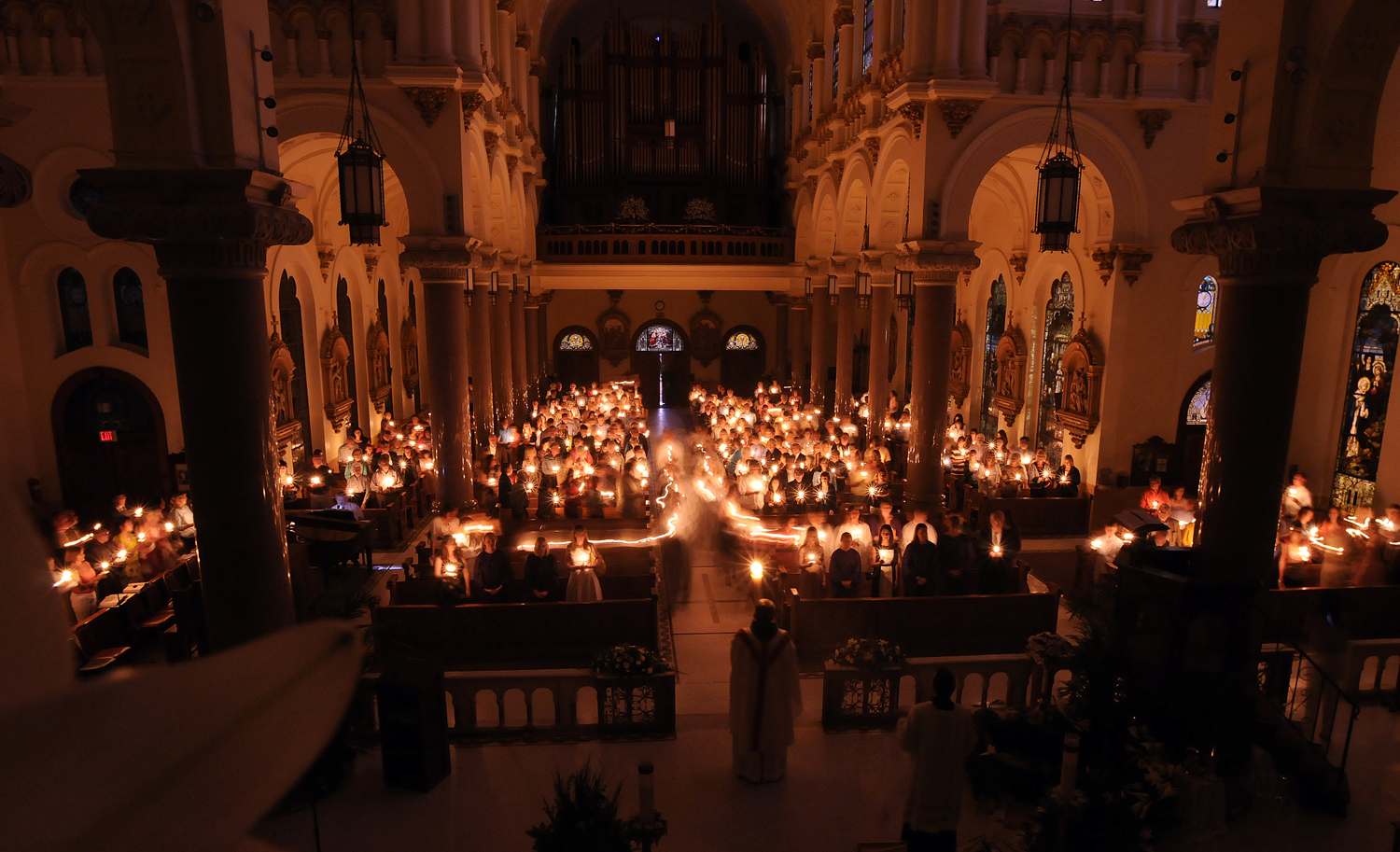
Darkness, Candles, and Things Unsaid

Easter Vigil at Sacred HeartI am always amazed at the sayings that are attributed to St. Francis of Assisi.  Today, I was asked if the following saying was from Francis: “All the darkness in the world cannot extinguish the light of a single candle.”  Nice, but at first blush it does not possess the language or sense of language for which Francis is known. The language is not even particularly medieval, but then maybe this is just a modernized version of the saint’s words.

If you search the internet, you will find this “quote” has pretty wide distribution and uniform attributed to St. Francis.  Most have no citation; but some do.  The only source given was “The Little Flowers of St. Francis.”  You can find the Little Flowers in volume 3 (pp. 566-658) of Francis of Assisi: Early Documents  –  Armstrong, Regis, J.A. Wayne Hellmann, and William Short, eds. (New York: New City Press, 1999–2004).

What you can’t find is the quote, or an account for which the quote could be a reduction. I could be wrong.  If someone has the specific citation (text and chapter) that would be an interesting thing to know.   I know I should just let these things go, but…. let the saint speak for himself … I’m just saying.

The Persistent Widow – The Faith

01_Persistent_WidowThis parable is a twin of the parable of the neighbor in need (11:5-8). Both are used to illustrate the importance of persistence in prayer. Both present a person in need persistently pressing a request, and both parables call for reasoning from the lesser to the greater: If a neighbor or an unjust judge will respond to the urgent need and repeated request, then will not God also respond? It is an argument from lesser to the greater by which Jesus affirms the faithfulness of God – He will assuredly act on behalf of the righteous. Continue reading

The Persistent Widow – Context

01_Persistent_WidowLuke 18:1-8  1 Then he told them a parable about the necessity for them to pray always without becoming weary. He said, 2 “There was a judge in a certain town who neither feared God nor respected any human being. 3 And a widow in that town used to come to him and say, ‘Render a just decision for me against my adversary.’ 4 For a long time the judge was unwilling, but eventually he thought, ‘While it is true that I neither fear God nor respect any human being, 5 because this widow keeps bothering me I shall deliver a just decision for her lest she finally come and strike me.’” 6 The Lord said, “Pay attention to what the dishonest judge says. 7 Will not God then secure the rights of his chosen ones who call out to him day and night? Will he be slow to answer them? 8 I tell you, he will see to it that justice is done for them speedily. But when the Son of Man comes, will he find faith on earth?” Continue reading

Becoming Grateful

francisbrnOn his way to Jerusalem, Jesus meets 10 lepers. They ask for mercy, they are cured, and told to show themselves to the priest who will verify their healing and ritually cleanse them so that they can re-enter society. Only one returns to thank Jesus.  There are lots of commentaries and folks who conclude that the other nine, in some way, lack gratitude.

Could be, but I don’t think so… who wouldn’t be grateful to be cured of this dread disease? Who wouldn’t be grateful for being restored to their family and community?  Grateful, that they are no longer banished from the towns, the market, and the usual ebb and flow of life; no longer consigned to beg day upon day without end. I suspect they were grateful. Continue reading

Boundaries, Faith, and Gratitude – Gratitude

Gratitude

The Samaritan fell at the feet of Jesus and thanked him.  Some might argue that it reads too much into the posture to say that it is an act of worship (although I think that is a fair reading of Luke) – but in any event, is it an act of humility.  St. Bonaventure, sometimes referred to as the second founder of the Franciscan friars, wrote in his work The Tree of Life that humility is the guardian and gateway of all the other virtues and that gratitude is its first evidence. Continue reading

David and Goliath – a second look

I suspect most folks know and can tell some version of the story of David and Goliath (see 1 Samuel 17). It is a narrative that lends itself to story telling for people of all ages.  It is also a story that is so familiar that when we attempt to study the biblical passage we are likely to engage in isogesis, placing our interpretation upon the text, rather than exegesis, letting the story inform us. I regularly lead a bible study with emphasis on “study.”  I think the line I most often use is some variation of “Is that what the text says?”

With that as background, have a look at the ever interesting Malcolm Gladwell’s talk on David and Goliath