
 27 Now Jesus and his disciples set out for the villages of Caesarea Philippi. Along the way he asked his disciples, “Who do people say that I am?” 28 They said in reply, “John the Baptist, others Elijah, still others one of the prophets.” 29 And he asked them, “But who do you say that I am?” Peter said to him in reply, “You are the Messiah.” 30 Then he warned them not to tell anyone about him. 31 He began to teach them that the Son of Man must suffer greatly and be rejected by the elders, the chief priests, and the scribes, and be killed, and rise after three days. 32 He spoke this openly. Then Peter took him aside and began to rebuke him. 33 At this he turned around and, looking at his disciples, rebuked Peter and said, “Get behind me, Satan. You are thinking not as God does, but as human beings do.” 34 He summoned the crowd with his disciples and said to them, “Whoever wishes to come after me must deny himself, take up his cross, and follow me. 35 For whoever wishes to save his life will lose it, but whoever loses his life for my sake and that of the gospel will save it. (Mark 8:27–35) Continue reading
Take up the cross: context
Reply
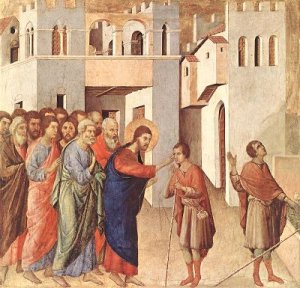 When I was fourth grade I suffered a long series of ear infections and operations that temporarily left my hearing very reduced, some days, virtually deaf. I missed a lot of school that year and when I did return to class there were two things that still stand out in my memory: (a) I had to sit in the front of the class directly in front of the teacher so that I could maximize the chance of hearing her, and (b) I had to stay behind during recess for extra lessons or studying for all that I had missed.
  Stories carry the lifetime of wisdom, experience, reflection, and all manner of insight – a true treasure trove. When I am at the bedside of a dying patient at TGH, with the family gathered, if it seems appropriate, I will ask them to tell me stories of their loved one. It is often difficult to be the first one to offer an account, but when they do, the floodgates open and the stories pour out. They are stories that make you laugh, cry, roll your eyes, and remember all the impish delight and love this one person brought into the world. As I said, a true treasure trove.
 The first reading today is from the Book of Deuteronomy, an account of the last words of the prophet Moses to the people at the end of their 40-year trek in the wilderness – from slavery in Egypt to the freedom of the promise land. His words are to the people who long ago made the decision to stay, to fight, to endure the years of struggle, the ones who remained.
 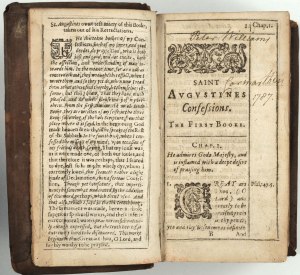 St. Augustine of Hippo begins his great work “Confessions” with a question: “How shall I call upon my God and my Lord, when by the very act of calling upon him I would be calling himself into myself? Is there any place within me into which my God might come? How can God who made the heaven and earth come into me? Is there any room in me for you, Lord, my God?” (I:2)
 friarmusings