
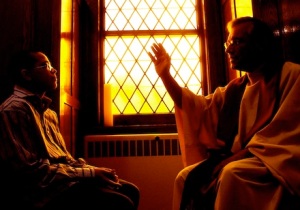
 On a rather regular basis, I am asked via email about the Sacrament of Reconciliation (Confession) and forgiveness of sins. The questions that I am thinking of are mostly from folks who are firmly entrenched in their Christian faith in the Protestant or Reformed tradition. But increasingly these days, inquiries also come from Catholics. Sometimes they are not really questions at all. They are invitations for me to debate them as they wish to free me from the errors of my Catholic beliefs or free the Catholic from the need to go to the Sacrament of Reconciliation. The question is always some variation of “how can priests forgive sins” when – and here are the variations in their logic – (a) there is no such thing as priest, there is only Jesus as High Priest, (b) only God can forgive sins, (c) people only have one mediator, jesus Christ, and therefore one need only ask Jesus for forgiveness, (d) Scripture never talks about confessing sins to a priest, ….and I think that covers the common debate topics. Continue reading
Breaking the chains
2
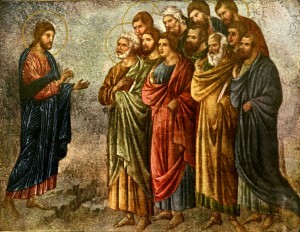 The gospel for the
  Adam is created as God’s first-born son. He’s also conceived as a priest. In
  This coming Sunday is the
  Fair warning, this is not my usual fare for posting. As it happens I am in my office waiting for a parishioner when I came across this article. Here is the setup. Do you remember the chewing gum
  It is a familiar gospel, a well-known story. It is an episode of “Doubting Thomas.” The one held up for us as an example of what not to be – the one who doubted Jesus. “Don’t be a Doubting Thomas!” we are warned because that leaves you one step away from being Judas.
 Life can be breathless. Sometimes we need to take a breath and see how far we have come; to ponder our successes, our failings, all the hurdles we jumped, disasters we dodged, and things that we accomplished. As strange as it might seem, the Easter Season can be a time to think about Lent. At the beginning of Lent the classic refrain is “What are you giving up?” One parishioner who loves chocolate gave it up entirely for Lent. I asked, “Did that bring you closer to God?” The response was, “Not really. I just end up being cranky and miserable for all of Lent.” I am pretty sure that was not the hoped-for result. Within the tradition of prayer, alms giving, and fasting, there needs to be a path that makes room in your life for our God who is ever close to us.
  Over the last several weeks we have been considering what awaited the men who came to join Francis of Assisi and this growing fraternity of believers seeking to follow Christ more fully in the world. We had mentioned there were no rules, regulations, or even a formation program; there was only Francis and the other brothers. But what drew the men to want to “come and see?” Undoubtedly, as today, a complex of reasons, but key among those reasons was Francis of Assisi’s reputation for holiness and miracles.
 Saint Jerome believed that the zoology of his time taught that there were 153 different kinds of fish; and the number, as a result, reflected universality. Jerome was probably incorrect about the zoologists of his own day, but his idea about universal symbolism was probably correct. Augustine of Hippo argued that the significance lay in the fact that 153 is the sum of the first 17 integers with 17 representing the combination of divine grace (the 7 gifts of the Spirit) and law (the Ten Commandments). Augustine goes farther and notes that “153” is the “triangular number.” He arrives at this conclusion noting that 153=1!+2!+3!+4!+5! (math refresher: factorials). When the factorials are arranged (see diagram), one sees an image of the Trinity. (Sorry: I was an undergraduate math major , and just had to include this…!)
 1 After this, Jesus revealed himself again to his disciples at the Sea of Tiberias. He revealed himself in this way. 2 Together were Simon Peter, Thomas called Didymus, Nathanael from Cana in Galilee, Zebedee’s sons, and two others of his disciples. 3 Simon Peter said to them, “I am going fishing.” They said to him, “We also will come with you.” So they went out and got into the boat, but that night they caught nothing. [from
  friarmusings