This coming Sunday is the 29th Sunday in Year B of the lectionary cycle. It is a familiar story in which James and John seek glory: ““Grant that in your glory we may sit one at your right and the other at your left.” (Mark 10:37) The tenth chapter of Mark has been especially dense with preparing the disciples for the time when Jesus will no longer be with them as their teacher. Jesus will enter Jerusalem at the beginning of Mark 11. The terrible fate that Jesus has already predicted for himself awaits even as he strives to have the disciples more fully understand the meaning of the Kingdom. Continue reading
Monthly Archives: October 2021
Just passing through
There was a young friar who sought to live simply and a contemplative life. His Guardian gave him permission to live in his own lean-to down by the river. For the first week the friar was ecstatic – his prayer life blossomed and he really felt he had taken a major step on his journey to God. At the end of the week, the young friar washed his one habit and put it out to dry. The next morning he was dismayed to find that some rats had torn his habit to shreds. So he covered himself as best he could, went to a nearby village and begged for another. A week later, after washing, the rats destroyed that habit as well. So, the young friar got a cat – and presto – rat problem solved. Continue reading
8 Years Stranded
I ran across this fascinating article this morning about ships that were stranded in the Suez Canal upon the start of the 6-Day War between Israel and Egypt in 1967. The ships remained stranded for eight years. What happened to the crew? the cargo? the ships? Enjoy the read.
Francis and the Leper: Fraternity and Factions
…and we continue with some historical context and background for our consideration of the accounts of St. Francis and the Leper.
While Francis was present with them in the years before 1219, the newness and charismatic dynamism of Francis was enough to keep the small group of brothers open to the unfolding vision that God was giving Francis. They took on no special tasks or roles, rather they committed to a certain way of living the Gospel of Jesus Christ. But as seen in the vocational questions above, the world and the Church had true needs, and the Pope especially saw in Francis and his brothers a ready reserve of workers for the vineyards of the Lord. Continue reading
Nature Abhors a Vacuum
The expression is attributed to Aristotle who articulated a belief that nature contains no vacuums because at the mere existence of a vacuum, the denser surrounding material continuum would immediately fill the void. He also argued against the void in a more abstract sense that by definition a void, itself, is nothing, and following Plato, nothing cannot rightly be said to exist. The idea was restated as “Natura abhorret vacuum” by François Rabelais (d. 1553), a French humanist and physician mainly remembered for his bawdy songs and poetry. The strictest criterion to define a vacuum is a region of space and time where all the components of the stress–energy tensor are zero. This means that this region is devoid of energy and momentum, and by consequence, it must be empty of particles and other physical fields (such as electromagnetism) that contain energy and momentum. But what does that have to do with today’s readings? Continue reading
For the sake of the Gospel
This coming Sunday is the 28th Sunday in Ordinary Time in Cycle B of the Lectionary. It is a familiar story as Jesus encounters a rich young man who asks what must he do to inherit eternal life. He doesn’t like Jesus’ answer and goes away sad. Peter hears this and “…began to say to him, “We have given up everything and followed you.” Jesus said, “Amen, I say to you, there is no one who has given up house or brothers or sisters or mother or father or children or lands for my sake and for the sake of the gospel who will not receive a hundred times more now in this present age: houses and brothers and sisters and mothers and children and lands, with persecutions, and eternal life in the age to come. But many that are first will be last, and (the) last will be first.” (Mark 10:28-31) Continue reading
Governor McConaissance?
I have to admit I am not a fan of politics, politicians, and the milieu they create. I am reminded of the famous quote from Obi Wan-Kenobi: “Mos Eisley spaceport. You will never find a more wretched hive of scum and villainy. We must be cautious.” Ok, that might be a bit over the top, but it is a great quote … and if you don’t know who Obi Wan-Kenobi is … well, I can’t help you. Continue reading
The Franciscan Crown Rosary
At our parish in Tampa we have a Gift & Book Store. After shopping in the store, a parishioner sought out the pastor. “Father, your gift store has rosaries that were made by someone who didn’t know the rosary. Were they made in China?” The parishioner had noticed that some rosaries had seven decades of beads in contrast to the traditional five. It was not a mistake – those rosaries were called “Franciscan Crowns.”
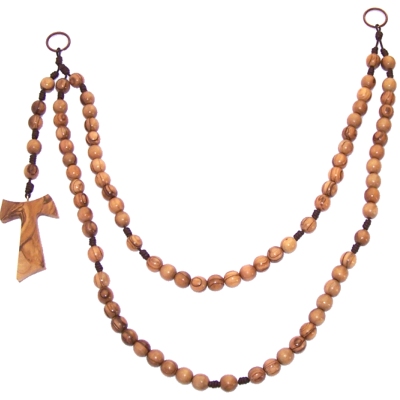
The Franciscan Crown – The Franciscan Crown (or Seraphic Rosary) is a rosary consisting of seven decades in commemoration of the Seven Joys of the Virgin – a tradition of the middle ages:
- the Annunciation,
- the Visitation,
- the Nativity of Jesus,
- the Adoration of the Magi,
- the Finding in the Temple,
- the Resurrection of Jesus, and
- the Assumption and Coronation of the Virgin.
The Franciscan Crown has also been called the Franciscan Rosary, the Seraphic Rosary or the Rosary of the Seven Joys of Our Lady.
History of the Crown – The Franciscan historian, Father Luke Wadding (1588-1657) dates the origin of the Franciscan Crown to the year 1422. In 1442 an apparition of the Blessed Virgin Mary took place in Assisi, to a Franciscan novice named James. As a child, he had the custom of offering daily the Virgin Mary a crown of roses. When he entered the Friars Minor, he became distressed that he would no longer be able to offer this gift. The Blessed Virgin appeared to him to give him comfort and showed him another daily offering that he might do: to pray every day seven decades of Hail Mary prayers, meditating between each decade on one of the seven joys that she had experienced in her life. Friar James began this devotion, but one day the Director of Novices saw him praying and an angel with him who was weaving a crown of roses, placing a lily of gold between each of the ten roses. When the novice had finished praying, the angel placed the crown upon him. The Director asked Friar James what this vision meant. After hearing the explanation, he told the other friars and soon this devotion spread throughout the Franciscan family.
How to Pray the Franciscan Crown Rosary: The Franciscan Crown Rosary begins quite simply by stating the first Joy and then praying one Our Father and ten Hail Mary’s while meditating upon it. This same procedure is then followed for the other six Joys. It is common practice to add the Glory Be at the end of each decade. It is customary to finish by adding two Hail Mary’s in honor of the 72 years that Our Lady is said to have lived on earth, and one Our Father and Hail Mary for the intentions of the Pope.

Did you know – the Rosary
Prayers with beads like the rosary may have begun as a practice by the laity to imitate the Christian monasticism of the Liturgy of the Hours, during the course of which the monks prayed the 150 Psalms daily. As many of the laity and even lay monastics could not read, they substituted 150 repetitions of the Our Father for the Psalms, sometimes using a cord with knots on it to keep an accurate count. During the middle ages, evidence suggests that both the Our Father and the Hail Mary were recited with prayer beads. Continue reading
Malaria Vaccine
This morning’s email brought the news that the World Health Organization (WHO) approved the first vaccination for malaria. The vaccine, called Mosquirix, is not just a first for malaria — it is the first developed for any parasitic disease. Parasites are much more complex than viruses or bacteria, and the quest for a malaria vaccine has been underway for a hundred years. In this age of the covid-19 pandemic we are used to hearing vaccine efficacy of 95% plus. The malaria vaccine’s efficacy is only about 50% across all malaria pathogens, but that is a start. The vaccine targets plasmodium falciparum, the deadliest of five malaria pathogens and the most prevalent in Africa. Continue reading