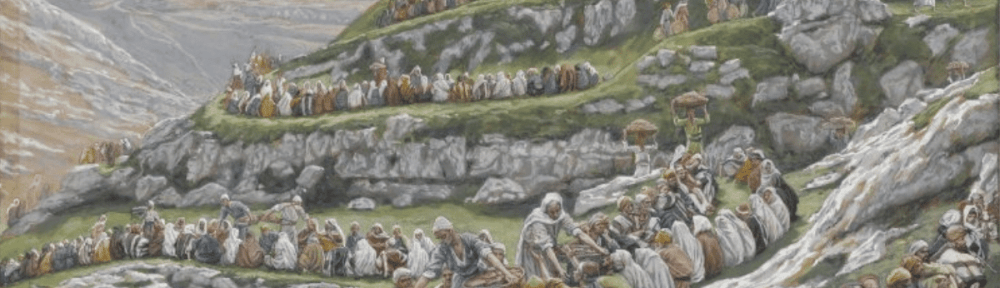
This coming Sunday is the 18th Sunday in Ordinary Time, Lectionary Cycle A. Eugene Boring (323-4) notes that this miracles account appears six times in the NT gospels and incorporates a wide variety of imagery from Scripture, as well as the Jewish and Christian traditions. Looking to all the various accounts, Boring lists the prominent imagery:
- the wilderness setting for the people of God en route from captivity to the promised land
- recalcitrant Israelites / disciples, who doubt that food can be provided in the wilderness (Ex. 16:2-3);
- God leads the people who are like sheep without a shepherd as the narrative calls to mind Ps 23 and its green grass;
- the giving of manna (Ex 16, Nb 11);
- Elisha’s miraculous provision of food (2 Kings 4:42-44) in which there are provisions left over;
- Jesus, accused of being a glutton (Mt 11:19) provided table fellowship for all;
- Jesus’ Eucharistic last meal with his disciples in which he takes on the role of the head of the new family, providing food and pronouncing the blessing; and
- the messianic banquet as part of the gathering of all creation seen in the bread and sea creatures.
The imagery points across the full breadth of salvation history, pointing to Jesus’ fulfillment as the “great prophet like Moses” and the Exodus experience, keying upon the miraculous feeding by Elisha in 2 Kings, pointing forward to the Last Supper and institution of the Eucharist, as well as indicating the breaking in of the Kingdom of Heaven in the typology of the great banquet with so much food that everyone had their fill and there are still foods leftover.
On this mountain the LORD of hosts will provide for all peoples a feast of rich food and choice wines, juicy, rich food and pure, choice wines. (Isaiah 25:6)
Image credit: James J. Tissot, ‘Miracle of the Loaves and Fishes’ (1886-94), Brooklyn Museum, NYC | PD-US
Discover more from friarmusings
Subscribe to get the latest posts sent to your email.

