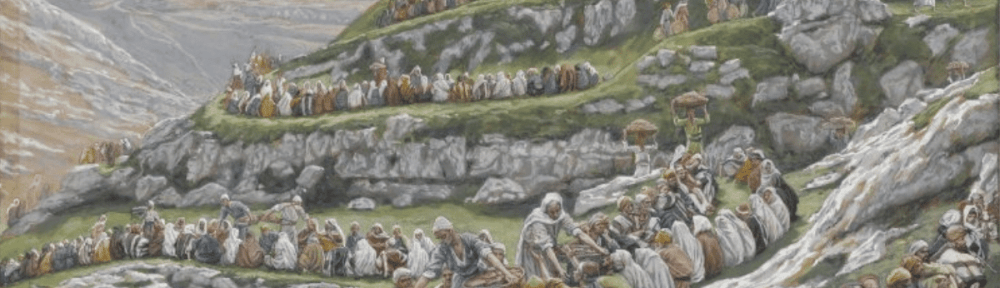
This coming Sunday is the 18th Sunday in Ordinary Time, Lectionary Cycle A. The miraculous feeding of a very large number of people in the wilderness is one miracle that is told in each of the four canonical gospels. Despite the consistency of the narrative there are, in every age, those who reject the miraculous offering that Jesus only inspired the people to share. Or they dismiss the narrative as apocryphal – or at best an altered memory of a large feast that imagined the coming banquet of the Kingdom. Keener (403) points out that nothing would be more memorable than a feeding miracle, especially in the context of the culture of their day. Keener offers four points:
- First, the disciples were right to be concerned about the people’s hunger but intended to solve the problem in a purely natural way (e.g. 1 Kings 17:16 and 2 Kings 4:43). Our expectations of what God can do often are too small; providing food in the wilderness was technically impossible, but God had used Moses, Elijah and Elisha for feeding miracles.
- Second, like God of the Hebrew scriptures, Jesus takes what his servants bring to him and multiplies it. (Ex 4:1-3; 2 Kings 4:1-7)
- Third, God does miracles only when his people need them – and the need is very evident in this wilderness area.
- Fourth, sharing is not the narrative thrust of Matthew’s writing. The ending points to thing outside and beyond the people present: (a) we are not to be intimidated by the magnitude of the problem because God is with us, and (b) the surprising leftovers point to the continuation of this miracle (greater than manna which had no leftovers) into the Apostolic Age.
Adding to Keener’s insight, there is also the clear Eucharistic intention in the use of four verbs ‘take’, ‘bless’, ‘break’ and ‘give’ which occur with minor variations not only in all six accounts of the two miraculous feedings and in that of the Emmaus meal, but also in all four accounts of the Last Supper.
That being said, at the event itself, the Eucharistic foretaste would be unknown and so Keener’s understanding of the event in Old Testament terms is appropriate.
Image credit: James J. Tissot, ‘Miracle of the Loaves and Fishes’ (1886-94), Brooklyn Museum, NYC | PD-US
Discover more from friarmusings
Subscribe to get the latest posts sent to your email.

