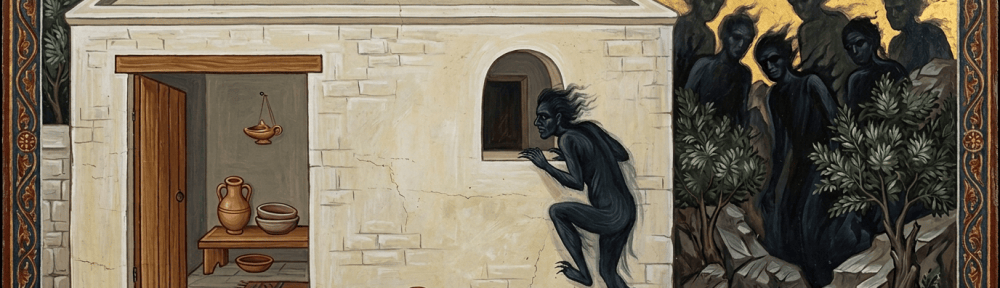
In today’s gospel we witness an encounter between Jesus and the people after Jesus had driven a demon out of an afflicted person. At the end of the dialogue, Jesus offers a parable: “When an unclean spirit goes out of someone, it roams through arid regions searching for rest but, finding none, it says, ‘I shall return to my home from which I came.’ But upon returning, it finds it swept clean and put in order.”
This sounds like a good thing, yes? The house has been cleaned up. Everything is orderly. What’s wrong with the house? Nothing, apparently. It’s clean, swept and orderly, but it’s also empty.
In the context of the gospel story, Jesus uses the man from whom the demon has been cast out as the source for the house in the parable. We might say that the person has reformed and cast out the bad things, the unholy things. But will that be enough?
As David Henry Thoreau commented: “Nature abhors a vacuum, and if I can only walk with sufficient carelessness I am sure to be filled.”
Apparently have been spiritually careless, the house/the person has not filled up with good, holy and true things. There exists a spiritual vacuum and when noticed by the demon, it “…brings back seven other spirits more wicked than itself who move in and dwell there, and the last condition of that man is worse than the first.” It seems that getting rid of what was there was not enough. Something needed to take its place. Nature abhors a vacuum. Apparently, according to Jesus, so does the human heart.
Moral reform is not the same as Christian conversion. Christianity cannot simply consist of removing things: I stopped doing this. I gave up that habit. I don’t hang out with those people anymore. “I’ve cleaned up life and set it in order.” All of that may be necessary. But Jesus seems to be saying that an emptied life, even a beautifully cleaned and orderly life, is still vulnerable. The Gospel isn’t simply about what leaves us when Christ enters our lives. It is about what fills us afterward.
Jesus isn’t offering generic advice about self-improvement. The context of the gospel message is the arrival of God’s Kingdom in Jesus: something stronger has arrived. The arrival of God’s Kingdom is far more than getting rid of the evil spirit. It extends to letting the Strong One in.
Yes, you’ve been baptized, confirmed, reared in the Faith, and have continued into your adult years. Those can be profound beginnings. But the house has to become a home. And that takes a lifetime to fill our lives with Christ. The Word of God is one essential means. The Eucharist another. Prayer, charity, sacramental life, Christian community: all are ways in which our lives become increasingly inhabited by Christ. Elsewhere, St. Paul gives us wonderful language for this: “Let the word of Christ dwell in you richly.” (Col 3:16) Not visit, or drop by, but dwell.
So… hopefully you have taken care of what should not be in your life, but should be there and up to now is missing? Maybe I’ve removed anger but have I cultivated mercy? I’ve stopped gossiping but have I learned to speak words that build others up? I’ve stopped spending time with those who would lead me astray but have I developed friendships with people who draw me toward God? I have cleared out lots of things, but what have I put in their place?
Every day something is forming us, filling our minds, and shaping our desires. Something is teaching us what to love. The question isn’t whether we will be filled. The question is what we are allowing to fill us.
Jesus didn’t come merely to clean up the house.
He came to make it His home in which He dwells.
Image credit: WordPress AI based on the text of the posts | downloaded 10-9-2026 | AI-described as: A vintage Greek folk-art illustration shows a pale stone house with an open wooden doorway, pottery, and a dark figure reaching from an arched window. A group of shadowy spirits gathers among olive trees and rocks to the right, creating an eerie contrast with the warmly lit house. The image is framed by an ornate blue, gold, and rust-colored border, with radiating lines behind the Greek title Η ΟΙΚΙΑ ΚΑΙ ΤΑ ΠΝΕΥΜΑΤΑ, meaning “The House and the Spirits.”
Discover more from friarmusings
Subscribe to get the latest posts sent to your email.

