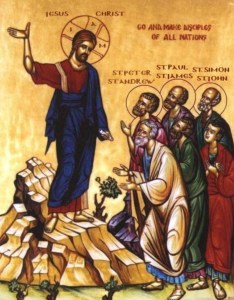
 The Solemnity of the Holy Trinity is a celebration of the revelation of God as three-persons-in-One: Father, Son, and Holy Spirit. The origins of the celebration of Trinity Sunday can be traced the time of the Arian heresy of the early fourth century. Arius believed that Christ was a created being, and in denying the full divinity of Jesus, he denied that there are three Persons in God – essentially arguing that Jesus was as though a “lesser god.” Arius’ chief opponent, St. Athanasius, upheld the orthodox doctrine that there are three Persons in one God, and the orthodox view prevailed at the Council of Nicaea, from which we get the Nicene Creed, recited in most Christian churches every Sunday.
For many centuries, the Athanasian Creed, traditionally ascribed to St. Athanasius, was recited at Mass on Trinity Sunday. While seldom read today it is a testimony to the mystery of the Holy Trinity.
The Athanasian Creed
Whosoever will be saved, before all things it is necessary that he hold the catholic faith. Which faith except every one do keep whole and undefiled; without doubt he shall perish everlastingly. And the catholic faith is this: That we worship one God in Trinity, and Trinity in Unity; Neither confounding the Persons; nor dividing the Essence. For there is one Person of the Father; another of the Son; and another of the Holy Ghost. But the Godhead of the Father, of the Son, and of the Holy Ghost, is all one; the Glory equal, the Majesty coeternal. Such as the Father is; such is the Son; and such is the Holy Ghost. The Father uncreated; the Son uncreated; and the Holy Ghost uncreated. The Father unlimited; the Son unlimited; and the Holy Ghost unlimited. The Father eternal; the Son eternal; and the Holy Ghost eternal. And yet they are not three eternals; but one eternal. As also there are not three uncreated; nor three infinites, but one uncreated; and one infinite. So likewise the Father is Almighty; the Son Almighty; and the Holy Ghost Almighty. And yet they are not three Almighties; but one Almighty. So the Father is God; the Son is God; and the Holy Ghost is God. And yet they are not three Gods; but one God. So likewise the Father is Lord; the Son Lord; and the Holy Ghost Lord. And yet not three Lords; but one Lord. For like as we are compelled by the Christian verity; to acknowledge every Person by himself to be God and Lord; So are we forbidden by the catholic religion; to say, There are three Gods, or three Lords. The Father is made of none; neither created, nor begotten. The Son is of the Father alone; not made, nor created; but begotten. The Holy Ghost is of the Father and of the Son; neither made, nor created, nor begotten; but proceeding. So there is one Father, not three Fathers; one Son, not three Sons; one Holy Ghost, not three Holy Ghosts. And in this Trinity none is before, or after another; none is greater, or less than another. But the whole three Persons are coeternal, and coequal. So that in all things, as aforesaid; the Unity in Trinity, and the Trinity in Unity, is to be worshipped. He therefore that will be saved, let him thus think of the Trinity.
Furthermore it is necessary to everlasting salvation; that he also believe faithfully the Incarnation of our Lord Jesus Christ. For the right Faith is, that we believe and confess; that our Lord Jesus Christ, the Son of God, is God and Man; God, of the Essence of the Father; begotten before the worlds; and Man, of the Essence of his Mother, born in the world. Perfect God; and perfect Man, of a reasonable soul and human flesh subsisting. Equal to the Father, as touching his Godhead; and inferior to the Father as touching his Manhood. Who although he is God and Man; yet he is not two, but one Christ. One; not by conversion of the Godhead into flesh; but by assumption of the Manhood by God. One altogether; not by confusion of Essence; but by unity of Person. For as the reasonable soul and flesh is one man; so God and Man is one Christ; Who suffered for our salvation; descended into hell; rose again the third day from the dead. He ascended into heaven, he sitteth on the right hand of the God the Father Almighty, from whence he will come to judge the living and the dead. At whose coming all men will rise again with their bodies; And shall give account for their own works. And they that have done good shall go into life everlasting; and they that have done evil, into everlasting fire. This is the catholic faith; which except a man believe truly and firmly, he cannot be saved. Amen
To further stress the doctrine of the Trinity, other Fathers of the Church, such as St. Ephrem the Syrian, composed prayers and hymns that were recited in the Church’s liturgies and on Sundays as part of the Divine Office, the official prayer of the Church. A special (votive) Mass text in honor of the Holy Trinity was introduced and incorporated in the Roman liturgical books. This Mass was not assigned for a definite day but could be used on certain Sundays according to the private devotion of each priest. During the first thousand years of Christianity there was no special feast day celebrated in honor of this mystery, but, as Pope Alexander II (1073) declared, every day of the liturgical year was devoted to the honor and adoration of the Sacred Trinity.
It was however in the ninth century on, various bishops of the Frankish kingdoms promoted in their own dioceses a special feast of the Holy Trinity, usually celebrated on the Sunday after Pentecost. Eventually, a special version of this office began to be celebrated on the Sunday after Pentecost, and the Church in the England isles, at the request of St. Thomas à Becket (1118-1170), was granted permission to celebrate Trinity Sunday. The celebration of Trinity Sunday was made universal by Pope John XXII in 1334.


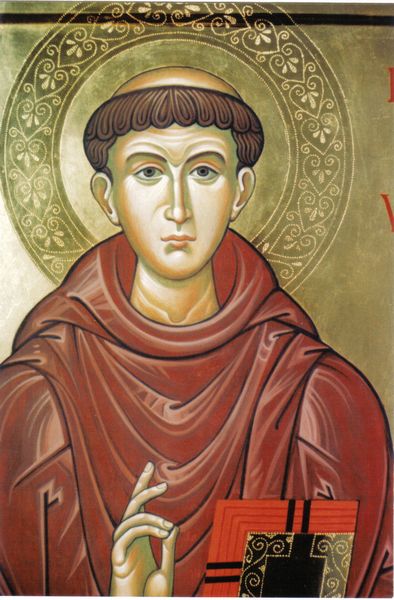 When we Franciscans arrived at Sacred Heart in 2005, we were quite surprised to find that one of the clerestory windows (the ones up high in the nave vault) was Saint Anthony of Padua, a Franciscan contemporary of St. Francis of Assisi. In fact, we Franciscans still have a brief letter, in Francis’ own hand, written to Anthony. Most people know St. Anthony of Padua as the patron saint of lost and stolen articles, but have you ever wondered why he is that particular patron saint? Continue reading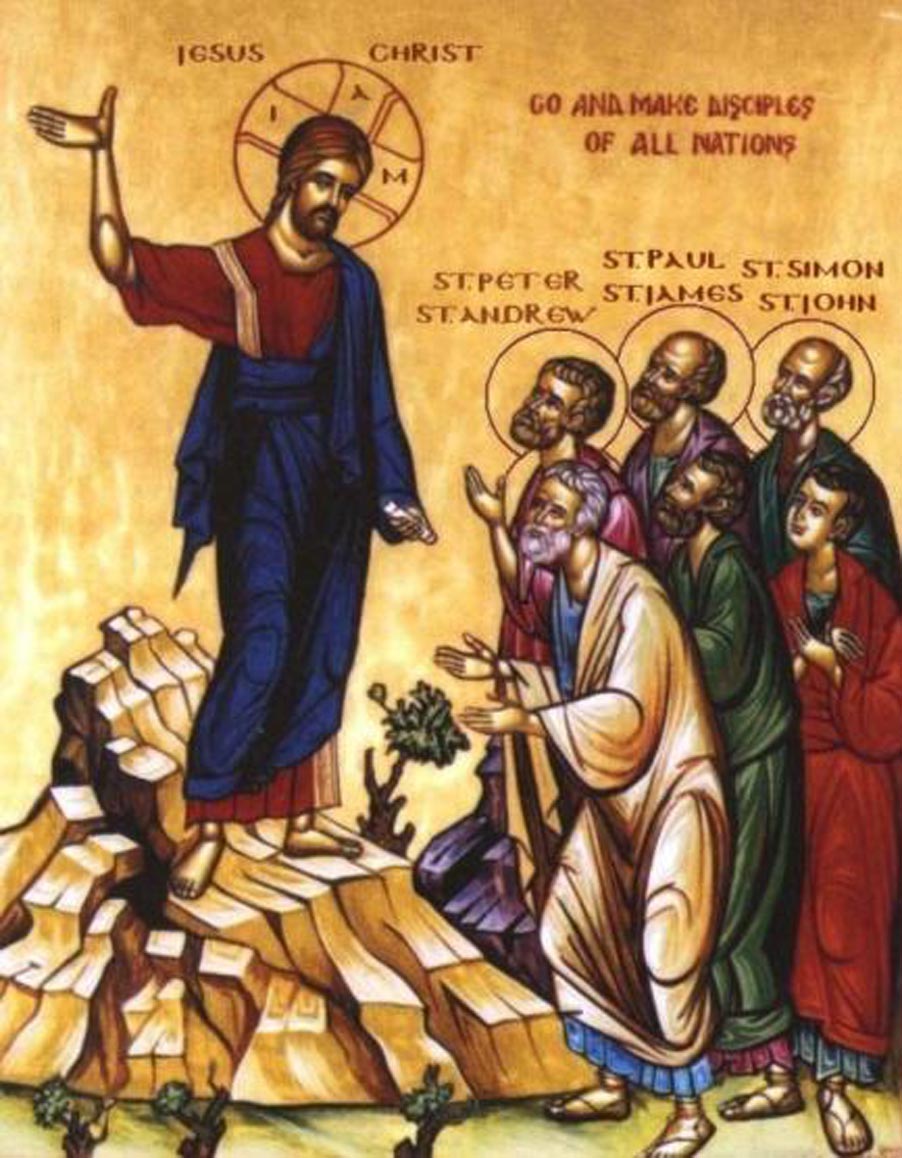
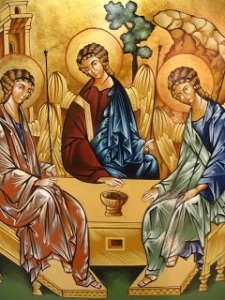 Holy Trinity Sunday is celebrated on the first Sunday following Pentecost in most of the liturgical churches in Western Christianity. It is a solemn celebration of the belief in the revelation of one God, yet three divine persons. It was not uniquely celebrated in the early church, but as with many things the advent of new, sometime heretical, thinking often gives the Church a moment in which to explain and celebrate its own traditions; things it already believes and holds dear. In the early 4th century when the Arian heresy was spreading, the early church, recognizing the inherent Christological and Trinitarian implications, prepared an Office of Prayer with canticles, responses, a preface, and hymns, to be recited on Sundays to proclaim the Holy Trinity. Pope John XXII (14th century) instituted the celebration for the entire Church as a feast; the celebration became a solemnity after the liturgical reforms of Vatican II.
 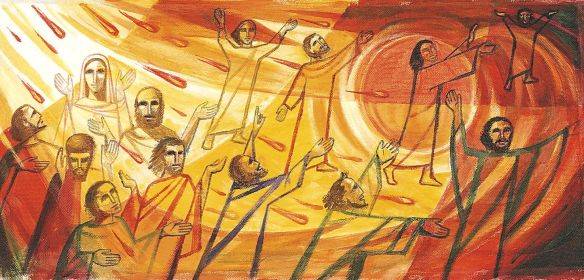 “And they were all filled with the holy Spirit and began to speak in different tongues, as the Spirit enabled them to proclaim… At this sound, they gathered in a large crowd, but they were confused because each one heard them speaking in his own language… They were all astounded and bewildered, and said to one another, “What does this mean?” But others said, scoffing, “They have had too much new wine.”
  Today’s post is a “guest column” from parish Director of Faith Formation, Barbara Ferreris
 This coming Sunday marks the
  friarmusings