
Unknown's avatar

About Friar Musings

Franciscan friar and Catholic priest at St. Francis of Assisi in Triangle, VA

The Mission Ahead

This coming Sunday we celebrate the Solemnity of the Ascension. The first reading for Sunday is taken from the first chapter of Acts of the Apostles. The gospel reading is taken from Luke 24. Yesterday we considered a high-level view of the unity of the two volumes as a way of showing the centrality of the Ascension as a connection of the mission of Jesus and the mission of the Church. Today we consider the Ascension itself.

I think it may be a fair statement that we modern readers are more engaged by the actual ascending into heaven, but I would suggest that is not Luke’s central focus. Luke is more concerned with what was said than with what happened. The vital question was the one posed by the disciples: now that Jesus had been raised from the dead, was God going to complete his purpose by finally establishing his rule? The answer given was twofold. First, the time of this event remained God’s secret; what was more important was the immediate task of the disciples which was to act as witnesses to Jesus from Jerusalem to the end of the earth. The spread of God’s rule was to take place by means of the disciples, empowered by the Spirit. This was the final command of Jesus before he left the disciples. 

Secondly, the departure of Jesus was interpreted as a pattern for his ultimate return to the earth to inaugurate the final establishment of the rule of God. These verses spell out God’s purpose and the place of the church in it. They postulate that the period of witness and mission must precede the return of Jesus. They were in effect a warning to the disciples not to expect a speedy winding up of history. For Luke’s readers some forty or more years later they were a reminder of an ongoing task: the gospel must still be taken to the end of the earth. At the same time the words contain a note of promise in that the departure of Jesus is compensated for by the coming of the Spirit, given by Jesus himself (2:33).

When they had gathered together they asked him, “Lord, are you at this time going to restore the kingdom to Israel?” 7  He answered them, “It is not for you to know the times or seasons that the Father has established by his own authority.  The question about restoring the rule to Israel in 1:6 also shows continued misunderstanding about what the kingdom of God meant. Acts 2:3 will show that God’s promise was about the coming of the Holy Spirit, not an earthly empire. The prohibition against trying to compute the times of the end is meant to discourage Luke’s readers from guessing what cannot be known. Rather, they should focus on the power of the Spirit as the sign of living in the promised final days. Luke says Christians are to use this power during whatever time is left to witness to Jesus to the ends of the earth. They should not waste energy trying to figure out when the end of the world will be….to be continued. 


Image credit: detail of “Ascension of Jesus” | John Singleton Copely, 1775 | Museum of Fine Arts, Boston | PD-US
The scorpion and the fox

A well know fable:

A scorpion wants to cross a river and asks a fox to carry him across on its back.
The fox hesitates, afraid that the scorpion will sting him.
The scorpion argues, “If I sting you, we’ll both drown.”
The fox agrees, and they begin to cross the river.
Halfway across, the scorpion stings the fox.
As they both begin to sink, the fox gasps, “Why did you do that?”
The scorpion replies, “I couldn’t help it. I am what I am.”

The fable teaches that some people cannot (or are unwilling) change their fundamental nature—even when it’s self-destructive or goes against logic. It is with that in mind that I recommend the the article: Why Americans Don’t Understand Vladimir Putin.

Evangelization Masterclass

The account of St. Paul’s address on the Areopagus in Athens is a masterclass in the evangelization of the culture – a skill surely important for our day and age. His arrival in Athens is, in its way, the introduction of Christianity to Europe. It was an event, while of no particular note or importance to historians, thoughts leaders, or philosophers of the day, was one that shaped the history of Western Europe and eventually the world.

Continue reading

Ascension Account Compared

This coming Sunday we celebrate the Solemnity of the Ascension. The first reading for Sunday is taken from the first chapter of Acts of the Apostles. The gospel reading is taken from Luke 24. Previously we considered the Acts of the Apostles as a whole, Today we take a high-level view of the unity of the two works of scripture.

Luke begins Acts as he begins his Gospel, with a foreword to his patron Theophilus, reminding him that the “first book” covered the time until Jesus was taken up by God to heaven. The Gospel ends with a brief reference to this incident (Luke 24:51), which was preceded by important teaching given by Jesus to his disciples. So important was this teaching that we have three accounts of it. Luke records it in the Gospel (Luke 24, especially vv. 44–49); he then summarizes it briefly in this introductory part of Acts, and then he covers certain aspects of it once again in the story of the ascension which is the first incident in the main narrative in Acts (1:6–11). The repetition is partly for emphasis, and at the same time it indicates that the period from Easter Sunday to the Ascension is both the conclusion of the earthly ministry of Jesus and the beginning of the work of the church. This period had two important characteristics. It provided evidence that Jesus was alive (1:3), having risen from the dead, and it was the time when Jesus gave his mission orders to the apostles (1:4f.; cf. 1:7f.).

Continue reading

Faith that Frees

In today’s first reading from the Acts of the Apostles, Paul and Silas are stripped, beaten, and thrown into prison. Their only “crime” was setting a slave girl free from possession by a spirit – and interfering with the men who profited by her oracles. But what stands out most in this passage isn’t the injustice they suffered — it’s what they did while imprisoned: they prayed and sang hymns to God.

Paul and Silas were not only physically bound, but also humiliated and wounded. Yet, “about midnight”, when things seemed darkest, they chose to pray and sing. This is more than optimism — it is deep trust in God. They didn’t wait for their chains to fall off before worshiping. They worshiped while still in chains.

What about us? How often do we wait for our problems to be solved before thanking God? Paul and Silas show us that praise is not dependent on our situation — it needs to be rooted in our relationship with God.

there was suddenly such a severe earthquake that the foundations of the jail shook; all the doors flew open, and the chains of all were pulled loose” (Acts 16:26)

But Paul and Silas don’t run — and neither do the other prisoners. Something about their prayerful presence kept everyone calm and centered.

What about us? I hope you realize that your quiet prayers, your long years of trust in God might be helping others just by being steady, faithful, and present. It is witness and can influence those around us. The jailer, who was ready to take his own life thinking the prisoners had escaped, finds hope because of their witness. Paul says, “Do no harm to yourself; we are all here.” (v.28)  The jailer, shaken to the core, falls before them and asks: “…what must I do to be saved?

Paul responds with the Gospel in its simplest form: “Believe in the Lord Jesus and you and your household will be saved.” That very night, the jailer and his whole household are baptized. He who once held Paul and Silas captive now washes their wounds. This is the power of grace: it reverses roles, heals enemies, and brings salvation where there was despair.

When we find ourselves “in prison” — whether through suffering, discouragement, or uncertainty — may we remember this lesson from Paul and Silas. Let us choose prayer over panic, praise over bitterness, and faith over fear. God still opens prison doors and loosens chains — sometimes not by removing the problem, but by transforming hearts, starting with our own.


Image credit: “Paul and Silas in Prison” | Joseph Mulder (ca.1725) | Museum of Fine Arts Ghent | PS-US

A day in Navy history

Some days in history are just filled with interesting events, but then there have many years and centuries – so something interesting is bound to happen on any given date. This day in history marked some significant events in naval history

In 1905 the Japanese fleet destroys the Russian East Sea fleet in the Battle of Tsushima, the only decisive clash between modern steel battleships in history. It was the first major victory of an Asian power over a European one in modern times. As a result it fueled Japanese nationalism and reinforced the belief that military strength was essential for Japan’s security and prestige. It also elevated the Imperial Japanese Navy as a symbol of national power, encouraging further investment in military expansion.

The victory boosted the influence of military leaders in government, setting a precedent for the army and navy to play a greater role in politics. Over time, military success became intertwined with Japan’s identity, laying the groundwork for the later dominance of militarists in the 1930s.

In changed Japanese view of the Western powers, justifying further expansion into Korea (1910 annexation) and into Manchuria. This was the beginning that set the stage for Japan’s imperial ambitions in East Asia and the Pacific. 35 years after Tsushima, the Japanese attacked Pearl Harbor.

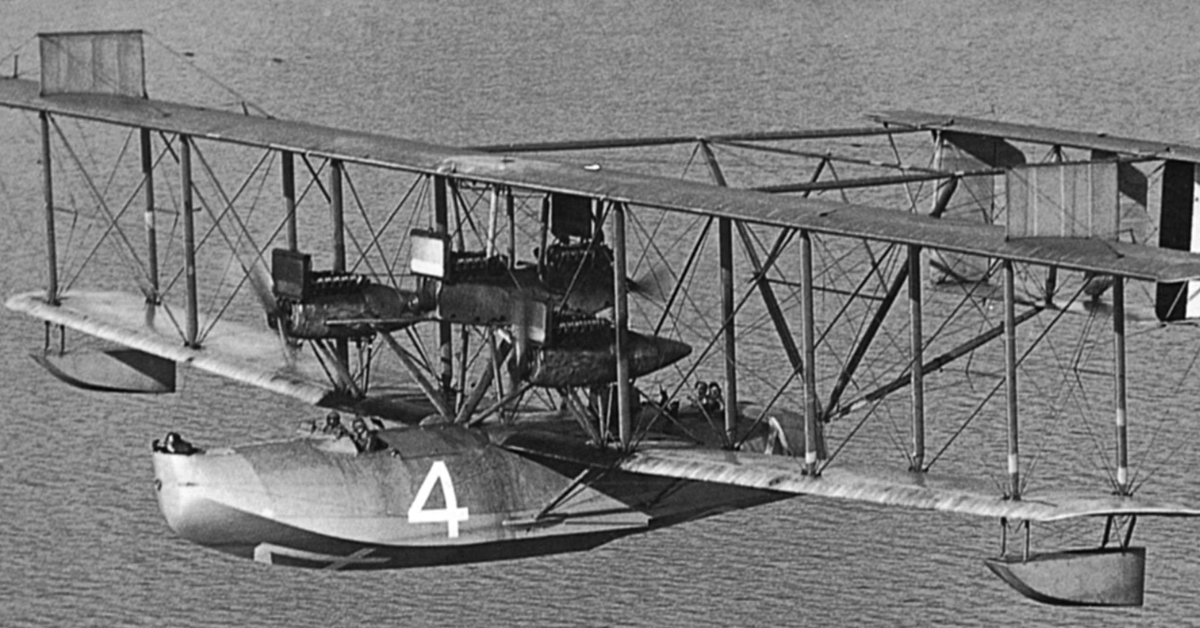
This day in history (1919) the US Navy’s NC-4 flying boat completed the first Trans-Atlantic Flight, albeit not non-stop. A crew of United States Navy and US Coast Guard aviators flew the NC-4 from New York State to Lisbon, Portugal, over the course of 19 days. This included time for stops for numerous repairs and crewmen’s rest, with stops along the way in Massachusetts, Nova Scotia, Newfoundland, and twice in the Azores Islands. Then its flight from the Azores to Lisbon completed the first transatlantic flight between North America and Europe, and two more flights from Lisbon to northwestern Spain to Plymouth, England, completed the first flight between North America and Great Britain. This accomplishment was somewhat eclipsed in the minds of the public by the first nonstop transatlantic flight, made by the Royal Air Force pilots John Alcock and Arthur Whitten Brown two weeks later.

The Navy/Coast Guard aviators became a footnote in history. Alock and Brown were were knighted by King George V and awarded 10,000 English pounds – that’s about $825,000 US (2025).

Image creator: Olaf Rahardt | Credit: ullstein bild

Also on this day in history (1941) the German battleship Bismarck sunk by British naval force sea and air forces. The Bismarck was the pride of the Kriegsmarine (German Navy)—one of the most powerful and modern battleships in the world at the time. Its loss marked a crippling setback to Germany’s surface fleet and ended its realistic hopes of challenging British naval dominance in the Atlantic. Its sinking ensured greater security for Atlantic convoys, which were vital for Britain’s survival and war effort – and was a boost in English morale in the midst of the “Battle of Britain.”

Bismarck was ultimately disabled by torpedo bombers from the aircraft carrier HMS Ark Royal, showing the growing dominance of air power in naval warfare. It marked a shift from traditional battleship-on-battleship engagements to more integrated naval operations.

After the Ascension

This coming Sunday we celebrate the Solemnity of the Ascension. The readings are taken from St. Luke’s Gospel and his Acts of the Apostles. Both the first reading and the gospel are accounts of the Ascension, making this event the lynchpin between the two works of St. Luke. Yesterday was an introductory post. Today’s post takes a bird’s eye view of the mission to the world after the Ascension.

Peter was the leading member of the Twelve (Acts 1:13, 15), and after the Resurrection and Ascension was gifted by the Holy Spirit to perform miracles in the name of Jesus (see Acts 3:1-10; 5:1-11, 15; 9:32-35, 36-42) and was the spokesman for the Christian community. In the early days of the Christian Church, it was Peter who was largely responsible for the growth of the community among the Gentile people of Israel, along with Philip. Paul eventually joined the community at Antioch, which subsequently commissioned him and Barnabas to undertake the spread of the gospel to Asia Minor. This missionary venture generally had mixed results among the Jews outside of Israel (the diaspora) but enjoyed success among the Gentiles in cities across Asia Minor, Macedonia, and Greece.

Continue reading

Land of the Free, Because of the Brave

Memorial Day 2025

“Today, we’re not just fortunate heirs of their legacy. We have a responsibility to be the keepers of their mission—that truest memorial of their lives: the actions we take every day to ensure that our democracy endures, the very idea of America endures.” (President Biden, Memorial Day, 2024)

“The Americans who rest beneath these beautiful hills and in sacred ground across our country and around the world, they are why our nation endures. Each simple stone marker arranged in perfect military precision signifies the cost of our blessings. It is a debt we can never fully repay. But it is a debt we’ll never stop trying to fully repay, by remaining a nation worthy of their sacrifice.” (President Obama, Memorial Day 2015)

Video graciously forwarded this day by a good parishioner.

The Journeys

This coming Sunday is the 7th Sunday of Ordinary Time, but in almost all of the dioceses of the United States, as allowed, the Solemnity of the Ascension is transferred from its traditional Thursday celebration to the following Sunday, replacing 7th Easter. The celebration of the Ascension offers an interesting combination of readings – each by the same author, St. Luke.  The first reading for Sunday is taken from the first chapter of Acts of the Apostles. The gospel reading is taken from Luke 24. In a way the accounts of the Ascension serve as the lynchpin between the two works of St. Luke. I will attempt to cover both during the course of the week.

Continue reading