Unknown's avatar

About Friar Musings

Franciscan friar and Catholic priest at St. Francis of Assisi in Triangle, VA

Seven Things Paul VI Did Before Pope Francis Made it Cool

Original Post at USSCBlog by Don Clemmer

Pope-Paul-VI Pope-FrancisOnly a pope who has railed against clericalism to the extent that Pope Francis has could get away with canonizing two popes at once and then beatifying a third within six months. But that’s exactly what will happen October 19, when Pope Francis moves another one of his predecessors, Paul VI (1963-1978), one step closer to official sainthood.

There’s been ample consideration of how Pope Francis completes a triumvirate with his two immediate predecessors, and it’s easy to compare Francis to the jovial, Council-calling, tradition-shirking John XXIII. But in numerous other ways, there’s a direct line of influence from Pope Paul to his latest successor, who was ordained a priest during Paul’s pontificate and largely formed by it:

“A poor Church for the poor.” In his first audience as pope, Francis explained his choice of name as inspired by Francis of Assisi — the man of poverty, the man of peace, the friend of creation. He has gone on to condemn on numerous occasions a “throwaway culture” linking everything from poverty to genocide to a willingness to cast people aside as disposable. Pope Paul’s 1967 encyclical Populorum Progressio greatly laid the foundation for this thinking, as did his 1972 World Day of Peace message, “If you want peace, work for justice.” Continue reading →
Imagio Dei

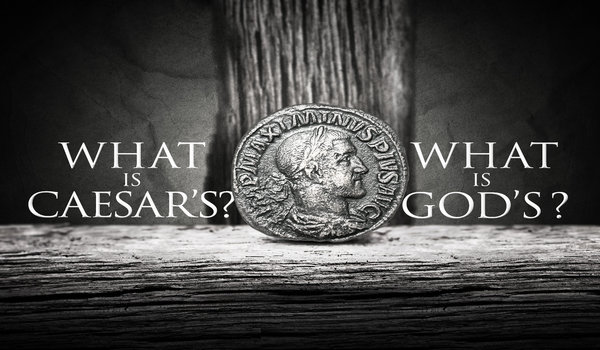
Coinage1An Underlying Thought. Jesus’ answer calls into question the basic presupposition behind their question, that there is an essential incompatibility between loyalty to the governing authority and loyalty to God. This was precisely Judas the Galilean’s position as explained by Josephus (War 2.118 and Ant. 18.23): to pay the tax was to tolerate a mortal sovereign in place of God. It was loyalty to God which was the basis for Zealot objections to Roman taxation, but Jesus, without reducing the demands of loyalty to God, indicates that political allegiance even to a pagan state is not incompatible with it. This is not a rigid division of life into the ‘sacred’ and the ‘secular’, but rather a recognition that the ‘secular’ finds its proper place within the overriding claim of the ‘sacred’. Continue reading →

Why are you testing me?

Coinage1Matthew 22:15–22 15 Then the Pharisees went off and plotted how they might entrap him in speech. 16 They sent their disciples to him, with the Herodians, saying, “Teacher, we know that you are a truthful man and that you teach the way of God in accordance with the truth. And you are not concerned with anyone’s opinion, for you do not regard a person’s status. 17 Tell us, then, what is your opinion: Is it lawful to pay the census tax to Caesar or not?” 18 Knowing their malice, Jesus said, “Why are you testing me, you hypocrites? 19 Show me the coin that pays the census tax.” Then they handed him the Roman coin. 20 He said to them, “Whose image is this and whose inscription?” 21 They replied, “Caesar’s.” At that he said to them, “Then repay to Caesar what belongs to Caesar and to God what belongs to God.” 22 When they heard this they were amazed, and leaving him they went away. Continue reading →

Caesar and God: context

Coinage1Matthew 22:15–22  15 Then the Pharisees went off and plotted how they might entrap him in speech. 16 They sent their disciples to him, with the Herodians, saying, “Teacher, we know that you are a truthful man and that you teach the way of God in accordance with the truth. And you are not concerned with anyone’s opinion, for you do not regard a person’s status. 17 Tell us, then, what is your opinion: Is it lawful to pay the census tax to Caesar or not?” 18 Knowing their malice, Jesus said, “Why are you testing me, you hypocrites? 19 Show me the coin that pays the census tax.” Then they handed him the Roman coin. 20 He said to them, “Whose image is this and whose inscription?” 21 They replied, “Caesar’s.” At that he said to them, “Then repay to Caesar what belongs to Caesar and to God what belongs to God.” 22 When they heard this they were amazed, and leaving him they went away. Continue reading →

Many are invited…

cast out13 Then the king said to his attendants, ‘Bind his hands and feet, and cast him into the darkness outside, where there will be wailing and grinding of teeth.’ 14 Many are invited, but few are chosen.”

The Elect of God. The judgment seems harsh, but Matthew is thinking not of an actual wedding party, but of the last judgment. The language “weeping and gnashing of teeth” corresponds to 8:12; 13:42, 50; 24:51; 25:30, an apocalyptic expression (cf. Luke 13:28) that became a favorite of Matthew’s to picture the terror of condemnation at the last judgment. Continue reading →

The Wedding Garment

weddingfeastredhouse11 But when the king came in to meet the guests he saw a man there not dressed in a wedding garment. 12 He said to him, ‘My friend, how is it that you came in here without a wedding garment?’ But he was reduced to silence.

What to Wear. Scholars are of mixed opinion about the urgency of the “feast is ready” in v.8 as it applied to those invited when the servants scour the main road. One line of thought offers that these royal wedding feasts were several days in the making and even more in the execution. Not all guests came at the beginning nor stayed until the end. There was a great deal of coming-and-going during it all. There is no reason to suppose that, once invited, these people have no time to go home, to change their clothes, and to borrow clothes from their neighbors, if necessary. Continue reading →

Community Called: Good and Bad Alike

Parable_Of_The_Great_Supper7 The king was enraged and sent his troops, destroyed those murderers, and burned their city. 8 Then he said to his servants, ‘The feast is ready, but those who were invited were not worthy to come. 9 Go out, therefore, into the main roads and invite to the feast whomever you find.’ 10 The servants went out into the streets and gathered all they found, bad and good alike, and the hall was filled with guests. Continue reading →

Invited to Feast with the King

ur_invitedIn the Various Traditions. Among the various sources of Christian tradition, this parable of the wedding banquet has been preserved in three distinct versions. The simplest, and some say most authentic, rendering of the parable can be found in the non-canonical Gospel of Thomas. In Thomas’ version, the parable is composed of a series of refusals to a dinner. Each of the guests who begged off did so for reasons of business or commerce. Consequently the host sent servants into the streets to bring back whomever they could find. The tag line of the parable proclaims: “Buyers and merchants will not enter the places of my Father” (Thomas 64:12). Luke’s version of the parable (Luke 14:16-24), also preserves the reversal motif and bears evidence of the evangelist’s conviction, that the poor, outcasts, those otherwise marginalized from society will find a welcome in the kingdom. Continue reading →

The Wedding Feast: context

Gospel_MatthewMatthew 22:1–14 1 Jesus again in reply spoke to them in parables, saying, 2 “The kingdom of heaven may be likened to a king who gave a wedding feast for his son. 3 He dispatched his servants to summon the invited guests to the feast, but they refused to come. 4 A second time he sent other servants, saying, ‘Tell those invited: “Behold, I have prepared my banquet, my calves and fattened cattle are killed, and everything is ready; come to the feast.”’ 5 Some ignored the invitation and went away, one to his farm, another to his business. 6 The rest laid hold of his servants, mistreated them, and killed them. 7 The king was enraged and sent his troops, destroyed those murderers, and burned their city. 8 Then he said to his servants, ‘The feast is ready, but those who were invited were not worthy to come. 9 Go out, therefore, into the main roads and invite to the feast whomever you find.’ 10 The servants went out into the streets and gathered all they found, bad and good alike, and the hall was filled with guests. 11 But when the king came in to meet the guests he saw a man there not dressed in a wedding garment. 12 He said to him, ‘My friend, how is it that you came in here without a wedding garment?’ But he was reduced to silence. 13 Then the king said to his attendants, ‘Bind his hands and feet, and cast him into the darkness outside, where there will be wailing and grinding of teeth.’ 14 Many are invited, but few are chosen.” Continue reading →