
The Peace of God revealed…

6th Sunday of Easter, Year C: John 14:23-29

23 Jesus answered and said to him, “Whoever loves me will keep my word, and my Father will love him, and we will come to him and make our dwelling with him. 24 Whoever does not love me does not keep my words; yet the word you hear is not mine but that of the Father who sent me. 25“I have told you this while I am with you. 26 The Advocate, the holy Spirit that the Father will send in my name—he will teach you everything and remind you of all that (I) told you. 27 Peace I leave with you; my peace I give to you. Not as the world gives do I give it to you. Do not let your hearts be troubled or afraid. 28 You heard me tell you, ‘I am going away and I will come back to you.’ If you loved me, you would rejoice that I am going to the Father; for the Father is greater than I. 29 And now I have told you this before it happens, so that when it happens you may believe.

Introduction

Our passage today is taken from the “Farewell Discourse” of Jesus contained in five chapters of John (13:1-17:56). In other words, we have but a few verses which are an integral part of a much larger passage. Accordingly, the Discourse can be outlined in a number of ways, though three main parts are fairly clear: Continue reading

The Son of Man glorified…

The Gospel for the Fifth Week of Easter: John 13:31-35

31 When [Judas] had left, Jesus said, “Now is the Son of Man glorified, and God is glorified in him. 32 (If God is glorified in him,) God will also glorify him in himself, and he will glorify him at once. 33 My children, I will be with you only a little while longer. You will look for me, and as I told the Jews, ‘Where I go you cannot come,’ so now I say it to you. 34 I give you a new commandment: love one another. As I have loved you, so you also should love one another. 35 This is how all will know that you are my disciples, if you have love for one another.”

Introduction

Perhaps we should place this short gospel passage in context. The public ministry of Jesus has drawn to a close with Chapter 12.  Here in Chapter 13 begins the “private ministry” of Jesus preparing his disciples for his impending death.  John 13:1-17:26 is characterized by Jesus’ being alone with his disciples before his betrayal and arrest. While there may have been others present, such as those who were serving the meal, the focus is on the Twelve (so also Mt 26:20; Mk 14:17;  Lk 22:14). The section begins with an account of Jesus washing the disciples’ feet and the prediction of Judas’ betrayal (13:1-30). Then there is a lengthy section known as the farewell discourse, which consists of teachings (13:31–16:33) and a concluding prayer by Jesus (17:1-26). Continue reading

The Good Shepherd

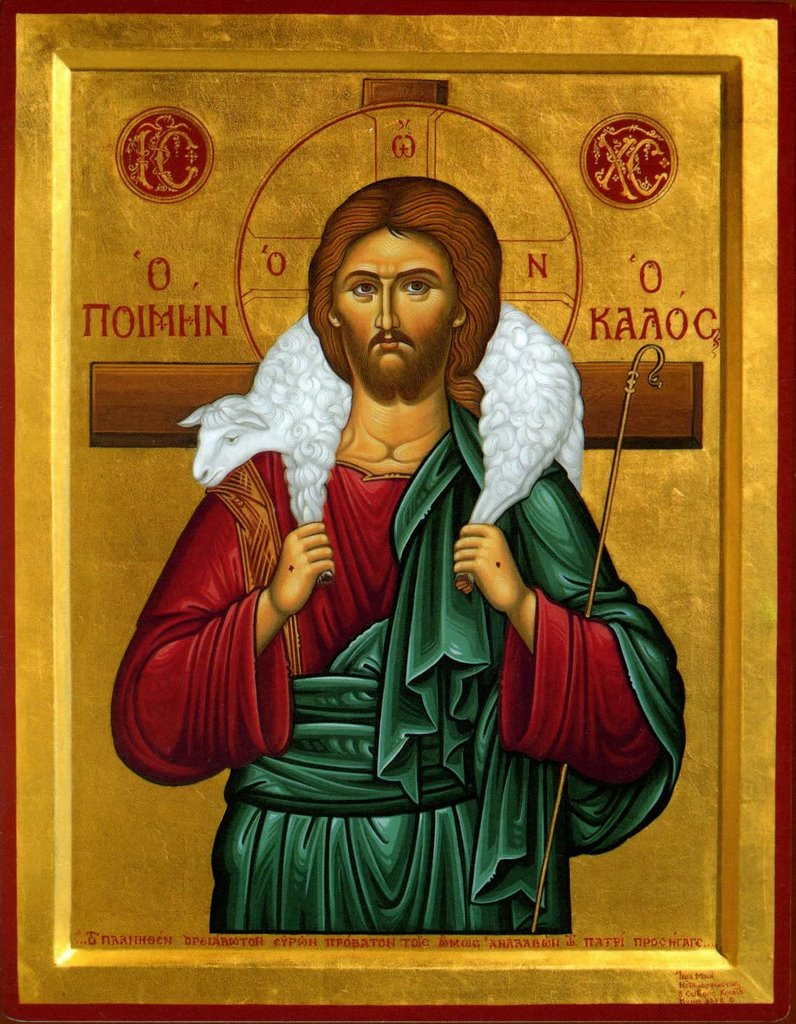
Christ the Good ShepherdThis coming Sunday, the 4th Sunday in Easter, is often referred to as “Good Shepherd Sunday” as the gospel comes from John 10. I thought I would share some notes I have assembled over the years…. as I note when I post such things, credits, footnotes and other such things are incomplete.  Please know the work of many true scholars makes this post possible.

John 10:27-30

27 My sheep hear my voice; I know them, and they follow me. 28 I give them eternal life, and they shall never perish. No one can take them out of my hand. 29 My Father, who has given them to me, is greater than all, and no one can take them out of the Father’s hand. 30 The Father and I are one.”

Continue reading

The cords that bind and lead us…

francisbrnI am still waiting for the call from Rome telling me that I have been appointed Papal Household Swim Coach.  It has been a running joke in the office since the papal elections. So, it was somewhat humorous several weeks ago when the parish telephone rang – and on the other end was a call from Rome.  Wasn’t the swim coach call, but rather it was the Vicar General of the Franciscan OFM Order worldwide asking me to consider a new job.  It was not a pastoral job, but a full time job more akin to running a business – and in a place where people wear sweaters even in summer – as opposed to Tampa where sweaters are optional most of the year. I promised to pray about it Continue reading

The Upper Room

2nd SunSt-thomas5day of Easter – Year C: John 20:19-31 – Jesus Appears to the Disciples in the Upper Room

Something to consider. We have come to know this passage as the story of “Doubting Thomas.” Yet among all the Greek words for “doubt” [diakrinomai, dialogismos, distazō, dipsychos, aporeō, or aporia] none of these appear in the gospel text. Thomas is described as apistos, that is, without trust, lacking assurance, or questioning. What, if any, difference is there between “doubting” and “questioning?” Continue reading

Connecting the dots

he_qi_road_to_emmaus

Road to Emmaus by He Qi

The daily Mass readings for the Wednesday in the Octave of Easter includes the well-known account of two travelers on the road to Emmaus. Earlier this week I included a commentary on the passage. This morning in Mass I offered a few thoughts on the passage.

It seems to me that we all have plans. It is my experience that those plans never unfold quite as we had planned.  Some are side-tracked, some laid aside for other plans, others fall away forgotten or unused, and some are part of disappointment, discouragement, or a life slipping off the rails. Continue reading

The Gospel of Luke – The Road to Emmaus


In Luke’ narrative there is no account of the Resurrection; there in only the empty tomb – which is not the source of faith for people in Luke’s rendering of the gospel. Rather, in Luke’s gospel it is the empty tomb and the encounter with the person of the Risen Jesus.

The empty tomb is what Jesus had said would happen “on the third day.”  The event of its discovery points back to Jesus’ word.  A word mostly fully realized later in the ‘breaking of the bread.”

Luke 24:13 Now that very day two of them were going to a village seven miles from Jerusalem called Emmaus,14 and they were conversing about all the things that had occurred.15 And it happened that while they were conversing and debating, Jesus himself drew near and walked with them,16 but their eyes were prevented from recognizing him.17 He asked them, “What are you discussing as you walk along?” They stopped, looking downcast.18 One of them, named Cleopas, said to him in reply, “Are you the only visitor to Jerusalem who does not know of the things that have taken place there in these days?”19 And he replied to them, “What sort of things?” They said to him, “The things that happened to Jesus the Nazarene, who was a prophet mighty in deed and word before God and all the people,20 how our chief priests and rulers both handed him over to a sentence of death and crucified him.21 But we were hoping that he would be the one to redeem Israel; and besides all this, it is now the third day since this took place. Continue reading

A clear test….

Folks who read blogs don’t always know too much about the person whose writings they have taken the time to read.  You can always find out a little something on an “About” page. Here is mine. I am a Franciscan friar and an ordained Catholic priest.  It is who I am.

Speaking at the Chrism Mass on Holy Thursday at St. Peter’s Basilica yesterday, Pope Francis gave “a clear test” of the meaning of ordained priesthood.

A good priest can be recognized by the way his people are anointed. This is a clear test. When our people are anointed with the oil of gladness, it is obvious: for example, when they leave Mass looking as if they have heard good news. Our people like to hear the Gospel preached with “unction”, they like it when the Gospel we preach touches their daily lives, when it runs down like the oil of Aaron to the edges of reality, when it brings light to moments of extreme darkness, to the “outskirts” where people of faith are most exposed to the onslaught of those who want to tear down their faith. People thank us because they feel that we have prayed over the realities of their everyday lives, their troubles, their joys, their burdens and their hopes. And when they feel that the fragrance of the Anointed One, of Christ, has come to them through us, they feel encouraged to entrust to us everything they want to bring before the Lord: “Pray for me, Father, because I have this problem”, “Bless me”, “Pray for me” – these words are the sign that the anointing has flowed down to the edges of the robe, for it has turned into prayer. The prayers of the people of God. When we have this relationship with God and with his people, and grace passes through us, then we are priests….

Pray for me that I may be a priest who strives to daily pass this “clear test.”

Pope Francis – honeymoon, challenges, and legends

While we are still in the early days of the papacy of Pope Francis, the reports, accounts, stories and insights continue to pour into the “newsverse.”  I thought it might be helpful to have a summary of some of the ones I have seen that I think are helpful.

There are lots of others posts available out there – one only needs to query.  And while 88% of American Catholics are currently happy to extremely happy with his election, that still leaves 12% who are not – and some of their blogs are scathing. But I will leave you to find them

And for the history of Jorge Mario Bergoglio in graphic form, you can look here.