Blindness: miracles

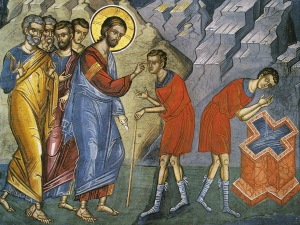
A Man Born Blind: John 9:1-41  1 As he passed by he saw a man blind from birth. 2 His disciples asked him, “Rabbi, who sinned, this man or his parents, that he was born blind?” 3 Jesus answered, “Neither he nor his parents sinned; it is so that the works of God might be made visible through him. 4 We have to do the works of the one who sent me while it is day. Night is coming when no one can work. 5 While I am in the world, I am the light of the world.” (the remainder of the gospel can be read here).

Our narrative begins with the simple phrase “As he passed by…” It lacks the general markers (time, geography, etc.) that indicate a break in continuity, sug­gesting that John intends the story of the blind man to be read in continuity with the preceding chapters. So what was in the preceding chapter? The primary narrative in Chapter 8 is the “woman caught in adultery,” Jesus’ self-identification as the “light of the world,” and a long discussion between Jesus and the “Jews” about the very nature of what it means to be of the covenant people – a dialogue that occurs in the context of the Feast of Tabernacles. Continue reading

At the well: we have heard for ourselves

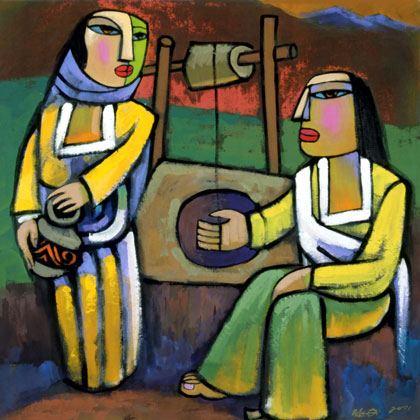
SamaritanWomanAtTheWellJesus’ words overflow with metaphor: living water, the hour, food, harvest. Each of these metaphors attempts to open reality in fresh ways for his conversation partners. Jesus wants to open the eyes of the Samaritan woman and his disciples so that they can see what is being offered to them in the present instead of continuing to view everything through the lens of old realities. Jesus wants the Samaritan woman to see who is speaking with her at this moment and the gifts that he offers (4:10). He wants her to see that the present moment is the time of eschatological fulfillment (4:23-24). Jesus wants his disciples to see that the harvest is ready now, contrary to popular understandings (4:35). In both conversations (4:7.26, 31-38), Jesus takes familiar images and fills them with new meaning in order to open up for his listeners the possibilities of a life defined by God’s gifts. The metaphors of these verses keep the terms of the conversations always fresh, always suggestive, always open to new meanings in changing circumstances. Continue reading

At the well: one sows another reaps

SamaritanWomanAtTheWellArrival of the disciples and departure of the woman.  27 At that moment his disciples returned, and were amazed that he was talking with a woman, but still no one said, “What are you looking for?” or “Why are you talking with her?” 28 The woman left her water jar and went into the town and said to the people, 29 “Come see a man who told me everything I have done. Could he possibly be the Messiah?” 30 They went out of the town and came to him. 31 Meanwhile, the disciples urged him, “Rabbi, eat.” 32 But he said to them, “I have food to eat of which you do not know.” 33 So the disciples said to one another, “Could someone have brought him something to eat?” 34 Jesus said to them, “My food is to do the will of the one who sent me and to finish his work. 35 Do you not say, ‘In four months the harvest will be here’? I tell you, look up and see the fields ripe for the harvest. 36 The reaper is already receiving his payment and gathering crops for eternal life, so that the sower and reaper can rejoice together. 37 For here the saying is verified that ‘One sows and another reaps.’ 38 I sent you to reap what you have not worked for; others have done the work, and you are sharing the fruits of their work.” Continue reading

At the well: go call your husband

SamaritanWomanAtTheWell16 Jesus said to her, “Go call your husband and come back.” 17 The woman answered and said to him, “I do not have a husband.” Jesus answered her, “You are right in saying, ‘I do not have a husband.’ 18 For you have had five husbands, and the one you have now is not your husband. What you have said is true.” 19 The woman said to him, “Sir, I can see that you are a prophet. 20 Our ancestors worshiped on this mountain; but you people say that the place to worship is in Jerusalem.” 21 Jesus said to her, “Believe me, woman, the hour is coming when you will worship the Father neither on this mountain nor in Jerusalem. 22 You people worship what you do not understand; we worship what we understand, because salvation is from the Jews. 23 But the hour is coming, and is now here, when true worshipers will worship the Father in Spirit and truth; and indeed the Father seeks such people to worship him. 24 God is Spirit, and those who worship him must worship in Spirit and truth.” 25 The woman said to him, “I know that the Messiah is coming, the one called the Anointed; when he comes, he will tell us everything.” 26 Jesus said to her, “I am he, the one who is speaking with you.”

Go call your husband. Jesus introduces a new topic in v.16 possibly to provide a fresh angle on his identity. In vv.7-15, his invitation to the woman was couched in the metaphor of living water; in vv.16-18, Jesus’ invitation will be grounded in the woman’s own life. Continue reading

At the well: give me a drink

SamaritanWomanAtTheWellConversations between Jesus and the Sa­maritan woman (Jn 4:7-26). The dialogue between Jesus and the Samaritan woman consists of thirteen exchanges, one of the longest dialogues in the Gospel. It divides into two sections, each section introduced by a request/command by Jesus: (I ) vv.7-15 (“Give me a drink”); (2) vv.16-26 (“Go, call your husband”).

7 A woman of Samaria came to draw water. Jesus said to her, “Give me a drink.” 8 His disciples had gone into the town to buy food. 9 The Samaritan woman said to him, “How can you, a Jew, ask me, a Samaritan woman, for a drink?” (For Jews use nothing in common with Samaritans.) 10 Jesus answered and said to her, “If you knew the gift of God and who is saying to you, ‘Give me a drink,’ you would have asked him and he would have given you living water.” 11 (The woman) said to him, “Sir, you do not even have a bucket and the cistern is deep; where then can you get this living water? 12 Are you greater than our father Jacob, who gave us this cistern and drank from it himself with his children and his flocks?” 13 Jesus answered and said to her, “Everyone who drinks this water will be thirsty again; 14 but whoever drinks the water I shall give will never thirst; the water I shall give will become in him a spring of water welling up to eternal life.” 15 The woman said to him, “Sir, give me this water, so that I may not be thirsty or have to keep coming here to draw water.” Continue reading

At the well: some background

SamaritanWomanAtTheWellWho are the Samaritans? In John 4:4-42, Jesus’ ministry enters a new stage. He leaves the confines of traditional Ju­daism and turns to those whom his Jewish contemporaries reckoned as outsiders and ene­mies: the Samaritans. The breach between Jews and Samaritans can be traced to the Assyrian occupation of northern Palestine (721 BCE; see 2 Kings 17), but the most intense rivalry began about 200 BCE. The source of the enmity between Jews and Samaritans was a dispute about the correct location of the cultic center (cf. John 4:20). The Samaritans built a shrine on Mt. Gerizim during the Persian period and claimed that this shrine, not the Jerusalem Temple, was the proper place of worship. The shrine at Mt. Gerizim was destroyed by Jewish troops in 128 BCE, but the schism between Jews and Samaritans continued (cf. John 4:9).

When Jesus meets the Samaritan woman at the well, he meets someone who stands in marked contrast to all that has come before in this gospel. When Jesus spoke with Nicodemus (3:1-21), he spoke with a named male of the Jewish religious establishment, a “teacher of Israel.” When Jesus speaks to the Samaritan woman, he speaks with an unnamed female of an enemy people. Continue reading

Crucifying the King: The Penitent Thief

"Christ and the Thief" by Nikolai Ge.Luke 23:35-43. 33 When they came to the place called the Skull, they crucified him and the criminals there, one on his right, the other on his left. 34 (Then Jesus said, “Father, forgive them, they know not what they do.”) They divided his garments by casting lots. [The above is not part of the Sunday reading, but is generally considered within the narrative. ] 35 The people stood by and watched; the rulers, meanwhile, sneered at him and said, “He saved others, let him save himself if he is the chosen one, the Messiah of God.” 36 Even the soldiers jeered at him. As they approached to offer him wine 37 they called out, “If you are King of the Jews, save yourself.” 38 Above him there was an inscription that read, “This is the King of the Jews.”  39 Now one of the criminals hanging there reviled Jesus, saying, “Are you not the Messiah? Save yourself and us.” 40 The other, however, rebuking him, said in reply, “Have you no fear of God, for you are subject to the same condemnation? 41 And indeed, we have been condemned justly, for the sentence we received corresponds to our crimes, but this man has done nothing criminal.” 42 Then he said, “Jesus, remember me when you come into your kingdom.” 43 He replied to him, “Amen, I say to you, today you will be with me in Paradise.”

The “Penitent Thief” While one of the criminals, already crucified, began to revile “Jesus, saying, “Are you not the Messiah? Save yourself and us.” The word “revile” is eblasphēmei, literally “blaspheme.” It is then we hear the words from the one we know as “the penitent thief.”  Luke does not describe the criminal is such terms. His crime is never described and his penitence is conveyed only by his acknowledgement of his guilt and Jesus’ innocence, and his request that Jesus remember him. Continue reading

Crucifying the King of the Jews

Copia desde la Crucifixion dibujada hacia 1540...Luke 23:35-43. 33 When they came to the place called the Skull, they crucified him and the criminals there, one on his right, the other on his left. 34 (Then Jesus said, “Father, forgive them, they know not what they do.”) They divided his garments by casting lots. [The above is not part of the Sunday reading, but is generally considered within the narrative.] 35 The people stood by and watched; the rulers, meanwhile, sneered at him and said, “He saved others, let him save himself if he is the chosen one, the Messiah of God.” 36 Even the soldiers jeered at him. As they approached to offer him wine 37 they called out, “If you are King of the Jews, save yourself.” 38 Above him there was an inscription that read, “This is the King of the Jews.”  39 Now one of the criminals hanging there reviled Jesus, saying, “Are you not the Messiah? Save yourself and us.” 40 The other, however, rebuking him, said in reply, “Have you no fear of God, for you are subject to the same condemnation? 41 And indeed, we have been condemned justly, for the sentence we received corresponds to our crimes, but this man has done nothing criminal.” 42 Then he said, “Jesus, remember me when you come into your kingdom.” 43 He replied to him, “Amen, I say to you, today you will be with me in Paradise.”

Those Who Mocked. The people stood by and watched; the rulers, meanwhile, sneered at him and said, “He saved others, let him save himself if he is the chosen one, the Messiah of God.” Luke pictures the majority of the people (laos) don’t mock Jesus (contrary to Mark’s description); they are simply watching. Executions were popular functions and doubtless many attended this one. But it was the rulers, not the people, who mocked (cf. Ps. 22:6–8). The leaders sneer (v. 35; lit. “look down their noses” or “thumbed their noses”) and the soldiers mock (v. 36) and one criminal blasphemes (v. 39). They all say the same thing: “Save yourself” – essentially the same temptations of the devil in Luke 4 – avoid the pain and suffering of the cross. Culpepper notes that “The irony here is that Luke underscores both Jesus’ real identity and the true meaning of his death. Jesus was hailed as the Savior at his birth (2:11); as the Son of Man, he had come to seek and save the lost (19:10). But just as he had taught that those who lost their lives for his sake would save them (9:24), so now he must lost his life so that they might be saved. Continue reading

Crucifying the King: “Father forgive them…”

jesus_crucifiedLuke 23:35-43. 33 When they came to the place called the Skull, they crucified him and the criminals there, one on his right, the other on his left. 34 (Then Jesus said, “Father, forgive them, they know not what they do.”) They divided his garments by casting lots. [The above is not part of the Sunday reading, but is generally considered within the narrative.] 35 The people stood by and watched; the rulers, meanwhile, sneered at him and said, “He saved others, let him save himself if he is the chosen one, the Messiah of God.” 36 Even the soldiers jeered at him. As they approached to offer him wine 37 they called out, “If you are King of the Jews, save yourself.” 38 Above him there was an inscription that read, “This is the King of the Jews.”  39 Now one of the criminals hanging there reviled Jesus, saying, “Are you not the Messiah? Save yourself and us.” 40 The other, however, rebuking him, said in reply, “Have you no fear of God, for you are subject to the same condemnation? 41 And indeed, we have been condemned justly, for the sentence we received corresponds to our crimes, but this man has done nothing criminal.” 42 Then he said, “Jesus, remember me when you come into your kingdom.” 43 He replied to him, “Amen, I say to you, today you will be with me in Paradise.”

Commentary. In verses just prior to our gospel reading, Jesus addresses the women as representative of the nation: “daughters of Jerusalem” (Is 37:22; Mic 1:8; Zeph 3:14; Zech 9:9). Jesus notes that they weep for the wrong thing: “weep for yourselves and for your children.” This is because Jesus’ rejection means judgment for the nation (Luke 13:34; 19:41-44; 21:20-21). The tragedy, Jesus says, is not his death but the nation’s failure to choose deliverance, life and forgiveness. Continue reading