Much of Francis’ youth had been spent as an apprentice in his father’s cloth business by day and as playboy by night – a time that the older Francis refers to as “When I was in sin.” At the same time, the intrigue and rivalry of imperial and papal politics swirled around Assisi. When Francis was 16-years old, the popolo, as the merchant and new generation of leaders were called, rose up in revolt against the nobles of Assisi (1198 AD). The last remnant of feudal governance was replaced by the “commune” of the city-state of Assisi. Loyalty to the Emperor was replaced by nominal loyalty to the Papal State. The noble families of Assisi – likely including the family of the young woman who would become St. Clare of Assisi – fled to Perugia, the age-old enemy of Assisi, across the Spoleto Valley. While the people of Assisi thought it to be the definitive victory, it was but a lull in the conflict. Continue reading
Category Archives: franciscan
Who are my mother and brothers?
The reading from today’s gospel (with a few extra verses) and St. Francis of Assisi’s answer to the question.
20 Jesus came with his disciples into the house. Again the crowd gathered, making it impossible for them even to eat. 21 When his relatives heard of this they set out to seize him, for they said, “He is out of his mind.” … 31 His mother and his brothers arrived. Standing outside they sent word to him and called him. 32 crowd seated around him told him, “Your mother and your brothers* [and your sisters] are outside asking for you.” 33 But he said to them in reply, “Who are my mother and [my] brothers?” 34 And looking around at those seated in the circle he said, “Here are my mother and my brothers. 35[For] whoever does the will of God is my brother and sister and mother.” (Mark 3) Continue reading
Francis of Assisi – The Young Man
The first article of the series about St. Francis essentially proposed that what most people think they know about St. Francis of Assisi is a very limited and romanticized version of the “poor man from Assisi.” Such versions often emphasize the Francis who loves animals, who was an ecologist before “ecology” was a word or a concern, and who wrote the “peace prayer.” The first article ended with a challenge: discover the “real” Francis whose story will challenge, inspire, unsettle, amaze, and maybe…. just maybe, change your world.
Francis of Assisi – An Introduction
Every year – or so it seems – very good biographies of St. Francis of Assisi are published. The ones published in the last 10 years all share some great qualities: readable and increasingly historical – introducing the “real” St Francis of Assisi to the world.
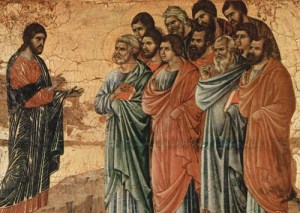
You might ask why I say the “real” St Francis? Did you know that statues of St Francis are the second most popular lawn/garden ornament sold every year – right behind pink flamingos. Rather like the popular icon shown above. That is an image many people have of St Francis, certainly one reinforced by Franco Zefferelli’s film Brother Sun, Sister Moon, another in a long line of romantic interpretations of the poor man from Assisi. Especially in the 20th century, Francis was portrayed as “a free spirit, a wild religious genius, a kind of medieval hippie, misunderstood and then exploited by the ‘medieval Church.’ Or perhaps they know him as the man who spoke to animals, a nature mystic, an ecologist, a pacifist, a feminist, a ‘voice for our time.’ For others he is the little plaster man in the birdbath, the most charming and nonthreatening of Catholic saints…. almost everyone has his or her own Francis” (Francis of Assisi, Augustine Thompson OP).
Continue readingAloha FarmVille
For those of you that were players committed to the Facebook app “Farmville” back in 2010 or 2011 (…or so), we are sad to report that FarmVille shut down last week. Daniel Victor (NYT, 12/31) commented that many technique FarmVille popularized – nagging notifications to friends and encouragements to check back daily to tend to your crops – are now being imitated by everything from Instagram to QAnon. Where FarmVille was the time-eating destination of friends and family – there are many social media apps that are as demanding, nagging, and lead one down the “rabbit hole” of lost time. Where FarmVille feared not to tread, everyone else followed. Alas and aloha.
End of Watch
Serve in the military and at some point you will “stand watch” as we would say in the Navy. Each branch of the service has its own name. The experience is the same. I think anyone who has ever stood sentry, stood watch, served during the “dog watch”, been on duty during the long hours of the night as others sleep – we all remember the dilation of time as it seemed to slow and stretch forever. Biding time. Scanning for the first glimmers of light through the long shade of night. The tiring body, the yawns, talking to one’s self… and then the morning star pushed the first light over the horizon, slowly glowing, pushing back the night, and painting the world with a new day. At last, duty is done and one reports in to command, “Lord, now let your servant go in peace; your word has been fulfilled…” Continue reading
Merry Christmas
My Generation
Yesterday’s psalm refrain was “The Lord is gracious and merciful; slow to anger, and of great kindness.” From that I asked the personal question, “Do you ever wonder if people think you are gracious, merciful, slow to anger and of great kindness?” Today’s gospel begins: “Jesus said to the crowds: To what shall I compare this generation?‘” In one sense, it is the same question just on a larger scale. And a complex question to even begin to form a response.

Subsidiarity and Tech
The principle of subsidiarity is perhaps one of the most crucial and most misunderstood in Catholic social teaching. According to the principle of subsidiarity, decisions should be made at the lowest level possible and the highest level necessary. A little moral theology and then some practical tech application.
In Quadregesimo Anno, Pope Pius XI is concerned with the common good of society and in particular with both the growing power of the state and an increasing individualism (see paragraph 78). It should be noted that Pius is concerned that we will end up with a social order in which there are individuals and the state – with no intermediary communities, institutions or levels. The richness and diversity of human society is what Pius seeks to promote and protect. Thus he writes in paragraph 79:
Continue readingFranciscans in China
Servant of God – John of Montecorvino
Franciscan and first Bishop of Beijing
Writing earlier about St. Francis Xavier, I was reminded about a Franciscan missioner, John of Montecorvino, whose feast was November 29. Mention John of Montecorvino and most people – even most Franciscans – will say “who?” John was the first Catholic missionary to China, centuries before the efforts of other Catholic religious orders. It is a compelling story. If you would like to read an interesting and accessible account of the travel within the context of an art historian comparing 13th century Italian and Chinese art, read Lauren Arnold’s: Princely Gifts & Papal Treasures: The Franciscan Mission to China & Its Influence on the Art of the West, 1250-1350 – fascinating book.